
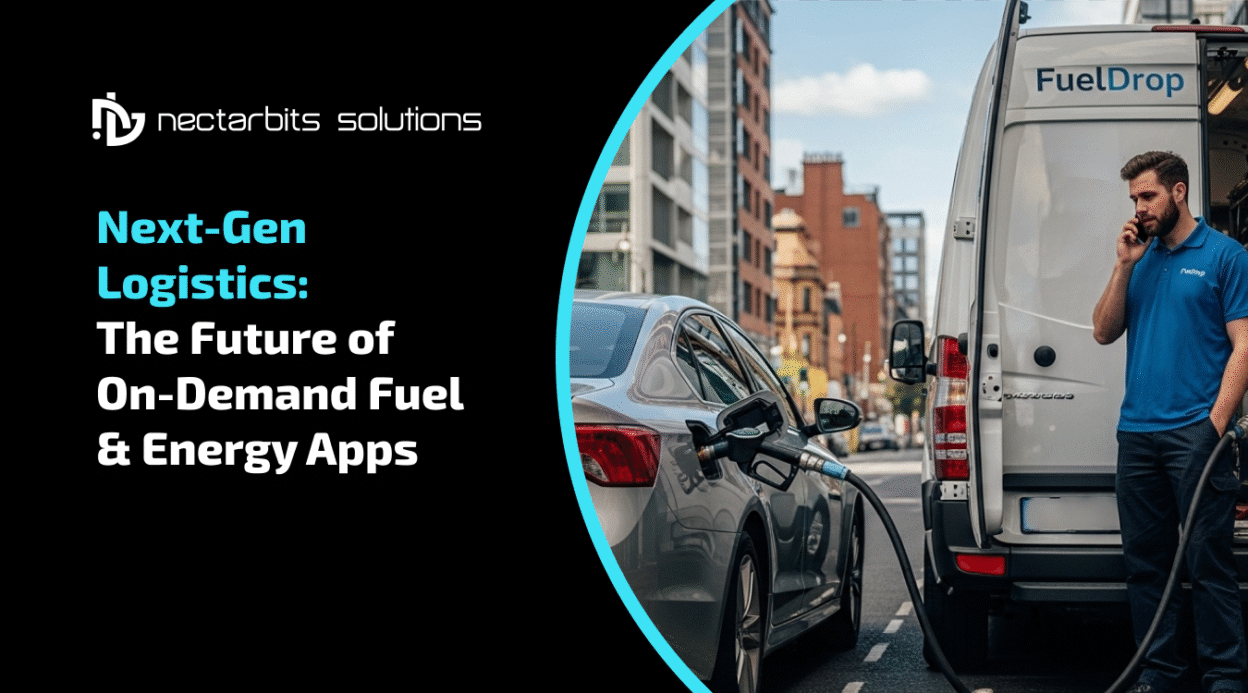
On-demand fuel delivery is an essential topic to understand. The logistics landscape is experiencing a digital revolution that’s fundamentally reshaping how we think about fuel and energy distribution. Traditional gas stations, once the cornerstone of automotive refueling, are giving way to innovative solutions that bring fuel directly to consumers wherever they are. This transformation represents more than convenience; it’s a complete reimagining of energy logistics for the modern world.
On-demand fuel delivery has emerged as a $12 billion market opportunity, with projections showing an explosive 91% CAGR through 2035. What started as a niche service for fleet operators has evolved into a comprehensive ecosystem serving everyone, from busy professionals to construction sites that require bulk diesel deliveries.
The convergence of mobile technology, GPS tracking, and sophisticated logistics algorithms has created unprecedented possibilities. Companies can now predict fuel needs, optimize delivery routes in real-time, and provide transparent pricing, all while reducing the environmental footprint of traditional fuel distribution networks.
This shift toward next-generation logistics isn’t just about fuel; it’s about more than that. The infrastructure being built today will accommodate electric vehicle charging, hydrogen fuel cells, and other emerging energy sources, creating a unified platform for tomorrow’s diverse energy landscape.
The Evolution of Fuel Delivery: From Gas Stations to Apps
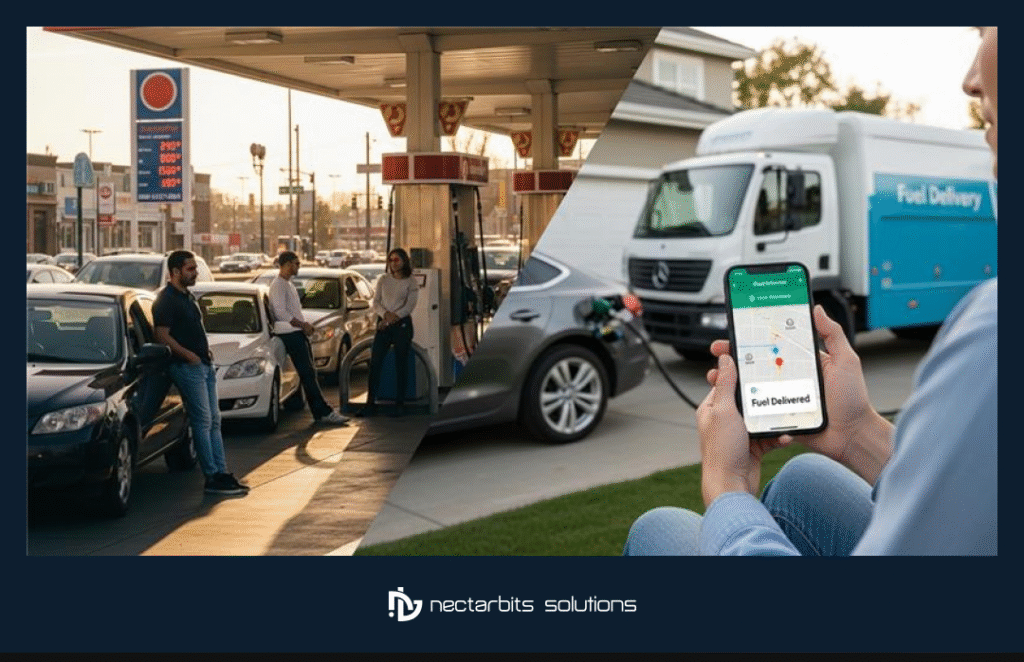
The traditional fuel distribution model has remained largely unchanged for over a century, until now. Mobile fuel delivery apps are disrupting this established system by eliminating the need for physical gas stations.
According to market research, the on-demand fuel delivery market is projected to surpass $12 billion by 2035, driven by a staggering 91% compound annual growth rate.
This transformation represents more than technological advancement; it’s a fundamental shift in consumer behavior. Where drivers once planned routes around gas stations, they now expect fuel to come to them. The model mirrors successful on-demand services like ride-sharing, food delivery and applies the same convenience-first approach to energy distribution.
The catalyst for this evolution stems from urbanization challenges, time constraints, and environmental consciousness. Fleet operators particularly benefit from centralized fuel management without route disruptions, while individual consumers gain hours previously spent at gas stations.
As this market matures, the underlying technology powering these services becomes increasingly sophisticated, enabling precise logistics coordination and real-time tracking capabilities.
Understanding Mobile Fuel Delivery Technology
The technology powering mobile fuel delivery represents a sophisticated integration of logistics software, GPS tracking, and safety protocols that transforms traditional refueling into a seamless digital experience. At its core, these platforms utilize advanced routing algorithms that optimize delivery schedules based on real-time traffic patterns, fuel demand, and vehicle locations.
Modern fleet fueling solutions leverage IoT sensors and telematics to monitor fuel levels automatically, triggering delivery requests before tanks run empty. This predictive approach eliminates the guesswork from fuel management while ensuring operational continuity.
The technology stack typically includes secure payment processing, regulatory compliance tracking, detailed analytics dashboards that provide insights into consumption patterns, and cost optimization opportunities. Safety remains paramount in mobile fuel operations, with specialized delivery vehicles equipped with advanced containment systems and emergency protocols. According to On Demand Fuel Delivery Market Analysis, the integration of digital verification systems and automated safety checks has significantly reduced incidents while improving delivery accuracy.
The real innovation lies in data intelligence—these platforms continuously learn from delivery patterns to predict demand, optimize routes, and reduce wait times. This technological foundation sets the stage for expanding beyond traditional petroleum products into alternative energy solutions.
Fuel Delivery Apps Are Becoming Vehicle “Super Apps”
Fuel delivery apps are no longer just about refueling vehicles. They are evolving into all-in-one vehicle service platforms, becoming part of broader vehicle and fleet management ecosystems. This “super app” convergence follows the same pattern seen in fintech and mobility platforms, where multiple services are unified into a single, seamless experience.
Key ways fuel delivery apps are transforming into super apps include:
- Bundled Vehicle Services: Fuel delivery is increasingly integrated with car wash and detailing services, allowing users to refuel their vehicles while cleaning and maintenance tasks are completed at the same location.
- Maintenance + Fuel Integration: Auto-maintenance platforms now combine services such as oil changes, tire checks, and inspections with on-demand refueling, reducing multiple service visits into a single scheduled operation.
- Fleet Management Dashboards: For businesses, fuel delivery is becoming a built-in feature of fleet platforms that manage vehicles, drivers, routes, expenses, and fuel consumption from one centralized dashboard.
- OEM and Connected Vehicle Integration: Modern vehicles from manufacturers like Ford, GM, and Tesla are moving toward in-dashboard energy ordering. Vehicles can automatically request fuel or charging services based on real-time fuel levels, without drivers opening a separate mobile app.
This convergence positions fuel delivery app development as a foundational layer of next-generation vehicle platforms, transforming it from a standalone convenience service into a core component of connected mobility ecosystems.
Autonomous Refueling Robotics: The Next Leap in Logistics
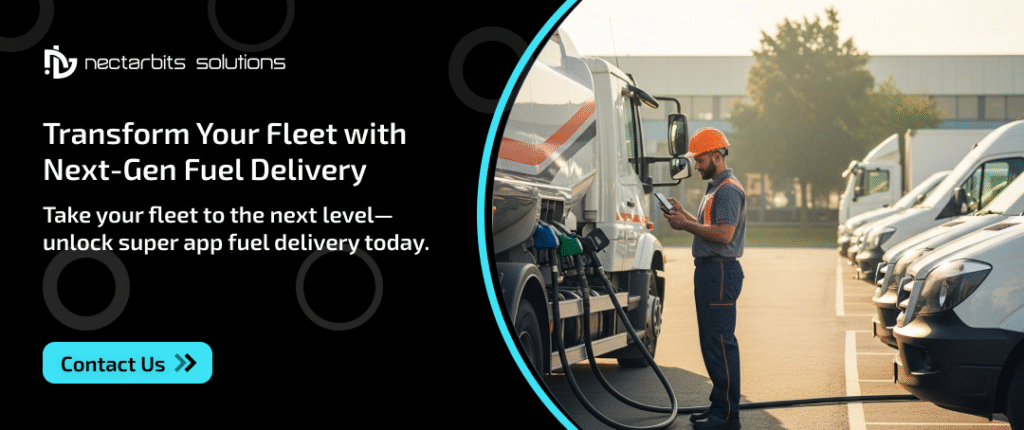
While autonomous vehicles often dominate conversations about the future of mobility, autonomous refueling is emerging as an equally important innovation in next-generation logistics. Advanced fuel delivery systems are beginning to incorporate robotic refueling arms capable of opening fuel caps and inserting nozzles without human involvement.
Autonomous refueling technologies offer several strategic advantages:
- Reduced Labor Costs: Robotics significantly lowers dependency on manual labor, improving scalability for large fleets.
- Improved Safety and Compliance: Automated systems reduce human error and exposure to hazardous fuels, lowering insurance and liability risks.
- Operational Consistency: Robots deliver uniform fueling procedures, which is especially valuable for enterprise fleets and overnight refueling operations.
- Cross-Energy Compatibility: These systems are being developed for both liquid fuels and electric vehicle charging, supporting hybrid and future-ready energy models.
As autonomous refueling technologies mature, they are expected to become a defining feature of advanced fuel delivery app development, enabling safer, faster, and more scalable energy logistics for fleets and mobility providers.
Energy Diversification: Beyond Gasoline
The future of on-demand fuel delivery extends far beyond traditional gasoline, encompassing a diverse energy ecosystem that reflects evolving transportation needs. Modern delivery platforms are already expanding to include diesel, propane, and aviation fuel, while preparing infrastructure for emerging alternatives like hydrogen and synthetic e-fuels.
AI-powered logistics systems are becoming essential for managing this complexity, optimizing delivery routes across multiple fuel types while maintaining safety protocols specific to each energy source. These intelligent systems can predict demand patterns for different fuels based on fleet compositions, seasonal variations, and regional preferences.
The E-Fuel Compatible Fuel Delivery Market analysis indicates significant growth potential in synthetic fuel distribution, particularly as carbon-neutral alternatives gain traction. Electric vehicle charging services represent another frontier, with some platforms exploring mobile battery units and rapid charging solutions.
However, each fuel type presents unique storage, transportation, and safety challenges. Regulatory compliance varies significantly across energy sources, requiring specialized equipment and trained personnel. This diversification strategy positions delivery companies to capture market share across the entire energy spectrum rather than relying solely on gasoline demand, which faces long-term uncertainty as transportation electrifies.
Why Hydrogen Delivery Favors Mobile Logistics
Hydrogen fuel infrastructure presents one of the most compelling use cases for mobile energy delivery. Permanent hydrogen refueling stations can cost over $2 million to construct, making widespread deployment economically challenging in the short term.
Mobile hydrogen delivery pods offer a practical alternative by creating a “virtual pipeline” for fuel cell electric vehicles. These systems bypass the need for expensive fixed infrastructure while enabling early adoption of hydrogen-powered fleets. For fuel delivery app development, hydrogen logistics represent a critical bridge technology in the broader energy transition.
The Future of Gas Stations: Adapting to a Hybrid Energy & On-Demand World
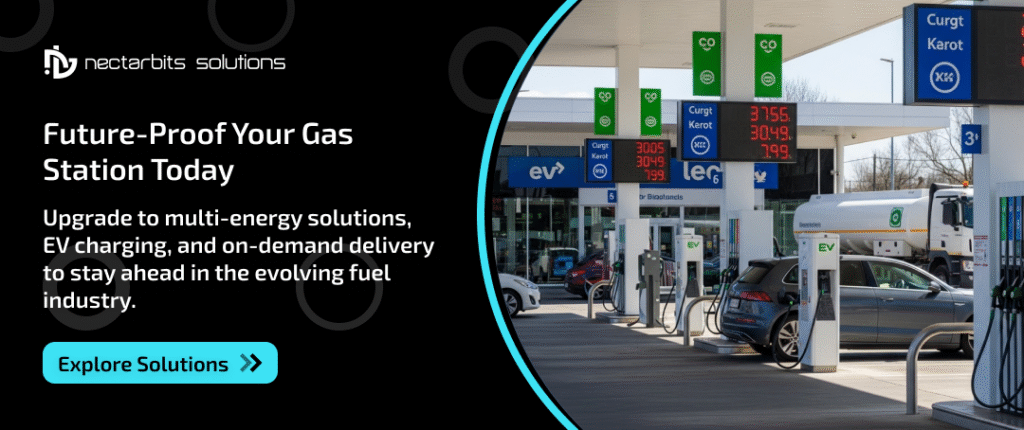
Traditional gas stations are no longer just places to fill up, they are rapidly transforming into multi-energy and service hubs as mobility shifts toward electrification, digital experiences, and on-demand delivery models. Rather than disappearing, the smartest fuel retailers are evolving their offerings to stay relevant in a changing landscape.
1. EV Charging Integration Is Exploding
- Globally, major energy companies are investing heavily in charging infrastructure. For example, Shell aims to operate 500,000 public EV charging points by 2025 and BP targets 70,000 by 2030.
- In India alone, the number of petrol pumps offering EV chargers has more than doubled from 6,700, and public sector oil companies are planning up to 22,000 EV charging facilities at fuel outlets.
- In the U.S., interstate and urban EV charging networks are also expanding rapidly through partnerships like GM + EVgo’s plan for 2,000 fast chargers at 500 travel plazas.
Why this matters: EV ownership is rising globally, and customers expect convenient charging options where they already stop at traditional fuel points.
2. Hydrogen & Alternative Fuel Infrastructure Is Emerging
- There were 1,369 hydrogen refueling stations across 44 countries by 2024, with hundreds more under construction.
- Though still concentrated in markets like China, Japan, and Europe, hydrogen fueling is gaining traction as a critical alternative for heavy transport, buses, and long-haul fleets.
- Building permanent hydrogen stations is expensive, often $1 million to $4 million each, which makes mobile delivery and hybrid station models attractive transitional solutions.
Why this matters: Stations that evolve into multi-energy hubs can serve traditional fuel, EV charging, and hydrogen, increasing their service relevance and revenue streams.
3. Stations Are Becoming Micro-Fulfillment & Delivery Nodes
- Forward-thinking retailers are partnering with on-demand fuel delivery platforms rather than viewing them as competition.
- Gas stations can act as local fulfillment centers, supplying fuel for rapid on-demand deliveries and reducing delivery distances and costs.
- Some chains are integrating digital management systems that coordinate inventory and deliveries in real time, increasing operational efficiency and lowering waste.
Why this matters: As mobile fuel delivery grows, stations that support both walk-in customers and delivery fleets capture dual revenue streams, future-proofing their business.
4. Petrol Pumps Are Becoming Full Energy & Service Ecosystems
- In India, programs are underway to convert many stations into “Energy Stations” that offer petrol, diesel, CNG, LNG, biofuels, and EV charging, with more than 1,000 operational by late 2025.
- Beyond energy, stations are integrating convenience retail, food & beverage, fintech services, and customer-experience offerings as new non-fuel revenue sources.
- Global players like ADNOC are even leasing space in stations for restaurants and financial services, broadening the station’s role as a community hub.
Why this matters: Increasing dwell time and diversified revenue bolsters profitability as fuel margins shrink.
5. Economic Forces Are Pushing Modernization
- Traditional fuel station counts are declining in some regions, with analysts estimating that up to 25% could close by 2035 if they fail to diversify.
- Adding EV chargers and alternative energy offerings can require capital investments anywhere from hundreds of thousands to millions per location, but major brands are pursuing this transformation to secure future relevance.
Why this matters: Market pressure and customer expectations are incentivizing fuel retailers to adapt, not retreat.
6. Strategic Partnerships Are Reshaping the Industry
- Major energy companies are incorporating EV charging into partnerships beyond fuel — for example, BP Pulse plans to install ultra-fast chargers at Waffle House locations across the U.S. in 2026.
- Convenience store chains and travel centers are collaborating with fast-charging firms to attract both EV drivers and traditional customers.
Why this matters: These partnerships help gas stations become multi-purpose energy and service destinations.
Cost Factors: Developing and Running Fuel Delivery Apps
Building a successful fuel delivery app requires substantial upfront investment and ongoing operational expenses that shape the industry’s competitive landscape. Development costs typically range from $50,000 to $300,000 for a comprehensive platform, with real-time delivery tracking systems representing one of the most technically complex and expensive components to implement effectively.
The primary cost drivers include fleet management technology, insurance coverage, regulatory compliance systems, and customer acquisition expenses. Platform operators must invest heavily in GPS tracking infrastructure, payment processing security, and driver background verification systems.
According to market research, operational costs can consume 60–70% of revenue in the early stages as companies establish delivery networks and build customer trust. Ongoing expenses present equally significant challenges. Fuel procurement, vehicle maintenance, driver wages, and technology updates create recurring financial pressures.
However, successful platforms leverage economies of scale to reduce per-delivery costs as volume increases. Companies that achieve optimal route density can dramatically improve profit margins, making geographic expansion strategy critical for long-term viability.
Gig Economy Model vs. Professional Fleet Model
Fuel delivery app development supports two distinct operational approaches: the gig economy model and the professional fleet model. Similar to on-demand logistics and courier solutions, these platforms must choose between flexible contractor networks and dedicated professional teams
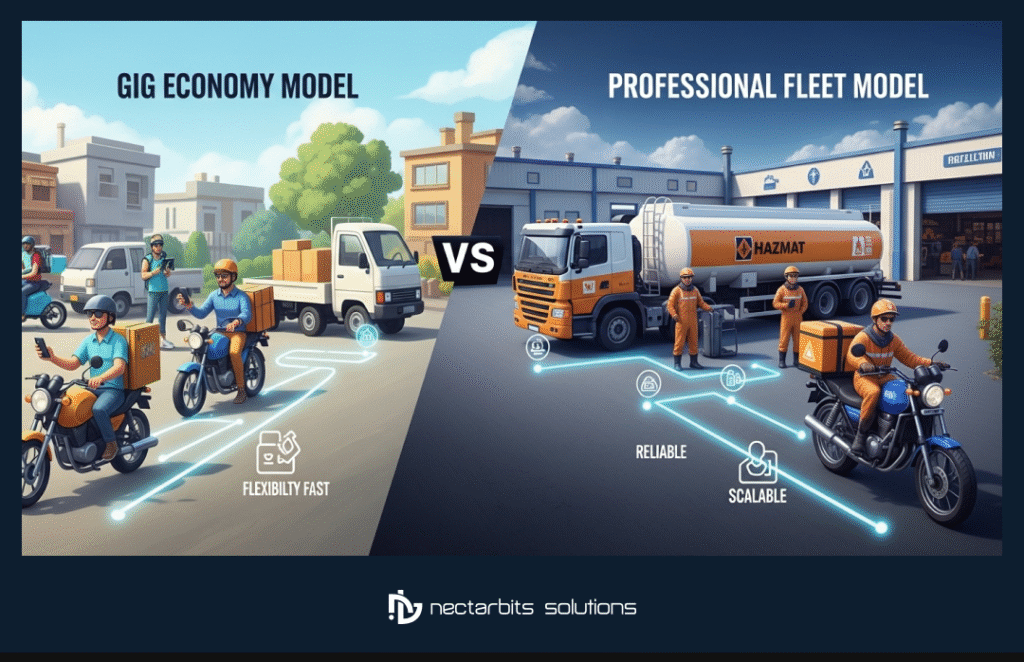
The gig economy model relies on independent contractors using smaller fuel transport vehicles. While this approach offers lower entry costs and rapid geographic expansion, it introduces higher regulatory complexity, insurance risks, and inconsistent service quality.
In contrast, the professional fleet model operates with hazmat-certified drivers, specialized tankers, and centralized safety compliance. Although this model requires higher capital investment, it delivers greater trust, reliability, and scalability for B2B and enterprise clients. Most successful platforms ultimately evolve toward the professional fleet approach as regulatory scrutiny increases.
How Much Does Fuel Delivery Cost Per Gallon?
Fuel delivery pricing typically includes a convenience premium ranging from $0.30 to $1.50 per gallon above standard gas station prices, depending on location and service provider. This markup covers the operational costs of mobile delivery, including driver wages, vehicle maintenance, and insurance requirements.
Most services structure their pricing around tiered delivery fees based on order volume. Small orders under 10 gallons often carry the highest per-gallon premiums, while bulk deliveries of 25+ gallons receive more competitive rates. Emergency or same-day delivery requests typically command additional surcharges of $5–15 per service call.
The rise of contactless fueling technology has helped some providers reduce operational costs by streamlining the delivery process and minimizing service time per customer. Some advanced platforms also integrate Price Book Management Software to efficiently manage pricing tiers and ensure consistent billing across multiple locations, which allows competitive services to offer more attractive rates, particularly for recurring customers who schedule regular deliveries.
According to Fuel Delivery Systems Market analysis, pricing pressures from increased competition are gradually narrowing the premium gap between traditional stations and delivery services. However, the convenience factor continues to justify higher costs for time-conscious consumers and fleet operators who value the operational benefits over pure cost savings.
Key Players and Market Trends
The on-demand fuel delivery landscape is steadily consolidating around a few dominant players, each following a distinct strategic approach. Booster leads the B2B and corporate fleet segment, serving enterprises, logistics providers, and office campuses with scheduled and high-volume fuel delivery services. FuelMe has gained traction in residential and suburban markets across multiple regions, while Yoshi focuses on premium, consumer-centric experiences in select metropolitan areas.
Alongside these service providers, technology partners play a crucial role in enabling scalable and compliant platforms. Companies like Nectarbits support fuel delivery businesses with custom fuel delivery app development, helping operators launch faster, manage fleets efficiently, and adapt to evolving market demands.
Market trends indicate a growing shift toward sustainable fuel delivery solutions, with providers increasingly offering biodiesel blends and planning electric vehicle charging integration. Industry research also highlights rising partnerships between traditional fuel companies and technology firms, creating hybrid models that combine established fuel supply chains with modern digital platforms.
Geographically, most players prioritize high-density suburban markets before expanding into urban cores, where parking constraints and regulatory requirements are more complex. Overall, the competitive landscape shows that operational efficiency, delivery reliability, and technology readiness, rather than pricing alone, are becoming the key factors in long-term customer retention and market leadership.
Want to go deeper?
Explore the best on-demand fuel delivery apps and understand what makes their platforms successful.
Corporate Sustainability Reporting and Carbon Intelligence
Enterprise customers increasingly demand more than fuel delivery—they require data to support sustainability and ESG reporting. Modern fuel delivery apps are responding by integrating carbon tracking and emissions analytics directly into their platforms.
These systems automatically calculate emissions per gallon delivered, enabling fleets to monitor environmental impact at a granular level. Many platforms also offer optional biofuel upgrades and one-click carbon offset programs, helping businesses progress toward net-zero targets without disrupting operations. This functionality transforms fuel delivery app development into a strategic ESG enabler for corporate clients.
What the Research Shows: Future of Crude Oil and Fossil Fuels
Global energy forecasts paint a complex picture for fossil fuel demand over the next decade. The Short Term Energy Outlook from EIA projects continued growth in liquid fuel consumption through 2025, driven primarily by developing economies and aviation sector recovery.
However, this growth trajectory masks significant regional variations and emerging disruption patterns. Peak demand scenarios are becoming increasingly credible, with multiple energy agencies forecasting fossil fuel demand plateaus between 2030 and 2035.
Transportation electrification accelerates this timeline, particularly in developed markets where electric vehicle adoption reaches critical mass. The implications for on-demand fuel delivery are profound—while short-term demand remains robust, delivery platforms must prepare for a structural shift toward hybrid energy portfolios.
What’s particularly striking is the emerging “last-mile fossil fuel” phenomenon—even as overall consumption declines, specialized delivery services may capture increased market share from traditional gas stations. This creates a unique opportunity window where fuel delivery apps could grow revenue despite shrinking total market size.
Limitations and Considerations for On-Demand Fuel Apps
Despite the promising growth trajectory, on-demand fuel delivery services face significant operational and regulatory hurdles that could constrain market expansion. Safety regulations represent the most substantial barrier, as fuel handling requires specialized licensing, insurance coverage, and compliance with hazardous materials transportation laws.
Infrastructure challenges also pose considerable constraints. Unlike traditional gas stations with established supply chains, mobile fuel delivery requires distributed storage networks and specialized vehicle fleets. The Fuel Delivery Systems Market analysis reveals that initial capital requirements for proper equipment and safety systems often exceed traditional retail fuel operations by 40–60%.
Geographic limitations further restrict service availability. Rural areas struggle to achieve the delivery frequency needed for economic viability, while urban markets face traffic congestion and parking restrictions that increase delivery times and costs. Weather conditions and emergencies can also disrupt service reliability.
The regulatory landscape remains fragmented, with inconsistent approval processes across markets creating operational complexity for companies seeking to scale nationally. However, these same barriers create opportunities for established players to build competitive moats through compliance expertise and infrastructure investments.
Example Scenarios: Mobile Fuel Delivery in Action
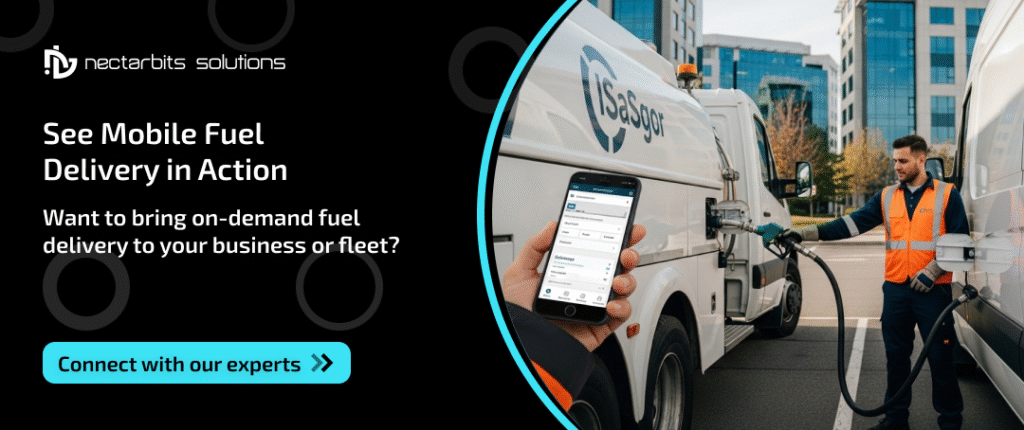
The practical applications of mobile fuel delivery extend far beyond simple convenience, addressing critical operational needs across multiple sectors. In fleet management, logistics companies increasingly turn to on-demand fuel services to maintain operational efficiency. A delivery company with 50 vehicles can reduce downtime by approximately 2–3 hours per vehicle weekly by eliminating trips to gas stations.
Emergency response scenarios showcase another compelling use case. When natural disasters disrupt traditional fuel infrastructure, mobile fuel units can rapidly deploy to support first responders, hospitals, and critical facilities.
Construction sites represent a growing market segment where on-demand fuel delivery eliminates the logistical challenge of moving heavy equipment to fuel sources. Project managers report improved workflow continuity when fuel arrives at scheduled intervals.
The residential market demonstrates different dynamics, with busy professionals and elderly customers finding particular value in doorstep fuel delivery. Early adopters typically include households managing multiple vehicles or those in suburban areas where gas stations require significant travel time.
Key On-Demand Fuel Delivery Takeaways
The on-demand fuel delivery market represents a fundamental shift in how businesses and consumers approach energy logistics. With the sector projected to reach $12 billion by 2035 at a 9.1% CAGR, the transformation extends beyond convenience to address operational efficiency across industries.
Mobile fuel delivery services are evolving into comprehensive energy platforms encompassing traditional fuels, electric charging, hydrogen logistics, and sustainability reporting. This convergence positions fuel delivery app development as a critical component of the broader energy transition.
The technology driving this evolution, from IoT-enabled monitoring to AI-powered route optimization, creates measurable value through reduced downtime, improved cost control, and enhanced visibility. Companies that succeed will be those that embrace platform thinking, regulatory excellence, and diversified energy offerings.
The future of fuel delivery is no longer just about transporting fuel. It is about building intelligent, adaptive energy ecosystems capable of supporting the next generation of mobility.
Continue Your On-Demand Fuel Delivery Journey
The world of on-demand fuel delivery is evolving rapidly, blending traditional fuel logistics with electric charging, hydrogen solutions, and intelligent delivery systems. Businesses that embrace these trends can not only streamline operations but also capture new revenue streams and improve customer satisfaction.
For a deeper dive into actionable strategies, operational tips, and regional growth opportunities, check out our guide on boosting your on-demand fuel delivery business. Learn how to optimize routes, manage fleets efficiently, and implement technology solutions that enhance reliability and profitability.
Frequently Asked Questions:
1. How do on-demand fuel delivery apps work?
The process mimics ride-sharing. Users pin their vehicle’s location, unlock the fuel door or leave it slightly ajar, and select the fuel type and amount. A certified driver arrives in a specialized mini-tanker, refuels the vehicle, and ensures the fuel door is closed. The app handles payment automatically and sends a digital receipt with photo verification of the completed service.
2. Will fuel delivery apps replace gas stations by 2030?
No, they will not replace them entirely. A hybrid model will emerge. Gas stations will remain essential for long-haul travel and highway refueling, while mobile delivery becomes dominant in dense urban centers and corporate office parks. Many urban gas stations may transition into EV charging hubs or real estate assets.
3. What is the market size and growth for fuel delivery apps?
The global on-demand fuel delivery market was valued at approximately $12 billion in 2024 and is projected to grow at a CAGR of over 9% through 2035. Growth is driven by fleet expansion and integration of alternative fuels such as hydrogen and mobile EV charging.
4. Which regions lead in adoption?
North America currently leads adoption due to high vehicle ownership and a mature mobile app infrastructure. The Asia-Pacific region, particularly India and China, represents the fastest-growing market due to rapid urbanization and digital-first infrastructure adoption.
5. What are the benefits for fleets and businesses?
The primary benefit is operational uptime. Refueling during downtime eliminates 20–30 minutes of lost productivity per driver per shift. Additional benefits include centralized billing, reduced fuel fraud, and detailed analytics on fuel consumption per vehicle.
6. How do apps handle safety and regulations?
Legitimate providers operate under strict hazmat regulations. Delivery vehicles use double-walled tanks, spill containment systems, and automatic shut-off nozzles. Drivers hold commercial licenses with hazmat endorsements, and apps use geofencing to prevent fueling in restricted areas.