
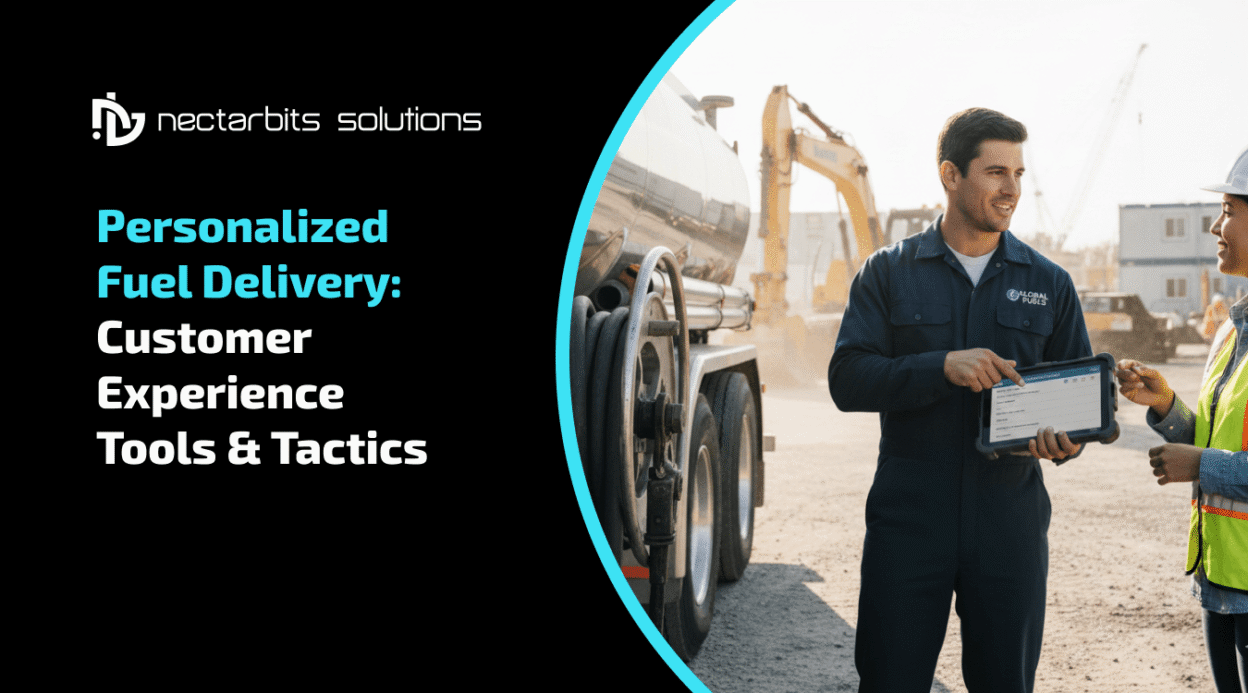
In an industry where fuel is an undifferentiated commodity, personalized fuel delivery represents the most powerful competitive advantage available to operators. According to McKinsey & Company, businesses that deliver customized experiences achieve 40% more revenue from these activities compared to companies that don’t personalize.
In fuel delivery, where switching costs are near zero, and competitors offer identical products at similar prices, personalization is the key differentiator that drives loyalty, retention, and profitability.
The Compelling Data Behind Personalization
Salesforce Research found that 73% of customers expect companies to understand their unique needs and expectations, while 66% say they’ll switch to a competitor after a poor experience. For fuel delivery operators, this translates directly to the bottom line: companies implementing comprehensive customer experience fuel delivery personalization strategies achieve:
- 67% higher customer retention rates
- 43% greater revenue per customer
- 52% lower customer acquisition costs
In a commoditized market with razor-thin margins, personalization isn’t a luxury—it’s a survival strategy. This comprehensive guide reveals the tools, technologies, and tactical approaches that transform transactional fuel delivery into personalized service that commands premium pricing and creates unshakeable customer loyalty.
Understanding Personalization in Fuel Delivery
What Personalization Really Means
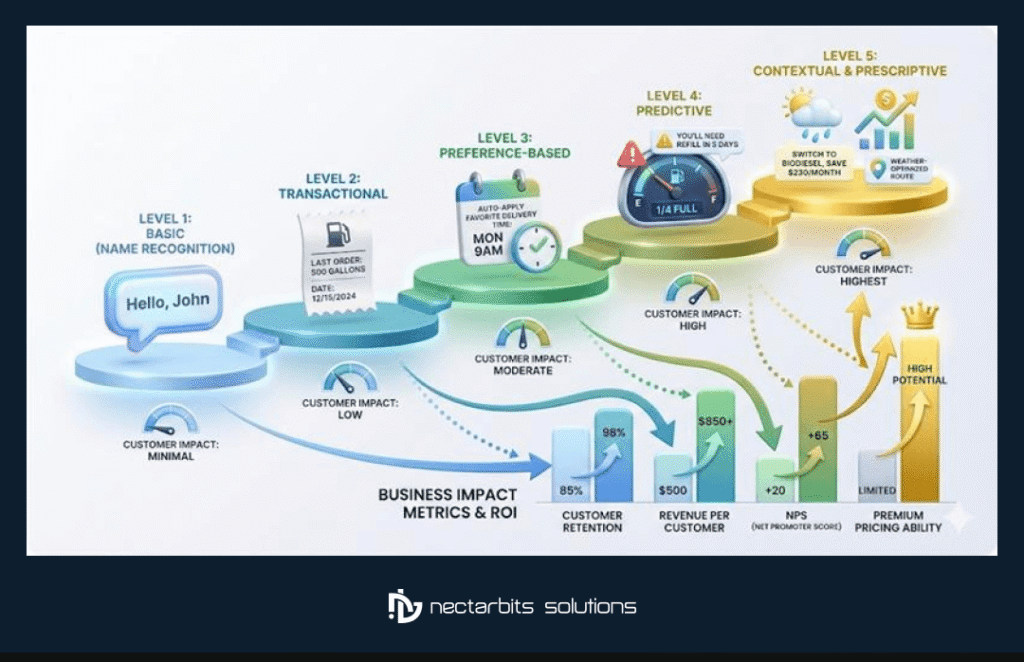
Personalized fuel delivery goes far beyond using a customer’s name in an email. True personalization means anticipating needs, adapting to preferences, and delivering contextually relevant experiences at every touchpoint.
The Personalization Spectrum
| Personalization Level | Description | Example | Customer Impact |
| Basic (Name Recognition) | Using the customer’s name in communications | “Hello, John,” in emails | Minimal (expected standard) |
| Transactional | Remembering past purchases | “Last order: 500 gallons of diesel” | Low (basic CRM function) |
| Preference-Based | Storing and applying preferences | Auto-apply favorite delivery time | Moderate (convenience) |
| Predictive | Anticipating needs before the customer asks | “You’ll need a refill in 5 days.” | High (proactive service) |
| Contextual | Adapting tothe current situation | “Weather delay expected—reschedule?” | Very High (situational awareness) |
| Prescriptive | Recommending optimal actions | “Switch to biodiesel—save $230/month.” | Highest (trusted advisor) |
Business Impact by Personalization Level
| Personalization Maturity | Customer Retention | Revenue Per Customer | NPS Score | Premium Pricing Ability |
| No Personalization | 58% | Baseline | 32 | 0% |
| Basic Personalization | 64% (+10%) | 0.08 | 41 | 0% |
| Moderate Personalization | 78% (+34%) | 0.23 | 58 | 5-8% |
| Advanced Personalization | 89% (+53%) | 0.43 | 72 | 12-18% |
Why Personalization Matters More in Fuel Delivery
Fuel Delivery Market Dynamics
Commoditization Challenges:
- Fuel is identical across suppliers (gasoline is gasoline)
- Price transparency makes margin competition brutal
- Low switching costs (the customer can change suppliers with one phone call)
- Limited differentiation on the core product
- Service quality is the ONLY sustainable competitive advantage
Customer Expectations Evolution:
Customers conditioned by Amazon, Netflix, and Spotify expect personalization everywhere:
- “Amazon remembers my preferences—why doesn’t my fuel supplier?”
- “Netflix recommends what I’ll like—why can’t my fuel company predict my needs?”
- “Uber tells me exactly when my ride arrives—where’s my fuel delivery tracking?”
The Loyalty Economics
| Metric | Transactional Customer | Personalized Relationship | Difference |
| Average Customer Lifespan | 2.3 years | 6.7 years | 1.91 |
| Annual Revenue | $8,400 | $12,000 | 0.43 |
| Lifetime Value | $19,320 | $80,400 | 3.16 |
| Referral Rate | 8% | 34% | 3.25 |
| Price Sensitivity | High (switch for 2% savings) | Low (willing to pay 10-15% premium) | Dramatic |
Customer Acquisition Cost Context: With average fuel delivery customer acquisition costs of $650-$1,200, losing customers due to poor personalization destroys profitability, while competitors building loyalty through personalization achieve 4-8x ROI on retention investments.

Personalization Tool 1: Intelligent Customer Profiling
Building Comprehensive Customer Profiles
Effective personalized fuel delivery begins with deep customer understanding:
Customer Profile Data Categories
| Data Category | Specific Information | Personalization Application |
| Basic Information | Business name, contact, location, billing | Foundation for all personalization |
| Consumption Patterns | Volume, frequency, and seasonal variations | Predictive ordering, inventory planning |
| Preferences | Delivery time windows, driver preferences, and communication channels | Service customization |
| Equipment | Tank size, fuel type, vehicle fleet details | Compatibility, recommendations |
| Historical Behavior | Order history, payment patterns, service issues | Predictive analytics, risk management |
| Business Context | Industry, seasonal factors, growth trajectory | Strategic advising, value-added services |
| Interaction History | Service calls, complaints, compliments | Relationship management, quality improvement |
| Financial Profile | Payment terms, credit history, and profitability | Pricing strategy, risk assessment |
Dynamic Profile Evolution
Static profiles become outdated quickly. Advanced systems continuously update profiles through:
Automated Profile Enrichment Data Sources:
- IoT tank monitoring: Real-time consumption, pattern changes
- Order behavior: Timing changes, volume fluctuations
- Communication patterns: Preferred contact times, channel preferences
- Service interactions: Issue types, resolution satisfaction
- External data: Weather impacts, economic indicators, industry trends
- Payment behavior: On-time trends, early payment discounts usage
Machine Learning Applications:
A sophisticated fuel delivery app development company builds ML models that:
- Consumption Prediction: Forecast next order timing with ±2 days accuracy
- Preference Learning: Identify unstated preferences from behavior patterns
- Churn Risk Scoring: Flag customers likely to leave (85% accuracy)
- Lifetime Value Estimation: Predict customer worth for resource allocation
- Next-Best-Action Recommendations: Suggest optimal service/communication for each customer
Implementation Example
Customer: ABC Manufacturing
- Profile Created: January 2023
- Initial Data: 1,000-gallon diesel tank, monthly refills
6-Month Learning:
- Consumption increases 35% before quarter-end (production surge)
- Prefers deliveries Tuesday-Thursday, 9-11 am
- Responds to email but ignores phone calls
- Pays within 15 days consistently
- Interested in fuel cost reduction strategies
Personalization Actions:
- Proactive outreach before quarter-end: “Your typical surge is coming—schedule early?”
- Automatic Tuesday-Thursday scheduling with 9-11 am window
- Email-only communication unless an emergency
- Extended payment terms offered (30 days) based on reliability
- Quarterly fuel efficiency consultation offered
Results:
- Customer retention: 4+ years (vs. 2.3 average)
- Revenue increase: 35% through optimized ordering
- Zero late payments
- 3 referrals generated
Personalization Tool 2: Predictive Delivery Scheduling
From Reactive Orders to Proactive Fuel Service
Traditional fuel delivery depends on customers placing orders when tanks run low—often leading to emergencies and rushed deliveries. Predictive delivery scheduling replaces this reactive model with data-driven, proactive service, automatically planning deliveries before fuel shortages occur.
By combining consumption data, tank levels, external factors, and customer preferences, fuel providers can deliver on time, with minimal customer effort and maximum reliability.
How Predictive Delivery Scheduling Creates Personalized Experiences
| Scheduling Input | What It Does | Personalization Value |
| Consumption Modeling | Calculates individual burn rates | Learns customer-specific usage patterns |
| Tank Level Monitoring | Tracks real-time or estimated inventory | Enables precise delivery timing |
| External Factors | Accounts for weather and seasonality | Adjusts predictions per customer impact |
| Delivery Preferences | Applies time and site constraints | Respects individual schedules |
| Automated Outreach | Sends proactive notifications | Uses preferred communication channels |
| One-Click Confirmation | Enables instant approval | Reduces ordering friction |
Business Impact at a Glance
Predictive scheduling significantly improves both customer experience and operational efficiency:
- 86% fewer emergency deliveries
- 98% reduction in out-of-fuel incidents
- 96% faster order placement
- Customer satisfaction rises to 94%
- 28% improvement in route efficiency
Personalization Tool 3: Customized Communication Strategies
Right Message, Right Channel, Right Time
Generic mass communications fail. Customer experience fuel delivery personalization requires individual communication strategies:
Communication Preference Profiling
| Customer Segment | Preferred Channel | Preferred Timing | Content Preference | Frequency Tolerance |
| Busy Executives | SMS | Early morning (6-8 am) | Brief, action-oriented | Minimal (essential only) |
| Operations Managers | Business hours (9 am-3 pm) | Detailed, data-rich | Moderate (weekly) | |
| Small Business Owners | Phone | Mid-morning (10 am-12 pm) | Personal, consultative | Higher (relationship-building) |
| Fleet Managers | Mobile App | Anytime | Real-time, visual (maps/tracking) | High (real-time updates) |
| Procurement Teams | Email + Portal | Afternoon (2-4 pm) | Formal, documentation-focused | Scheduled (monthly reports) |
Personalized Communication Examples
Delivery Confirmation Messages:
Generic (Ineffective):
“Your fuel delivery is scheduled for Tuesday.”
Personalized (Effective):
For Customer A (Prefers SMS, morning person, data-driven):
“Hi Maria! Tuesday 7:15 am: 850 gal diesel delivery to Main St location. Driver: Carlos (your usual). Track live: This puts you at 92% capacity—optimal for your weekly usage pattern.”
For Customer B (Prefers email, relationship-focused, less technical):
Good morning, John! Just confirming we’ll see you Tuesday morning around 9 am for your diesel delivery. Carlos mentioned last time you were interested in biodiesel—I’ve attached information about our new renewable diesel option that could save you about $180/month based on your usage. Looking forward to catching up! – Sarah
Personalized Content Strategies
| Content Type | Generic Approach | Personalized Approach |
| Price Notifications | Diesel prices increased 3%. | Your monthly fuel cost will increase by approximately $127 based on your typical 4,200-gallon usage. Want to discuss hedging strategies? |
| Service Updates | New biodiesel is available. | Based on your interest in cost reduction and your equipment compatibility, our new renewable diesel could save you $2,340 annually. Schedule a consultation? |
| Delivery Reminders | Delivery is scheduled for tomorrow. | Carlos will be at your Oak Street location tomorrow at 10:30 am (your preferred window). He’ll use the west entrance as you requested. Current fuel level: 22%. |
| Educational Content | 10 tips for fuel efficiency (generic blog) | Your fleet’s fuel efficiency decreased 8% last quarter. Here are 3 specific actions proven to work for construction fleets like yours… |
Working with an experienced Custom Fuel Delivery App Development Company ensures that communication systems automatically personalize messaging based on individual customer profiles.
Personalization Tool 3b: “Last Yard” Driver Intelligence
Digitizing Tribal Knowledge
The most sophisticated algorithm fails if the driver blocks the customer’s loading dock or lets the dog out. True personalization extends to the physical point of service—the “Last Yard.”
Traditionally, knowledge like “Code is 1234,” “Watch for the low branch,” or “The manager, Steve, likes a phone call 10 mins prior” lived in a senior driver’s head. When that driver retired or went on vacation, the customer experience collapsed.
The Solution: The Digital Sidekick
Modern driver apps push specific “Site Personality” data to the driver’s tablet upon arrival:
Visual Geofencing: Satellite maps marked with exactly where to park to avoid disrupting this specific customer’s operations.
Protocol Prompts: This customer requires a safety vest visibility check before exit (Automated checklist).
Relationship Notes: “Ask about their new warehouse expansion.”
Impact: When a relief driver executes a delivery with the same precision as a 10-year veteran because the app “personalized” the instructions, trust skyrockets.
According to Qualtrics XM Institute (2024), field service interactions (the driver) account for 45% of the total customer sentiment weight in logistics. A digitally personalized experience combined with a clumsy physical delivery drops NPS by an average of 30 points.
Personalization Tool 4: Customized Pricing and Loyalty Programs
Beyond One-Size-Fits-All Pricing
Personalized fuel delivery pricing strategies acknowledge different customer values and behaviors:
Tiered Service Pricing
| Service Tier | Customer Profile | Features | Pricing | Margin |
| Standard | Price-sensitive, flexible timing | Scheduled delivery, 4-hour windows, standard support | Market rate | 8-12% |
| Premium | Service-focused, values reliability | 2-hour windows, preferred driver, priority support, delivery tracking | +20–30% above market rate | 18-22% |
| Platinum | High-value, demands excellence | 1-hour windows, dedicated account manager, 24/7 emergency, proactive consulting | +40–50% above market rate | 28-35% |
| Custom Enterprise | Large fleets, complex needs | Fully customized service, on-site fueling, fleet management integration | Negotiated | 15-25% |
Personalized Loyalty Programs
Traditional (Ineffective) Loyalty Program:
- “Earn 1 point per gallon purchased.”
- Generic rewards (everyone gets the same options)
- Point expiration
- Complex redemption
Personalized (Effective) Loyalty Program:
Customer Profile-Based Rewards
| Customer Type | Values Most | Personalized Rewards |
| Cost-Focused | Savings, discounts | 2% cashback on all purchases, volume discounts |
| Convenience-Focused | Time, ease | Free emergency deliveries, priority scheduling |
| Relationship-Focused | Service, attention | Dedicated account manager, quarterly business reviews |
| Sustainability-Focused | Environmental impact | Free renewable fuel upgrades, carbon offset credits |
Implementation Example
Customer C Profile:
- Identified Value: Cost reduction (mentioned 6x in conversations)
- Behavior: Always compares prices, takes advantage of promotions
- Loyalty Program Assignment: Cost-Saver Tier
Personalized Rewards:
- 2.5% cashback on all purchases
- “Price Lock” option during volatile markets
- Quarterly fuel efficiency audit (helps them save)
- First notification of price promotions
Communication: Based on your purchases this quarter, you’ve earned $347 in cashback. Plus, your fuel efficiency improved 6% after our recommendations—that’s an additional $520 in savings!
Customer D Profile:
- Identified Value: Reliability and service (fleet can’t run out)
- Behavior: Willing to pay a premium for guaranteed service
- Loyalty Program Assignment: Premium Service Tier
Personalized Rewards:
- Guaranteed delivery within 4 hours (emergency)
- Rollover credit if ANY delivery is late
- Free annual tank inspection
- VIP support line (direct to manager)
Communication: As a Premium member, you have 3 emergency delivery credits available this quarter. Your 100% on-time delivery streak continues—12 months! Your dedicated driver, Carlos, has learned your site so well; deliveries now average 8 minutes faster.
Dynamic Pricing Personalization
Behavioral-Based Pricing
| Customer Behavior | Pricing Strategy | Rationale |
| Advance Schedulers | 3-5% discount | Improves route efficiency, warrants sharing savings |
| Flexible Time Windows | 5-8% discount | Enables optimal routing, reduces operational cost |
| Auto-Reorder (Predictive) | 4-6% discount | Eliminates sales/admin cost, guarantees retention |
| Bulk Pre-Purchase | Volume discounts + price lock | Improves cash flow, locks in customer |
| Emergency/Same-Day | 25-50% premium | Reflects the true cost of route disruption |
| Payment Terms (Prepay) | 2-3% discount | Eliminates credit risk, improves cash flow |
Personalization Tool 5: Value-Added Services Customization
Beyond Fuel: Personalized Service Ecosystem
Personalized fuel delivery extends beyond the commodity to comprehensive service:
Customer Need-Based Service Packages
| Customer Type | Core Needs | Personalized Value-Added Services |
| Small Business Owner | Simple, worry-free | Automatic ordering, consolidated billing, and basic tank maintenance |
| Fleet Manager | Efficiency, data | Fleet fuel analytics, driver fuel card integration, and consumption optimization consulting |
| Sustainability-Focused | Environmental impact | Carbon footprint reporting, renewable fuel options, and offset programs |
| Growth-Stage Business | Scalability, flexibility | Flexible contracts, multi-location management, and expansion support |
| Cost-Conscious | Maximum savings | Fuel efficiency audits, price hedging options, volume optimization |
Personalized Service Recommendations
A fuel delivery mobile app development platform with an AI recommendation engine suggests:
Example Scenario:
Customer E Analysis:
- Profile: 3-location restaurant chain
- Current Service: Standard fuel delivery only
Data Insights:
- Each location orders separately (inefficient)
- Consumption varies 40% between locations (operational inconsistency)
- The manager spends 2 hours/month on fuel ordering across locations
Personalized Recommendations:
- Multi-Location Consolidated Ordering: Save 3-5% through combined delivery routing.
- Fuel Consumption Analytics: Your downtown location uses 35% more fuel per revenue dollar—equipment efficiency issue?”
- Automated Predictive Ordering: Eliminate 2 hours/month management time—we’ll handle it automatically.
- Equipment Efficiency Audit: Potential $4,200 annual savings through equipment optimization.
Presentation: Customized proposal showing $6,800 total annual value (savings + time)
Result: Customer upgrades to Premium tier (+12% pricing) but nets $4,100 in value—win-win
The Ultimate B2B Lock-In: Personalized Carbon Reporting
In 2026, corporate clients aren’t just buying fuel; they are buying compliance. With strict Scope 3 emission reporting mandates in the EU, California, and Canada, your clients must report the carbon footprint of the fuel they burn.
From Commodity to Compliance Partner
Instead of a standard invoice, a personalized fuel platform generates a Monthly Sustainability Certificate for each client:
Carbon Calculation: Your 5,000 gallons of diesel resulted in X metric tons of CO2.
Biofuel Impact: “By choosing B20 biodiesel this month, you avoided Y tons of emissions compared to standard diesel.”
Offset Integration: Click here to purchase verified carbon offsets for this specific delivery.
The Data: 79% of B2B buyers categorize vendors who provide automated sustainability data as “Strategic Partners” rather than “Transactional Suppliers” (Deloitte, 2024).
Read more about personalization strategies, loyalty programs, and value-added services in fuel delivery for deeper insights into service customization approaches that drive revenue and retention.
Personalization Tool 6: Real-Time Experience Customization
Adaptive Customer Journeys in Fuel Delivery
Real-time experience customization allows fuel delivery providers to adjust customer interactions as conditions change, not days later. Instead of static notifications, customers receive context-aware, personalized messages that reflect their operational reality, fuel status, and preferences.
This adaptive approach transforms routine updates into reassuring, value-driven interactions that build trust, reduce friction, and prevent churn.
How Real-Time Personalization Improves the Fuel Delivery Experience
| Situation | Generic Response | Real-Time Personalized Experience |
| Weather Delay | “Your delivery may be delayed due to weather.” | Hi John, an ice storm may delay your Tuesday 9:00 am delivery to ~11:30 am. Your tank is at 35%—safe for four days. Would you like to move it to Wednesday at your usual time? |
| Price Increase | Fuel prices increased 5%. | Maria, diesel rose 5% this week. Based on your 3,200 gal/month usage, that’s ~$154/month. Your price-lock expires in two weeks—want to extend it before the increase applies? |
| New Customer Onboarding | Standard welcome email | “Welcome, Sarah! Since you run a landscaping business, here’s how we help lawn-care teams manage seasonal fuel spikes efficiently.” |
| Service Issue | We apologize for the late delivery. | John, I know your Tuesday 9:00 am delivery is critical. Today’s 45-minute delay wasn’t acceptable. I’ve credited $75 and added buffer time to your next delivery. —Mike, Account Manager |
| Usage Pattern Change | No response | Hi Maria, your fuel usage increased 28% over the last six weeks. Is this planned growth, or should we check for equipment issues? We’re here to help. |
Why Real-Time Customization Drives Loyalty
By responding instantly to operational context—weather, pricing, usage shifts, or service issues—fuel providers show customers they are seen, understood, and supported. This level of personalization reduces frustration, strengthens relationships, and turns everyday interactions into retention-building moments.
Omnichannel Personalization Consistency
Customers interact across multiple touchpoints. Personalized fuel delivery maintains consistency:
Touchpoint Personalization
| Touchpoint | Personalization Application |
| Mobile App | Personalized dashboard showing relevant metrics, recommended actions, and preferred products |
| Website Portal | Customer-specific pricing, order history, and customized product recommendations |
| Phone Support | Agent sees full history, preferences, open issues before answering—no repeating information |
| Driver Interaction | The driver app shows customer preferences, special instructions, and relationship notes |
| Email Communications | Segmented by profile, behavior-triggered, and content matched to interests |
| SMS Notifications | Only to customers who prefer SMS, timing based on individual preference data |
| In-Person Meetings | Account manager armed with analytics, insights, and personalized recommendations |
Technology Stack for Personalized Fuel Delivery
Essential Technology Components
| Technology Layer | Function | Personalization Capability |
| Customer Data Platform (CDP) | Centralize all customer data | Single source of truth for personalization |
| Analytics & ML Engine | Pattern recognition, prediction | Learn preferences, predict needs, identify opportunities |
| Communication Automation | Multi-channel messaging | Personalized content, timing, and channel selection |
| Mobile Applications | Customer and driver interfaces | Personalized dashboards, features, experiences |
| IoT Integration | Tank monitoring, consumption tracking | Real-time personalization based on actual usage |
| CRM System | Relationship management | Track interactions, preferences, and history |
| Recommendation Engine | Next-best-action suggestions | Personalized service/product recommendations |
“API-First” Personalization: Embedded Logistics
For enterprise clients, the highest form of personalization is invisibility. Large construction firms and logistics fleets do not want to log into your portal to see their data; they want your data to appear magically inside their systems (SAP, Oracle, QuickBooks, Procore).
Integration as Personalization
Auto-Reconciliation: Push invoices directly into the client’s accounting software (eliminating their data entry).
Asset Sync: Pull their vehicle list from their telematics system so you know exactly which trucks need fuel without them telling you.
Project Costing: Tag fuel deliveries with their internal project codes automatically.
Retention Stat: Suppliers with direct API integrations into client ERPs see churn rates below 3% annually, as switching suppliers would break the automated data flow (Gartner, 2024).
Implementation Considerations
Build vs. Buy Decision
| Approach | Pros | Cons | Best For |
| Off-the-Shelf CRM + Fuel Add-ons | Quick deployment, lower cost | Limited fuel industry specificity | Small operations, basic personalization |
| Custom Development | Perfect fit, proprietary advantage | Higher cost, longer timeline | Mid-large operations, advanced personalization |
| Hybrid (SaaS Platform + Custom) | Balance of speed and customization | Requires skilled integration | Most fuel delivery businesses |
Explore investment and cost considerations for implementing personalization tools in our comprehensive guide to logistics and transportation app development costs.
Data Privacy and Security
Personalization requires data—but customers demand privacy:
- Privacy-Respecting Personalization
- Transparent data collection: Tell customers what data you collect and why
- Value exchange clarity: Explain the benefits of sharing data
- Customer control: Allow opt-out, data viewing, and deletion
- Secure storage: Enterprise-grade security, encryption
- Regulatory compliance: GDPR, CCPA adherence
- Minimal collection: Only gather data you’ll actually use
Trust-Building Approach
We use your delivery history and usage patterns to predict when you’ll need fuel and schedule deliveries at your preferred times. This eliminates your ordering hassle and prevents running low. You can view all data we store and opt out anytime. Your information is never sold or shared.
Measuring Personalization Success
Key Performance Indicators
| Metric | Calculation | Target | Industry Benchmark |
| Customer Retention Rate | (Customers at end – New) ÷ Customers at start | >85% | 73% (generic service) |
| Net Promoter Score (NPS) | % Promoters – % Detractors | >60 | 38 (industry average) |
| Customer Lifetime Value | Average revenue × Lifespan × Margin | >$75,000 | $42,000 (transactional) |
| Revenue Per Customer Growth | Year-over-year per-customer revenue change | >15% | 3-5% (no personalization) |
| Customer Effort Score | How easy was it to…” (1-5 scale) | >4.5 | 3.2 (industry average) |
| Personalization Engagement Rate | % customers using personalized features | >70% | N/A |
| Recommendation Acceptance Rate | % personalized recommendations accepted | >45% | N/A |
| First-Time Delivery Success | % of deliveries completed without phone calls/clarifications | >98% | 84% |
ROI Calculation
Personalization Investment
| Component | Year 1 Cost | Ongoing Annual Cost |
| Technology Platform | $85,000 | $25,000 |
| Data Integration | $35,000 | $8,000 |
| Training and Change Management | $18,000 | $6,000 |
| Dedicated Personalization Manager | $75,000 | $75,000 |
| TOTAL | $213,000 | $114,000 |
Personalization Returns (500-customer operation)
| Benefit | Annual Value | Calculation Basis |
| Retention Improvement | $287,000 | 12% retention increase × $2.1M at-risk revenue × 11% margin |
| Revenue Per Customer Growth | $156,000 | 15% ARPU increase × $6.9M revenue × 15% incremental margin |
| Reduced Acquisition Spending | $94,000 | 35% fewer replacements needed × $900 CAC × 295 customers |
| Premium Pricing Capture | $121,000 | 23% of customers × $15,000 average spend × 12% premium × 28% margin |
| Operational Efficiency | $67,000 | Automated ordering, routing optimization, and reduced service calls |
| Compliance/ESG Value | $45,000 | Ability to charge a premium admin fee for automated Carbon Reporting to 50 B2B clients ($75/mo) |
| TOTAL ANNUAL BENEFIT | $770,000 | – |
| NET YEAR 1 ROI | $557,000 | $770K benefit – $213K investment |
| ROI % | 261% | Year 1 |
| Ongoing Annual ROI | 575% | Years 2+ |
Implementation Roadmap
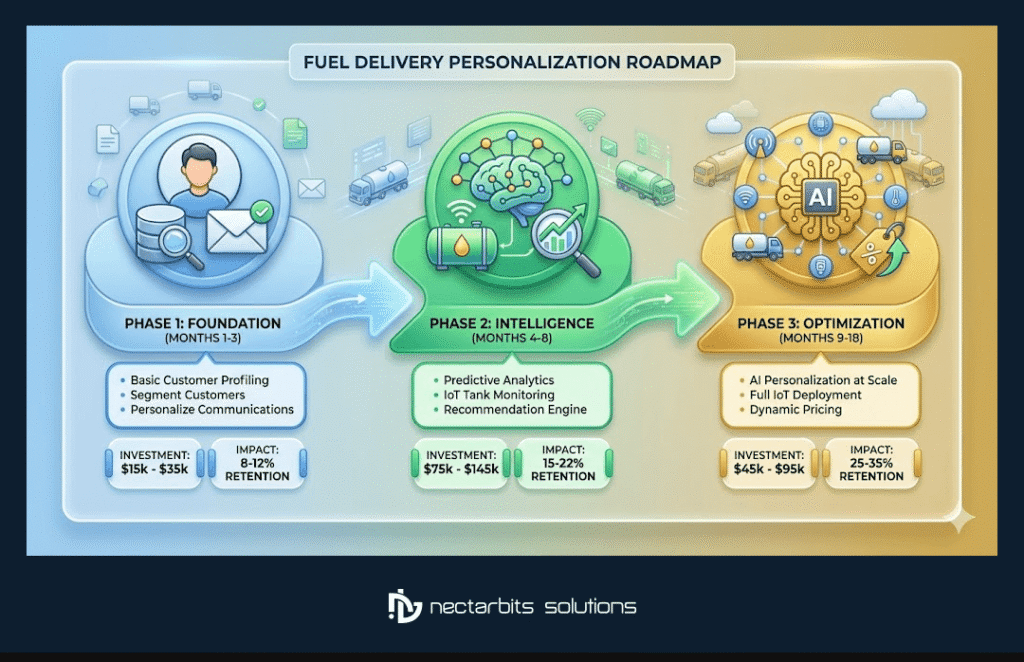
Phase 1: Foundation (Months 1-3)
Quick Wins:
- Implement basic customer profiling: Capture preferences, communication channels
- Segment customer base: 4-6 segments based on behavior/needs
- Personalize communications: Use names, reference history, tailor content
- Establish preferred delivery windows: Store and apply automatically
- Create customer portals: Self-service with personalized dashboards
Investment: $15,000 – $35,000
Expected Impact: 8-12% retention improvement, 15% satisfaction increase
Phase 2: Intelligence (Months 4-8)
Advanced Capabilities:
- Deploy predictive analytics: Consumption forecasting, churn risk scoring
- Implement IoT tank monitoring: Real-time data for top 20% of customers
- Build recommendation engine: Personalized service/product suggestions
- Launch tiered loyalty program: Rewards matched to customer values
- Enable omnichannel personalization: Consistent experience across touchpoints
- Deploy driver intelligence system: “Last Yard” personalization with site-specific instructions
Investment: $75,000 – $145,000
Expected Impact: 15-22% retention improvement, 25% ARPU increase
Phase 3: Optimization (Months 9-18)
Mastery Level:
- AI-powered personalization at scale: ML continuously optimizes
- Full IoT deployment: All customers monitored, fully predictive
- Dynamic pricing personalization: Behavior-based pricing optimization
- Comprehensive value-added services: Personalized service ecosystems
- Predictive lifetime value management: Resource allocation by customer worth
- API-first integration: Embedded logistics for enterprise clients
- Automated ESG/Carbon reporting: Compliance certificates for B2B clients
Investment: $45,000 – $95,000
Expected Impact: 25-35% retention improvement, 35-45% ARPU increase
Common Personalization Pitfalls to Avoid
Mistake 1: Creepy vs. Helpful Personalization
Creepy: “I see you searched for competitor pricing last Tuesday…”
Helpful: “Based on your typical usage patterns, you’ll need a refill around March 15th…”
The Line: Use data to serve customer needs, not demonstrate surveillance.
Mistake 2: Over-Automation Without Human Touch
Wrong: 100% automated, no human interaction
Right: Automation for efficiency, humans for relationship moments
Balance: Automate routine (scheduling, notifications, billing), personalize important (onboarding, issues, account reviews).
Mistake 3: Personalization Theater (No Real Impact)
Ineffective: Using first name in email subject line (surface-level)
Effective: Remembering the customer mentioned expansion plans 6 months ago and proactively offering a multi-location solution now
Test: Does this personalization create tangible customer value, or just demonstrate we have data?
Mistake 4: Inconsistent Personalization
Problem: The mobile app shows preferences, but the phone support agent doesn’t know them
Solution: Centralized customer data platform accessible across all touchpoints
Conclusion: The Competitive Imperative
In 2025, personalized fuel delivery is no longer optional; it’s the fundamental requirement for survival in a commoditized market. The data is undeniable:
- 316% higher lifetime value for personalized relationships
- 261% ROI in Year 1 on personalization investments
- 89% customer retention with advanced personalization vs. 58% without
The fuel delivery operators who win in the next decade won’t be those with the lowest prices—they’ll be those who know their customers best, anticipate their needs proactively, and deliver experiences so seamless and valuable that switching to a competitor becomes unthinkable.
Your competitors are already implementing these strategies. The question isn’t whether to personalize, it’s how quickly you can deploy these tools before your customer base decides that your transactional service no longer meets their expectations.
Related Reading
Looking to scale personalized fuel delivery with the right digital tools? Discover how custom platforms enable smarter personalization, automation, and customer retention.
👉 Explore Custom Fuel Delivery App Development
About NectarBits
NectarBits is a leading fuel delivery app development company specializing in custom logistics and transportation solutions. We help fuel delivery operators transform transactional businesses into personalized service ecosystems that command premium pricing and create unshakeable customer loyalty.
Our expertise includes:
- Custom fuel delivery app development
- IoT tank monitoring integration
- Predictive analytics and ML implementation
- API-first enterprise integrations
- ESG and carbon reporting automation
- Driver intelligence systems
Frequently Asked Questions:
1. What does personalized fuel delivery actually mean for businesses?
Personalized fuel delivery involves tailoring fuel scheduling, communication, pricing, and services to each customer’s usage patterns, preferences, and operational needs—rather than offering the same experience to everyone.
2. How does personalization improve customer experience in fuel delivery?
Personalization improves customer experience in fuel delivery by reducing emergencies, ensuring on-time deliveries, offering preferred communication channels, and proactively managing fuel needs—making the service more reliable and hassle-free.
3. Is personalized fuel delivery suitable for small businesses or only large fleets?
Personalized fuel delivery benefits both small businesses and large fleets. Small businesses gain convenience and cost savings, while large fleets benefit from predictive scheduling, analytics, and system integrations.
4. What technology is required to implement personalized fuel delivery?
Personalized fuel delivery typically requires a fuel delivery mobile app, customer data platform (CDP), predictive analytics, IoT tank monitoring, and automated communication tools—often built by an experienced fuel delivery app development company.