
Your fleet drivers are spending 45 minutes a day getting to and from fuel stations. For a 20-vehicle operation, that is 900 minutes of dead time every single day, on a task that produces zero revenue and zero customer value.
Multiply that across 250 working days: 3,750 hours of driver time, unnecessary vehicle wear, and idle fuel burn, gone. Layer on top the manual paperwork, the reconciliation errors, and the fuel theft that quietly drains 6–15% of the average fleet’s annual fuel budget — and you are looking at one of the most expensive, least examined operational problems in transport and logistics worldwide.
This is exactly what a fuel delivery app is designed to solve. Not as a convenience tool for occasional users, but as a measurable operational transformation with documented, calculable returns for businesses of every size.
In this guide, you will learn precisely what a fuel delivery app is, how it works step by step, the size of the market opportunity it taps into, and, the section every competitor skips, the real ROI numbers and industry-specific proof that make the business case airtight.
Quick answer: A fuel delivery app benefits businesses by eliminating driver downtime at fuel stations, automating compliance and billing, preventing fuel theft via IoT monitoring, and delivering 300–500% ROI within 18 months for established fleets.
What Is a Fuel Delivery App?
A fuel delivery app is a mobile and web platform that delivers fuel directly to a business’s vehicles, machinery, or job site on demand, eliminating the need for anyone to visit a traditional fuel station. Modern fuel delivery app development focuses on creating connected, real-time systems that streamline ordering, dispatch, tracking, and fuel management within a single digital ecosystem.
Think of it as the on-demand economy applied to energy: the same logic that brought food, taxis, and groceries to the customer’s door, now applied to one of the most essential operational inputs a business has. The difference, especially for commercial operators, is that this is not a lifestyle convenience. It is an infrastructure replacement that reduces cost, eliminates downtime, and generates measurable data that improves every subsequent fuel decision.
A fuel delivery app connects three types of users in one integrated system:
Customers, businesses, or individuals place orders, schedule deliveries, select fuel type and quantity, and pay securely within the app. They receive digital receipts and consumption reports that replace manual paper logs entirely.
Delivery partners, drivers, and tanker operators receive dispatched jobs on a dedicated driver app, navigate to the delivery location, and dispense fuel using IoT-connected meters. The exact volume dispensed syncs to the platform in real time, no manual entry, no paperwork, no room for error.
Administrators, fleet operators, or fuel business owners manage everything from a central dashboard: order volumes, driver dispatch, inventory levels, route optimisation, compliance documentation, and billing. Every data point from every delivery feeds into one operational view.
For a B2B fleet operator, this means vehicles are refueled overnight at the depot without touching driver schedules. For a construction company, it means bulk diesel arrives at the remote project site on schedule, preventing the equipment downtime that happens when a generator runs dry. For a fuel supplier going digital, it means direct-to-customer distribution with automated billing and real-time tracking, without the capital cost of building a physical retail network.
How Does a Fuel Delivery App Work?
Understanding the full workflow is important, both for businesses evaluating whether to adopt an on-demand fuel delivery solution and for entrepreneurs deciding whether to build one. Here is the complete operational cycle:
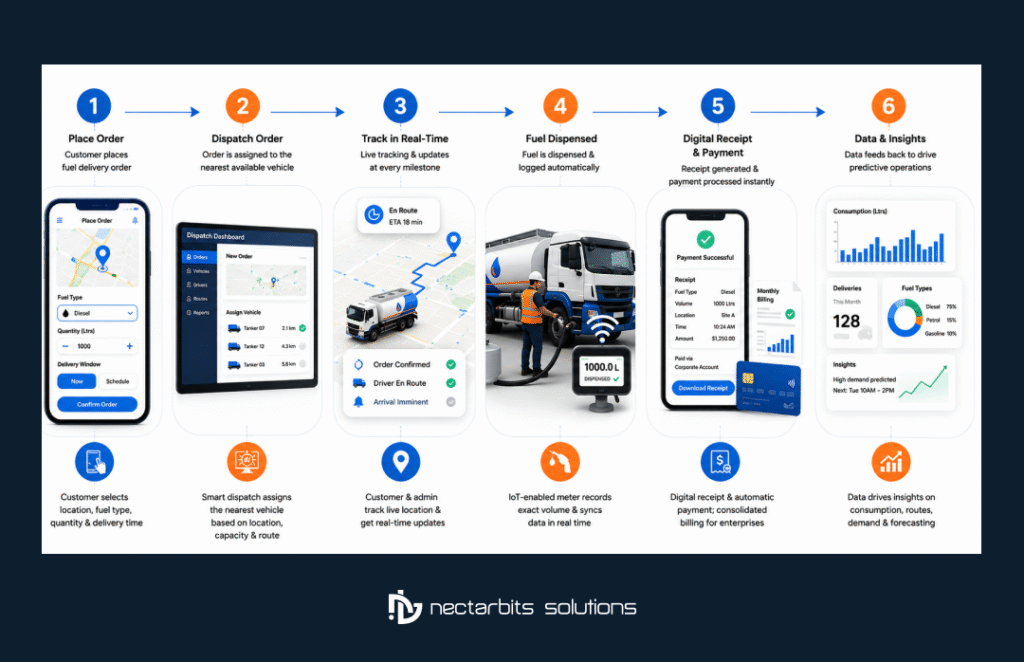
Step 1: The customer places an order. The customer opens the app, pins their delivery location (a depot, a job site, a fleet yard), selects fuel type and quantity, and picks a delivery window, immediate or scheduled. For enterprise B2B fleet clients, this step is often fully automated: IoT sensors monitor tank levels and trigger an order automatically when inventory drops below a set threshold.
Step 2: The order is dispatched. The admin dashboard, or an automated dispatch algorithm, assigns the order to the nearest available delivery vehicle based on location, load capacity, and route efficiency. The driver receives the job on their app with full delivery details, GPS navigation, and pre-delivery safety and compliance checklists.
Step 3: Real-time tracking activates. Both the customer and the admin track the delivery vehicle live via GPS. Estimated arrival time updates dynamically. The customer receives push notifications at each milestone: order confirmed, driver en route, arrival imminent.
Step 4: Fuel is dispensed and logged automatically. The driver arrives, connects the IoT-enabled metering equipment, and dispenses fuel. The exact volume is recorded by the meter and synced to the app in real time. There is no manual logging, no over-delivery, and no under-delivery. The system creates a tamper-proof digital record at the point of dispensing.
Step 5: Digital receipts and payments are processed instantly. Immediately after dispensing, the app generates a digital receipt showing fuel type, volume, location, timestamp, and cost. Payment clears automatically through integrated payment rails. For enterprise clients, billing consolidates monthly with itemised delivery reports per vehicle, no invoice delays, no manual reconciliation.
Step 6: Data feeds back into operations. Every delivery builds a growing operational dataset: consumption by vehicle, route efficiency, peak demand windows, and inventory forecast signals. Over time, this data shifts the operation from reactive, delivering when asked, to predictive, scheduling delivery before the customer needs to ask.
From the customer’s perspective, this entire cycle requires roughly 5–10 minutes of active interaction. The traditional equivalent, dispatch detour, fuel station queue, manual fill, paper receipt, manual log, return journey, requires 35–45 minutes per vehicle. The operational gap is measurable and consistent.
The Global Market Opportunity: Why Now Is the Right Time
The fuel delivery app is not a niche startup concept. It is a market that has crossed into mainstream commercial adoption, and the growth data reflects that clearly.
The global mobile fuel delivery market is valued at approximately $6.2 billion in 2026 and is projected to reach $10.1 billion by 2033, growing at a CAGR of 7.3%. The on-demand segment, B2B fleet fueling, logistics, and construction, is expanding at 15.97% CAGR and is expected to reach $1.76 billion by 2035 (Business Research Insights). Fuel delivery app users have surged 45% globally in the past two years alone.
North America: The Dominant Market and Why Businesses Here Cannot Afford to Wait
North America currently accounts for approximately 42% of the global mobile fuel delivery market (Persistence Market Research), driven by the highest concentration of commercial transportation networks, a mature on-demand service economy, and a fleet digitisation push that has been accelerating since 2022.
The United States Opportunity
The United States is the world’s single largest on-demand fuel delivery market. Platforms like Booster, Filld, EZFill, and Yoshi have collectively proven the model at scale, but penetration outside major metropolitan areas remains low. The US fleet sector, which spans over 6 million commercial vehicles, represents a majority of fuel demand that is still being served through traditional forecourt visits. Each day a fleet operation continues without a mobile fuel delivery solution, it absorbs the same driver downtime, fuel theft exposure, and manual reconciliation burden that competitors who have made the switch have already eliminated.
The DOT and Hazmat compliance framework in the US creates a natural moat for operators who build compliance automation into their platforms from day one. Fuel delivery businesses that can generate audit-ready documentation automatically per delivery, something a properly built fleet fuel management app makes entirely routine, can access government, healthcare, and municipal fleet contracts that paper-based competitors are locked out of by regulation.
Canada: A First-Mover Market with a Unified Regulatory Advantage
Canada represents one of the most strategically attractive fuel delivery app markets globally, and one of the most underserved. The US–Canada fuel delivery corridor is estimated at a $450 billion opportunity, with approximately $2.6 billion in petroleum products traded between the two countries daily.
What makes Canada particularly compelling for businesses building or deploying a fuel delivery platform is the unified federal compliance structure. Canada’s Transportation of Dangerous Goods (TDG) Act governs fuel transport nationally, providing a consistent regulatory framework that is structurally easier to scale across provinces than the patchwork of state-level requirements operators navigate in the US. Toronto, Vancouver, Calgary, and Edmonton all have dense commercial fleet concentrations, logistics operators, construction firms, and agricultural businesses that are currently underserved by on-demand fueling options.
Unlike South America or Southeast Asia, where local market knowledge creates high entry barriers, Canada shares timezone alignment, regulatory proximity to the US, and bilingual market access (English/French) that makes it a natural expansion corridor for any fuel delivery platform already operating south of the border. You can explore the full cost and compliance breakdown for building in this market in the fuel delivery app development cost guide for Canada and the USA.
South Africa: 18.9% CAGR, the Fastest-Growing Market Globally
South Africa is one of the clearest examples of an emerging market opportunity in this sector. The South African on-demand fuel delivery market is projected to grow at a CAGR of 18.9%, one of the fastest growth rates of any country tracked globally. The South African government has allocated approximately 10% of GDP toward the development of the fuel sector, and urbanisation is accelerating vehicle ownership across major cities.
For businesses serving fleets in South Africa’s mining, agriculture, and transport sectors, where distances are large and fuel station access is inconsistent, a mobile fuel delivery solution solves a structural problem that a forecourt model never can. Understanding why fuel delivery apps are disrupting traditional gas stations is particularly relevant here: in remote South African operational environments, the app is not a convenience layer on top of the existing system. It is the system.
Brazil: Diesel Pressure Creates Urgent Fleet Demand
Fuel prices in Brazil have surged approximately 15% over recent years, with diesel reaching BRL 5.50 per litre, placing significant pressure on fleet operational budgets. The Brazilian logistics sector is projected to grow by 4.5%, and fleet management technologies that reduce fuel expenses by 10–15% through real-time consumption data are increasingly essential for competitiveness. São Paulo, Rio de Janeiro, and Belo Horizonte account for the largest concentration of logistics and transport businesses in Latin America, and none of them have a mature on-demand fuel delivery option at scale.
Traditional Fueling vs. App-Based Fueling: The Real Operational Gap
Before unpacking each business benefit individually, it is useful to see the full operational difference in one view. This is the comparison most analyses never present.
| Factor | Traditional Fueling | App-Based Fuel Delivery |
| Steps to complete | 8 steps | 3 steps |
| Time per vehicle | 35–45 minutes | 5–10 minutes |
| Tracking visibility | None-paper logs | Real-time GPS + IoT dashboard |
| Receipt and billing | Manual, error-prone | Auto-generated, tamper-proof |
| Compliance logging | Manual, audit-vulnerable | Automated, audit-ready per delivery |
| Fuel theft exposure | 6–15% of the annual budget | IoT theft alert on any unauthorised dispensing |
| Admin time | 30–50% of the ops manager’s week | Reduced by 30–50% |
| ERP / fleet integration | None | Full API integration available |
| Scalability | Proportional cost with every new location | Marginal cost falls as volume grows |
This is not a theoretical comparison. It reflects documented operational differences between paper-based fleet fueling and the model used at scale by Filld, Booster, CAFU, and EZFill across commercial fleets in North America, the UAE, South Africa, and South Asia.
You can see how the Filld model specifically handles enterprise fleet fueling in the Filld case study and platform breakdown.
Key Benefits of a Fuel Delivery App for Businesses
1. Improving Customer Satisfaction Through Convenience
The most visible fuel delivery app benefit, for businesses operating customer-facing fuel delivery services, is what it removes from the experience. Every point of friction disappears.
For B2C customers, doorstep delivery eliminates the fuel station trip. 24/7 availability replaces fixed station hours. Real-time delivery tracking replaces the uncertainty of “when will it arrive.” Automatic digital receipts replace the manual log that no customer wants to maintain.
CAFU, the UAE-based on-demand platform, holds a 4.8-star rating built on scheduled delivery reliability, transparent pricing, and a contactless experience that works around the customer’s schedule, not the other way around. EZFill in the United States has built its growth on the same principle, serving both individual consumers and B2B fleet clients across the East Coast and expanding cities.
For fleet operators deploying a fuel delivery app internally, for their own vehicles and drivers, the satisfaction improvement is operational rather than customer-facing, but equally valuable. Drivers are not sent on fuel runs. Their routes are not interrupted by detours. Their vehicle is ready at shift start because it was fueled the night before.
Subscription-based fuel delivery models translate this convenience into retention. Businesses on monthly or quarterly fuel delivery plans show approximately 40% higher customer retention than pay-per-delivery accounts. When scheduled delivery becomes the default, customers stop evaluating alternatives. Loyalty programmes and personalised reorder schedules layer additional lifetime value on each account — converting one-time clients into predictable recurring revenue.
2. Streamlining Operations for Fuel Delivery Services
Operational efficiency is where a fuel delivery app delivers its broadest, deepest, and most compounding business benefit — and where the gap between app-based and traditional operations is widest.
Order Management and Inventory Automation
Order management moves from phone calls and spreadsheets to a self-service interface that feeds directly into the dispatch dashboard. Orders, scheduling, driver assignment, and billing all flow through one system, eliminating the coordination overhead that scales badly as a fuel business grows.
Inventory automation means fuel levels across tanker fleets and customer storage tanks are monitored in real time via IoT sensors. The system reorders, redispatches, and reschedules based on actual consumption data, not estimates or manual spot-checks. Operations managers report 30–50% reductions in administrative time after implementing digital fleet fuel management systems.
Route Optimisation That Pays for Itself
Route optimisation reduces delivery vehicle mileage by 15–25% per route. For a fuel delivery business running its own tanker fleet, this directly cuts the cost of operating the delivery operation itself, fuel-on-fuel savings that amplify overall ROI. A detailed breakdown of the must-have features in a fleet management software for fuel delivery businesses explains exactly how this optimisation works at the platform level.
Compliance Automation: The Operational Benefit Most Discussions Miss
Compliance automation is strategically significant and almost entirely overlooked in competitor content. Fuel delivery operates under strict regulatory frameworks in every market:
- United States: DOT and Hazmat standards govern vehicle certification, driver licensing, and delivery documentation
- Canada: The Transportation of Dangerous Goods (TDG) Act sets the national compliance framework, with provincial requirements layered on top
- South Africa: The Petroleum Products Act and PETRO set the compliance framework
- Brazil: ANP (Agência Nacional do Petróleo) regulates fuel distribution and transport standards
A properly built fuel delivery app automates compliance at the point of delivery. When the pump stops, the IoT meter pushes the exact volume dispensed, the GPS coordinates, the timestamp, and the driver credentials to a tamper-proof digital log. Audit-ready documentation is generated per delivery without any manual reconstruction. Operators with this capability can pursue enterprise fleet contracts — government, healthcare, municipal — that require proven compliance as a condition of the tender. Paper-based competitors cannot qualify.
3. Enhancing Efficiency with Real-Time Tracking
Real-time GPS tracking is the feature every competitor mentions. The deeper efficiency story — the one that actually changes the P&L, is what that tracking enables beyond knowing a tanker’s location.
Fuel theft prevention is the most financially significant and underreported benefit of real-time tracking in fleet fuel operations. Industry data shows that 6–15% of fleet fuel budgets are lost to theft and fraud annually. A fleet operation in Texas identified $35,000 in annual fuel theft only after implementing IoT-enabled monitoring, theft that had been occurring through unauthorised dispensing, ghost deliveries, and fuel card misuse that was completely invisible without event-level tracking.
A fuel delivery app with IoT meter integration eliminates these loss vectors. Every dispensing event is timestamped, geotagged, and linked to a confirmed active job. If the meter registers flow without an active job in the system, an immediate theft alert fires to the operations manager. Drivers cannot alter meter readings. Customers receive digital receipts showing exact volume delivered, eliminating reconciliation disputes that open the door to fraud.
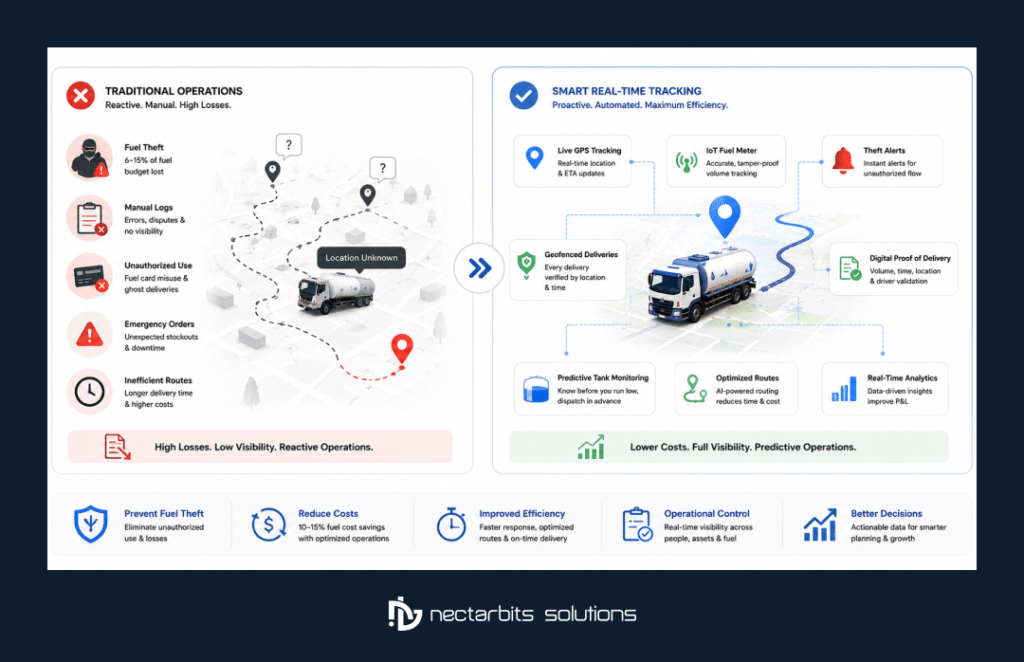
Predictive fueling is the next efficiency layer that IoT data makes possible. When sensors in customer storage tanks feed live level readings back to the delivery platform, the system identifies when a tank is approaching a critical threshold before the customer raises a request. Predictive dispatch, scheduling delivery in advance of the need, eliminates emergency orders, prevents equipment downtime on remote sites, and allows the delivery operation to optimise routes around planned deliveries rather than reactive scrambles.
For markets like South Africa, where mining operations and agricultural estates often sit far from commercial infrastructure, this predictive capability is not a premium feature — it is the primary operational value proposition. A remote cattle farm or a platinum mine that runs out of diesel at midnight does not have the same options a suburban fleet operator does. An IoT-connected delivery platform that monitors levels and dispatches proactively transforms an emergency into a scheduled event.
According to a 2023 Geotab fleet telematics analysis, businesses using live vehicle data achieve measurable improvements in response time, route visibility, and operational control. ATRI fleet technology research documents 10–15% fuel cost reduction through route optimisation and driver behaviour monitoring, and up to 25% reduction in insurance premiums for fleets with documented telematics records, all outcomes that flow directly from having real-time tracking data in the system. The future of on-demand fuel and energy apps covers how AI-powered route optimisation and predictive analytics are making these capabilities standard in next-generation platforms.
4. Scalability Opportunities for Fuel Delivery Businesses
The structural advantage of an app-based fuel delivery model over traditional pump-based retail is in how growth works. Traditional scaling requires proportional capital: land, infrastructure, staff, and years of payback per location. App-based scaling is software-first.
Adding a new service zone means extending geofencing, adding delivery vehicles, and updating dispatch routing. The marginal cost of a new market is a fraction of the capital required to open a physical outlet, and payback periods shrink accordingly.
Subscription revenue multiplies the advantage. Fleet operators, logistics companies, construction firms, and agricultural businesses all have consistent, predictable fuel needs. Subscription delivery plans convert these clients from transactional accounts, where each order is a new sales decision, into recurring revenue relationships where the monthly delivery is pre-committed. A portfolio of subscription clients converts revenue from variable to predictable, which fundamentally changes how the business can be financed and valued.
White-label licensing is the scalability opportunity that almost no competitor in the fuel delivery space discusses openly. A fuel delivery platform built on a properly architected, white-label foundation can be licensed to regional fuel distributors, logistics companies wanting to offer branded fueling as a managed service, or energy suppliers entering the on-demand market for the first time, without the licensing business carrying the operational overhead of those secondary markets. The platform becomes a product in its own right, generating a second revenue stream from the same initial investment.
For businesses in Brazil, this model is particularly relevant. Brazil’s logistics market is projected to grow 4.5%, driven by the rapid expansion of e-commerce and the concentration of large fleet operations across São Paulo, Rio de Janeiro, and Minas Gerais state. A white-label fuel delivery platform launched in São Paulo can be extended to Rio, to secondary logistics hubs, and eventually to other operators in the region, all from the same infrastructure, without proportional capital reinvestment.
EV charging integration is the longest-range scalability move in this sector right now. The Brazilian government has set a target of 30% of new commercial vehicles being electric, a policy direction that will reshape fleet fuel procurement over the coming decade. A fuel delivery app built today with architecture that can accommodate EV charging scheduling and on-site energy dispatch does not need to be rebuilt when fleet composition changes. It extends. That extension capability, serving diesel fleets today and electric fleets tomorrow from the same operational platform, is a strategic asset that purpose-built, fuel-only applications cannot replicate.
5. Building a Competitive Advantage in the Fuel Industry
The fuel delivery market is in early consolidation globally. The major platforms, Booster, Filld, CAFU, EZFill- have proven the model but have not saturated any market outside their core geographies. For businesses entering regional markets now, first-mover advantage is still genuinely available, particularly in Canada, South Africa, Brazil, and secondary US markets where the on-demand fuel category is still being defined.
Data as a Competitive Moat
The competitive moat that an app-based fuel delivery business builds over time is not speed to market. It is data. Every delivery, every route, every customer fuel consumption pattern, every seasonal demand trend becomes proprietary operational intelligence that traditional fuel suppliers, who see only the fuel card transaction, simply do not have.
When a fuel delivery app integrates with a client’s ERP or fleet management system, which enterprise clients increasingly require as a condition of supplier selection, that integration creates switching costs that lock the relationship. Replacing an integrated fuel delivery provider is a systems migration, not a purchasing decision.
Understanding How the Best Platforms Do This
The Booster Fuels model demonstrates exactly how data-driven competitive advantage compounds over time. Their Smart Tanker IoT system, combined with AI route optimisation, turns every delivery into proprietary intelligence about fleet behaviour, demand density, and route economics that competitors cannot replicate. The Booster Fuels business model breakdown unpacks how this architecture translates into enterprise client retention and market defensibility, directly relevant for anyone building or deploying a similar platform in North America.
ESG Positioning: From Preference to Procurement Requirement
ESG positioning is moving from preference to procurement requirement. Enterprise clients in logistics, construction, and municipal operations face scope 3 emissions reporting obligations. A fuel delivery operation with documented route optimisation data, per-delivery emissions tracking, and sustainable fuel options, renewable diesel, biodiesel, and synthetic blends, can meet corporate sustainability requirements that traditional forecourt suppliers cannot.
Compliance as a Competitive Moat
Fuel delivery operators with automated compliance documentation, audit-ready logs generated per delivery, can pursue regulated fleet contracts that require provable compliance as a procurement condition. Government fleet contracts, healthcare transport, emergency services: this tier of client is locked to compliant suppliers by policy, not preference.
The ROI of a Fuel Delivery App: Real Formula, Real Numbers
This is the section that closes every business case, investment proposal, and stakeholder presentation. No current top-ranking competitor provides a worked calculation. Here it is.
The ROI formula:
ROI = (Total Annual Savings − Annual Platform Cost) ÷ Annual Platform Cost × 100
Worked example — a 20-vehicle logistics fleet with a $400,000 annual fuel budget:
| Savings category | How it is calculated | Annual saving |
| Fuel cost reduction (10–15%) | $400,000 × 12.5% average | $50,000 |
| Route optimisation (15–25% distance) | Reduced miles × fuel cost per mile | $18,000–$30,000 |
| Admin time reduction (30–50%) | 1 ops manager × 40% × $65,000 salary | $26,000 |
| Fuel theft prevention (6% average) | $400,000 × 6% recovered | $24,000 |
| Total annual savings | $118,000–$130,000 |
Assume an annual platform cost of $30,000–$50,000 (amortised custom development over 3 years, or a white-label SaaS subscription):
ROI = ($118,000 − $40,000) ÷ $40,000 × 100 = 195% in year one
By year two, with route data optimised, subscription clients onboarded, and theft recovery compounding, established fleets reach 300–500% ROI. Payback period: 3–9 months.
These figures are grounded in ATRI fleet technology research, Verizon Connect’s 2024 fleet study, and the operational outcomes published by enterprise fleet platforms like Filld. They are not projections; they are documented benchmarks from businesses running this model at scale.
Want to explore how fuel delivery businesses improve profitability, reduce operational waste, and uncover hidden savings? Dive deeper into The Profit Detective: How to Use Fuel Delivery Analytics to Uncover Hidden Profits.
Industry Use Cases: How Different Businesses Benefit
Logistics and Transport Fleets
For logistics operators running 20–200 vehicles across regional routes, a fuel delivery app eliminates fuel station detours from driver routes. Vehicles are refueled overnight at depots or on-site during scheduled windows. Fuel consumption data integrates with route planning and ERP systems, giving operations managers a single view of fuel costs and delivery performance, data that most logistics businesses currently reconstruct from fuel cards and paper logs. As fleet operations become increasingly digitized, many transport companies are also investing in Logistics App Development to improve route visibility, dispatch coordination, and operational efficiency across multi-location delivery networks.
Construction and Remote Project Sites
Construction fleets face a challenge that forecourt-based fueling fundamentally cannot solve: distance from commercial infrastructure. A fuel delivery app for construction companies brings bulk diesel to the project location on a scheduled or on-demand basis. IoT monitoring of on-site storage tanks prevents the equipment downtime that occurs when a generator or machine runs dry unexpectedly. In markets like South Africa, where mining and infrastructure projects operate in remote areas with limited forecourt access — this is not a nice-to-have. It is the only viable fueling model.
Agriculture and Farming Operations
Agricultural fuel needs are seasonal, high-volume, and geographically isolated. A mobile fuel delivery solution enables pre-scheduled bulk deliveries timed to harvest and planting windows, with consumption tracking that informs the following season’s procurement. Automated compliance documentation also supports agricultural fuel tax relief claims in most jurisdictions, a financial benefit that often makes the platform effectively self-funding at scale. Businesses operating across large agricultural zones increasingly prefer custom app development solutions to manage fuel inventory, seasonal demand forecasting, and automated compliance reporting from a centralized platform.
Marine and Municipal Fleets
Municipal vehicle fleets, bus services, waste management, emergency services, and marine operations share a common requirement: consistent, scheduled, high-volume fueling at fixed locations. A fuel delivery app integrated with fleet management software creates a closed-loop system: automated scheduling based on vehicle telematics, delivery during off-peak hours, and consolidated billing that simplifies procurement reporting.
Conclusion:
A fuel delivery app is not an incremental improvement on traditional fueling. It is a structural replacement, one that turns fuel from a variable cost that happens to your business into an operational system that works for it.
The five benefits compound on each other: improved customer satisfaction builds retention. Streamlined operations reduce cost. Real-time tracking prevents theft and enables predictive supply. Scalability converts growth from capital-intensive to software-driven. Competitive advantage compounds with every ERP integration, every compliance log, and every data point that traditional competitors are not collecting.
The global market is growing at 7.4% CAGR. South Africa is growing at 18.9%. Brazil’s logistics sector is expanding 4.5%, with diesel costs creating urgent pressure on fleet operators to find smarter fueling solutions. In every one of these markets, the business that builds its platform now, while consolidation is still incomplete and regional first-mover advantage is still available, sets the terms for the operators that follow.
The ROI is documented. The market signals are clear. The question is whether your business captures this position now, or concedes it to the operator who does.
Further Reading
Explore how the top global platforms, Booster, Filld, CAFU, EZFill, and others, have built their models, what technology powers each platform, and what operators in Canada, the US, and emerging markets can learn from their growth strategies: Top Fuel Delivery Apps 2026: Your Ultimate Guide to On-Demand Fueling →
Frequently Asked Questions:
1. What is a fuel delivery app?
A fuel delivery app is a mobile platform that delivers fuel directly to a business’s vehicles or job site on demand, eliminating the need for anyone to visit a fuel station. It connects customers, licensed delivery drivers, and an admin operations dashboard through one integrated system.
2. How does a fuel delivery app work?
A customer places an order via the app — selecting location, fuel type, quantity, and delivery window. The system dispatches the nearest available driver. The customer tracks delivery in real time via GPS. The driver dispenses fuel using IoT-connected meters that log the exact volume automatically. A digital receipt and payment are processed immediately after delivery.
3. What ROI can a fuel delivery app deliver for a business?
For a 20-vehicle fleet with a $400,000 annual fuel budget, documented savings reach $118,000–$130,000 annually through fuel cost reduction, route optimisation, admin time savings, and theft prevention. That is approximately 195% ROI in year one, rising to 300–500% by year two. Typical payback period: 3–9 months.
4. How does a fuel delivery app improve customer satisfaction?
By removing the fuel station from the customer’s workflow entirely. Scheduled deliveries, 24/7 availability, real-time tracking, and automatic digital receipts eliminate the three main friction points in traditional fueling: travel time, delivery uncertainty, and manual record-keeping.
5. How does real-time tracking reduce fuel costs?
Real-time GPS enables route optimisation that cuts 15–25% of unnecessary delivery miles. IoT fuel sensors prevent theft and over-dispensing. Driver behaviour monitoring reduces consumption per vehicle. Combined, these mechanisms account for the 10–15% fuel cost reduction documented in ATRI fleet technology research.
6. What compliance requirements does a fuel delivery app handle?
Regulatory requirements vary by market but consistently include documented delivery records: volume, location, time, driver credentials, and vehicle certification. A properly built fuel delivery app generates this documentation automatically via IoT meter integration, producing tamper-proof, audit-ready logs per delivery — with no manual reconstruction required.