
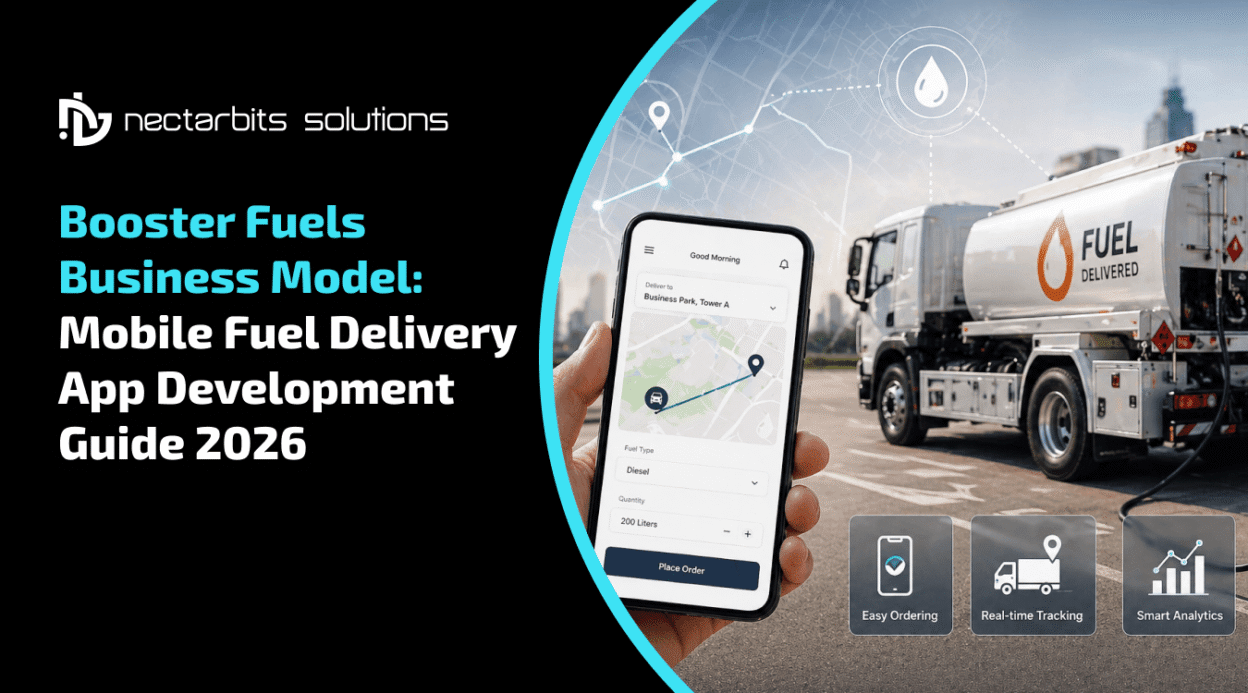
Every fleet manager knows the routine: drivers clock in, detour to the nearest gas station, wait in line, fuel up, and finally start their actual route, 20 to 30 minutes late before the workday even begins. Multiply that by 183 fueling trips per vehicle per year, across a 50-vehicle fleet, and you are quietly losing over $77,000 in wasted labor alone, without realizing it.
Booster Fuels looked at that problem and asked a simple question: What if the gas station came to you instead?
That one idea, applied with aerospace-grade engineering, AI-powered logistics, and a B2B distribution strategy, turned Booster into a near-$800 million company serving Amazon, UPS, FedEx, and Walmart across 28 US states.
In this blog, we break down the complete Booster Fuels business model: how their revenue works, what technology powers every delivery, the real cost savings they deliver to fleets, and what entrepreneurs need to know before building a similar platform in 2026. If you are researching on-demand fuel delivery app development, this case study explains everything.
What Is Booster Fuels and How Does the Business Model Work?
Booster Fuels is a mobile energy delivery company that brings fuel directly to parked vehicles, eliminating the need for drivers or fleet operators to visit a gas station at all.
Founded in 2015 in San Mateo, California, Booster operates through a vertically integrated model: it sources fuel wholesale, dispatches custom-built Smart Tanker trucks using AI-optimized routing, and delivers gasoline, diesel, renewable diesel, and DEF directly to corporate fleets, campuses, and business parks.
In short, instead of your vehicles going to the gas station, Booster brings the gas station to your vehicles.
The company has raised over $236 million in funding, serves more than 120,000 customers across 500+ fleets, operates in 28+ US states, and counts Amazon, UPS, FedEx, Walmart, Cisco, Oracle, eBay, and Facebook among its clients.
But the numbers are not what make this business model interesting. What makes it interesting is how Booster built it, who they built it for, and why it works when so many similar ideas have failed.
Why Fleet Fueling Is Broken And What It’s Silently Costing Your Business
Before Booster existed, fleet fueling worked the same way it had for 100 years: vehicles drove to a gas station, waited in line, fueled up, and drove back. That process seems simple until you do the math at scale.
For a company operating 50 delivery vans, each vehicle makes an average of 183 fueling trips per year. At 2.2 miles per round trip and 22 minutes per stop — including driving, waiting, and returning, that adds up to:
- 403 extra miles driven per vehicle per year, just to buy fuel
- 67 hours of lost driver time per vehicle per year
- $1,540 in wasted labor per vehicle per year (at the national average wage)
- Hundreds of dollars in unnecessary fuel consumption and vehicle wear
For a 50-vehicle fleet, that is over $77,000 wasted annually before a single gallon is even priced competitively.
Booster’s founding insight was simple: the gas station model was designed for individual consumers making infrequent trips. It was never designed for commercial fleets running predictable, high-frequency routes. Applying a 100-year-old consumer solution to a commercial logistics problem created an enormous efficiency gap, and that gap became Booster’s market.
Who Does Booster Serve, and Why B2B Always Wins
Booster serves three customer segments, each with different needs and different economics.
Enterprise Fleets: Booster’s Core and Most Profitable Segment
This is Booster’s core and most profitable segment post-2020. Commercial fleet operators — logistics companies, delivery services, rental car companies, healthcare providers, utilities — run vehicles on predictable overnight schedules. When those vehicles return to a yard or depot at the end of each shift, they need to be fueled and ready before the next shift begins.
Booster’s Smart Tankers arrive at fleet yards between midnight and 6 am, fuel every vehicle in the lot, and are gone before the first driver arrives in the morning. Zero detours. Zero downtime. Zero fuel cards to manage.
Enterprise clients include Amazon, UPS, FedEx, Enterprise Rent-A-Car, Stanley Steemer, and Carey International. A single enterprise fleet contract, say, 200 vehicles refueled 183 times per year, generates significant recurring monthly revenue with near-zero customer acquisition cost once the contract is signed. For a detailed look at how this B2B fleet fuel delivery model works at the platform level, contract structure, scheduling logic, and enterprise dashboard, the Filld case study is the closest operational comparison to Booster in the market.
Corporate Campuses: The B2B2E Model Explained
Booster’s original market was corporate campuses, tech giants like Cisco, Oracle, eBay, PayPal, and Facebook. The model here is called B2B2E (Business-to-Business-to-Employee): the employer signs the Booster agreement (at no upfront cost), promotes the service as an employee benefit, and employees leave their fuel door open when they park at work. Booster’s tankers fill the cars during working hours.
Employees love it; they never leave the office to buy fuel. Employers love it, it costs nothing to set up, and it improves staff retention. Booster loves it; high-density parking lots mean more deliveries per tanker per hour.
Government and Essential Services
Booster also holds contracts with municipal fleets, emergency services, healthcare providers, and government vehicle pools. This segment is recession-proof, publicly funded, and operates on long-term contracts, the most stable revenue base in Booster’s portfolio.
During the 2021 Texas winter storm blackouts, Booster kept fire trucks running and generators operational while the grid was down, a real-world demonstration of essential service capability that has since opened significant government procurement doors.
How Booster’s On-Demand Fuel Delivery App Works: Step by Step
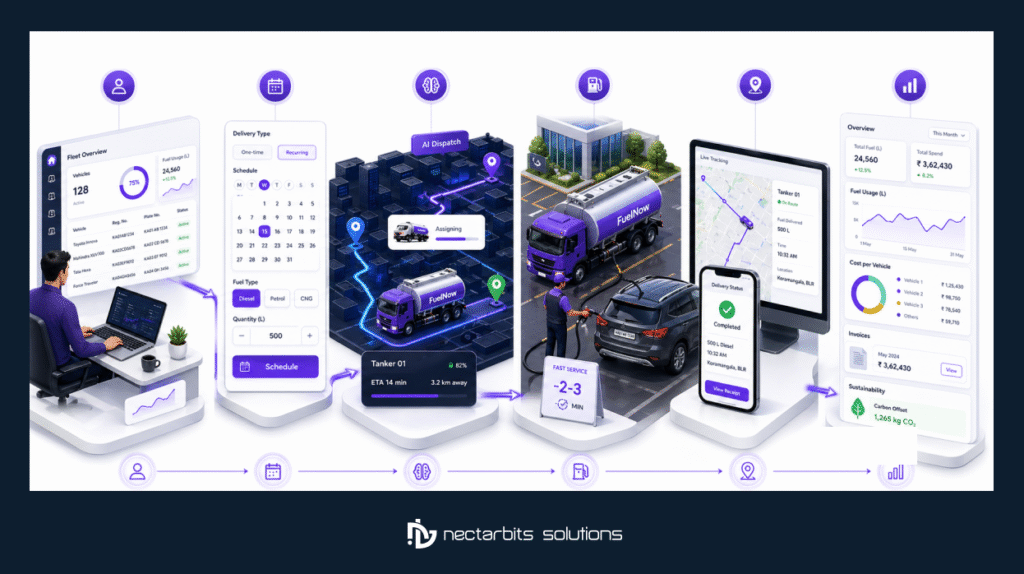
Here is the full delivery workflow from client sign-up to invoice:
Step 1: Free Fleet Audit and Onboarding
A business contacts Booster’s sales team. Booster conducts a free fuel analysis showing exactly how much the company currently wastes on traditional fueling (labor, mileage, fraud). The analysis itself becomes the sales argument. Fleet vehicles are registered in the system by license plate and fuel type.
Step 2: Scheduling Deliveries via Fleet Portal
Fleet managers configure their delivery preferences through the Booster web portal: recurring nightly schedule, specific delivery windows, fuel types per vehicle, and volume thresholds. No minimum fleet size is required to onboard.
Step 3: AI-Powered Dispatch and Route Optimization
Booster’s Kasparov AI engine calculates the optimal delivery route for every active tanker in real time, accounting for traffic, weather, demand volume, parking lot layout, and driver availability. Each driver receives a sequenced delivery list through the driver app.
Step 4: Delivery in 2 to 3 Minutes Per Vehicle
Booster’s CDL-certified, Hazmat-trained service professionals arrive at the designated location in purple Smart Tankers. Each vehicle is identified by license plate, the fuel door is opened (via a pre-registered mechanism or left open by the owner), and the vehicle is fueled. The entire delivery takes approximately 2–3 minutes per vehicle.
Step 5: Real-Time Confirmation and Data Logging
Every delivery is logged in real time: vehicle ID, gallons delivered, fuel type, delivery time, GPS location, and driver ID. A digital receipt is generated instantly. Fleet managers see every transaction live in the Booster Insights Dashboard.
Step 6: Monthly Invoice and Fleet Analytics Report
Clients receive a consolidated monthly invoice covering all deliveries, no fuel cards, no paper receipts, no manual expense reporting. The dashboard shows fuel consumption trends, cost-per-vehicle analytics, carbon offset data, and comparative benchmarks.
Revenue Model: How Booster Makes Money Across 5 Layers
Booster’s revenue model has multiple layers. Understanding all of them explains why the business is defensible even in a commodity market like fuel.
Layer 1: Per-Gallon Fuel Margin
Booster’s primary revenue comes from the margin between wholesale fuel cost and delivered price. By sourcing directly from fuel terminals, bypassing gas station infrastructure, real estate, and distribution middlemen, Booster compresses the supply chain and captures margin at the wholesale-to-delivery level.
The delivered price to clients is structured competitively with local gas station prices. For clients, this means they are paying roughly the same per-gallon cost they would at a pump — but receiving a dramatically more efficient service. For Booster, cutting out the gas station middleman means healthy margins at a competitive price point.
Layer 2: Delivery Fee Structure
On top of the fuel margin, Booster charges a delivery fee structured in one of three ways depending on client size and frequency:
- Per-gallon delivery surcharge for smaller or infrequent clients
- Per-vehicle fee for mid-size fleet contracts
- Per-visit flat fee for large fleet yards where one tanker services dozens of vehicles per stop
Volume discounts apply for larger fleets: a 500-vehicle fleet pays a lower per-gallon delivery fee than a 20-vehicle fleet, because the economics of each delivery run are far more favorable at scale.
Layer 3: Specialty Fuel Upcharges
Renewable diesel, biodiesel blends, and DEF carry higher margins than standard gasoline or diesel. As enterprise clients face increasing ESG pressure to reduce scope 1 emissions, demand for premium green fuels is rising — and Booster earns more per gallon on every sustainable delivery.
Additionally, Booster participates in government incentive programs, including LCFS credits (Low Carbon Fuel Standard) and RINs (Renewable Identification Numbers), federal and state programs that pay companies for delivering lower-emission fuels. These government credits create a revenue stream that competitors not yet in the renewable fuel space cannot access.
Layer 4: Analytics and Data Intelligence
The Booster Insights Dashboard is free to clients, but it creates deep switching costs. Once a fleet’s 12–18 months of fuel consumption data, vehicle-level analytics, carbon offset reports, and spending trends are inside Booster’s system, moving to a competitor means losing that operational intelligence entirely. Data lock-in at no subscription cost is one of Booster’s most elegant retention strategies. Operators exploring alternatives, including platforms like CAFU that run a fuel delivery subscription model alongside per-delivery pricing, use a different lock-in mechanism, but the goal is the same: predictable recurring revenue and low churn
Layer 5: Integration Revenue and Partnership Fees
Booster integrates with major fleet management platforms, including WEX, Voyager, Comdata, Geotab, Samsara, and Verizon Connect. These integrations reduce billing friction for enterprise clients — and generate partnership revenue through data-sharing and co-marketing agreements with the platform providers.
Traditional Fueling vs. Booster: What It Actually Costs Your Fleet
Both competing blogs list the benefits of the Booster without showing the actual cost comparison that fleet managers need to see. Here it is.
Per-Vehicle Annual Cost: Side-by-Side Breakdown
| Cost Category | Traditional Fueling | With Booster |
| Labor time (22 min × 183 trips × avg $25.24/hr) | $1,540 | $0 |
| Extra mileage cost (2.2 mi × 183 trips × $0.33/mi) | $134 | $0 |
| Vehicle wear on unnecessary mileage | ~$80 | $0 |
| Fuel fraud and card misuse (industry average) | $100–$500 | $0 |
| Fuel cost (at pump price) | Market rate | Competitive (±0–5%) |
| Total annual cost per vehicle | $1,850–$2,250+ | Fuel cost only |
Total Fleet Savings for 50 Vehicles Per Year
| Metric | Annual Value |
| Labor savings | $77,000 |
| Mileage and wear savings | $10,700 |
| Fraud elimination | $5,000–$25,000 |
| Dispatcher efficiency gains | $15,000+ |
| Total annual value delivered | $107,700–$127,700 |
These numbers explain why enterprise fleet managers sign Booster contracts without lengthy price negotiations. When you show a CFO that their fleet is wasting $100,000+ per year on gas station logistics, a Booster delivery fee that is cost-neutral on fuel but saves six figures in operational waste is an obvious decision.
The Technology Stack Behind Every Booster Fuel Delivery
Neither competing blog explains the full technology architecture behind Booster. Here is the complete picture.
Kasparov AI Engine: Real-Time Route Optimization
Named after chess grandmaster Garry Kasparov, this is Booster’s proprietary AI dispatch system, and it is what separates Booster from a simple fuel delivery service.
Kasparov processes real-time inputs, including live traffic, weather conditions, fuel demand per location, parking lot geometry, vehicle proximity, and delivery time windows, then calculates the optimal delivery sequence for every active tanker simultaneously. The output is a dynamic route that maximizes deliveries per hour per driver. This kind of AI-powered dispatch and route optimization is now the baseline expectation for any enterprise-grade fuel delivery platform, not a differentiator, but a requirement
The result: Booster averages more than 10 fuel deliveries per hour per driver, an exceptionally high throughput for any on-demand service category. This efficiency is what makes the unit economics work at competitive pricing.
FuelOS: The Cloud-Based Operations Platform
FuelOS is Booster’s cloud-based operational backbone. It manages:
- Real-time tanker dispatch and routing queues
- Driver app (delivery sequence, vehicle ID, confirmation)
- Customer mobile app (scheduling, tracking, receipts)
- Fleet management portal for enterprise clients
- Predictive demand forecasting
- Compliance documentation per city and state
- Billing, invoicing, and payment processing
- Telematics integration with external fleet systems
FuelOS is the layer that converts individual deliveries into a coordinated, data-driven logistics network. Without it, Smart Tankers are just trucks.
Smart Tankers: IoT-Enabled Mobile Fueling Vehicles
Booster’s purple Smart Tankers are custom-built vehicles designed specifically for high-frequency, tight-quarter fuel delivery. They are equipped with:
- Real-time GPS tracking
- IoT sensors for precise fuel volume measurement
- Digital delivery confirmation systems
- Spill prevention and emergency shutoff mechanisms
- Cloud connectivity for live operational reporting
Each tanker is both a delivery vehicle and a real-time data collection unit, continuously feeding Booster’s operations center with delivery performance, safety events, and fuel consumption data.
Booster Insights: Fleet Analytics and Reporting Dashboard
Every enterprise client gets access to a web-based analytics portal showing:
- Fuel consumption per vehicle and per driver
- Delivery history with digital receipts
- Monthly cost tracking and invoice management
- Carbon offset reports for ESG disclosure
- Integration with Geotab, Samsara, and Verizon Connect
- Benchmark comparisons against similar fleet profiles
This is what modern fleet management software for fuel delivery looks like at the enterprise level, and it is a non-negotiable feature set for any operator trying to win and retain commercial fleet clients.
Sustainability and Renewable Fuels: Booster’s Competitive Edge
One section every competing blog touches on without real data. Here are the actual numbers from Booster’s own published research:
| Environmental Metric | Booster Data |
| CO₂ saved per vehicle per year | 525 lbs |
| Smog reduction vs. traditional gas station fueling | 25% |
| Unnecessary miles eliminated per vehicle per year | 403 miles |
| Total CO₂ saved across all deliveries (cumulative) | 4+ million lbs |
| Last-mile delivery growth forecast by 2030 | +78% (industry projection) |
Why Booster Offers Fuels That Gas Stations Simply Cannot
Renewable diesel, made from plant materials and spent cooking oil, is not widely available at retail gas stations. Booster can offer it because its supply chain goes directly to fuel terminals and wholesale partners, bypassing the retail distribution system entirely.
In 2021, Booster partnered with Renewable Energy Group (REG), North America’s largest advanced biofuel supplier. REG had the product; Booster had the last-mile distribution network. The partnership converted thousands of diesel fleet vehicles to cleaner, renewable fuel without requiring any engine modifications. Fleet managers got lower emissions without changing a single piece of equipment.
This renewable fuel capability is a genuine competitive advantage for enterprise clients under ESG reporting pressure and generates higher per-gallon margins for Booster.
How Booster Grew From Zero to 500+ Enterprise Fleets
Booster’s client acquisition strategy is worth studying in detail because it explains how a fuel delivery startup signed enterprise clients that had worked with major fuel distributors for decades.
Zero Setup Cost: No-Friction Onboarding Strategy
Booster charged employers nothing to get started. No setup fee. No trial commitment. No minimum vehicle count. The only requirement was property access and internal promotion to employees.
This eliminated every objection from the enterprise decision-maker. There was no budget approval needed, no procurement process to navigate, no contract to negotiate. The employer’s risk was zero. This zero-friction onboarding approach is how Booster signed 300 corporate campuses in just a few years.
Purple Trucks in the Lot: Organic Word-of-Mouth Growth
Once inside a campus, Booster’s purple tankers in a parking lot created organic awareness. Employees who saw their colleagues’ cars being fueled while they worked became immediate prospects. Within weeks of launching on a campus, utilization grew through word-of-mouth without a dollar of paid user acquisition.
Free Fleet Audit: The Sales Tool That Closes Enterprise Deals
For commercial fleet prospects, Booster led every conversation not with pricing but with a free operational audit. Showing a fleet manager the $100,000+ in hidden annual costs their current fueling model generates, with fleet-specific data, converted prospects faster than any feature demo.
Earned Media Over Paid Advertising
Booster consistently generated press coverage in CNBC, TechCrunch, GeekWire, and Forbes. The story (bringing the gas station to you) is genuinely compelling and required no paid placement. This earned media built brand credibility with enterprise decision-makers who research vendors extensively before signing contracts.
Key Lessons for Anyone Building a Fuel Delivery App in 2026
After studying Booster’s full model, here is what actually matters for entrepreneurs and operators:
Density is the core unit economics challenge. One tanker servicing three scattered vehicles loses money. One tanker servicing 50 vehicles in a single parking lot is highly profitable. Launch in one dense market, one corporate campus, one fleet yard, before expanding geographically. This is why Booster started on Silicon Valley campuses before going national.
B2B revenue is more durable than B2C. Booster’s survival through COVID came entirely from fleet contracts. Consumer demand (individual employees) evaporated; enterprise demand (fleet operators) boomed. Build enterprise relationships before chasing consumer volume.
The software is the actual product. Fuel is a commodity. The routing engine, the fleet dashboard, the analytics platform, and the compliance layer are what clients pay for and what create switching costs. Two companies buying the same wholesale diesel at the same price can have completely different businesses depending on the software layer on top.
Regulation is a moat, not a paperwork exercise. Booster spent years building city-by-city operating permits. Once established, that compliance framework prevents underprepared competitors from entering enterprise accounts. Budget for it early.
Design for pivotability. Booster’s original campus model was not its final model. When COVID removed the campus market entirely, the platform’s architecture allowed a complete customer segment pivot in under a year. Build for flexibility. Yoshi Mobility went through the same kind of transition; its fuel delivery to fleet EV and mobile auto care pivot is a live case study in what happens when a fuel delivery company builds a platform flexible enough to evolve with the market.
Sustainability sells to enterprises. The 525 lbs of CO₂ saved per vehicle per year is not just an environmental claim. It is an enterprise sales tool that helps fleet managers satisfy ESG board mandates and sustainability reporting requirements without changing operations or equipment.
How to Build a Fuel Delivery App Like Booster: 6 Core Components
You do not need Booster’s proprietary hardware or a decade of regulatory groundwork to build a competing platform. What you need is the software layer, and that is fully buildable for any market today. The six components below form the complete architecture of a Booster-comparable platform, and each one is the kind of custom logistics software for on-demand fuel delivery that Nectarbits builds from the ground up for startups and fuel operators.
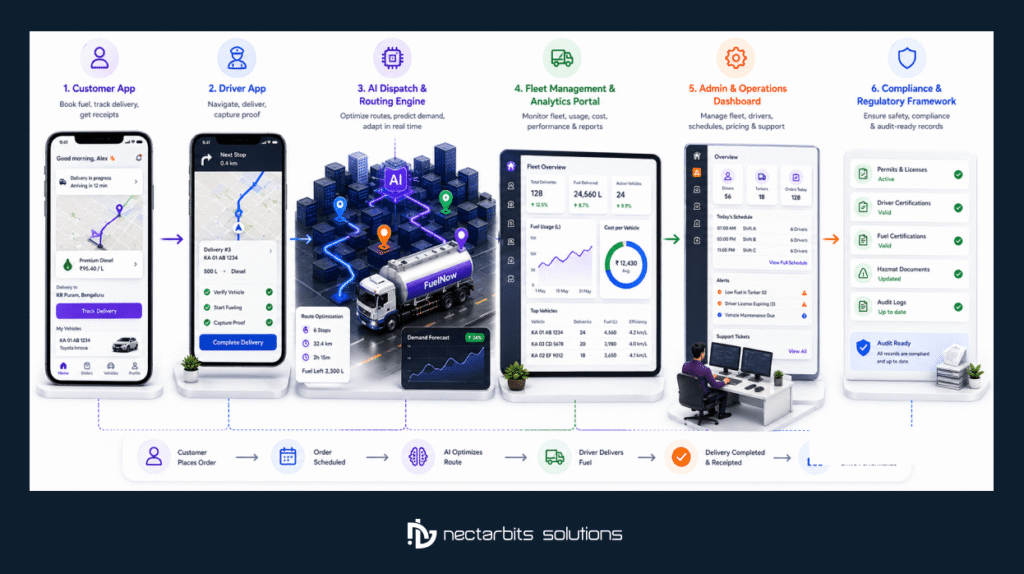
Here are the six core components of a Booster-comparable platform:
1. Customer App: iOS and Android
Vehicle registration by license plate, fuel type selection, location pinning and GPS-based address confirmation, delivery scheduling (one-time or recurring), real-time delivery tracking, push notifications, and digital receipts. The consumer experience needs to be frictionless — most users should complete their first order in under 90 seconds. This is where mobile app development decisions around platform (native vs cross-platform), UX flow, and real-time data architecture have the biggest direct impact on user adoption and retention.
2. Driver App: Navigation and Delivery Management
Turn-by-turn navigation to delivery sequence, vehicle identification via license plate scanner, fuel type confirmation, digital delivery log, IoT integration for precise volume measurement, and end-of-shift reporting. The driver experience determines delivery throughput — poor UX here costs deliveries per hour.
3. AI Dispatch and Routing Engine
Multi-stop route optimization accounting for traffic, delivery windows, fuel tank capacity, and parking logistics. Predictive demand modeling based on fleet schedules and historical patterns. Real-time resequencing when conditions change mid-shift. This is the hardest component to build and the most valuable once built.
4. Fleet Management and Analytics Portal
Multi-vehicle scheduling dashboard, delivery history and digital receipts per vehicle, usage reporting and cost-per-vehicle analytics, carbon offset tracking, invoice management, and API integration with telematics systems (Geotab, Samsara). Enterprise clients will not sign long-term contracts without this portal.
5. Admin and Operations Dashboard
Tanker fleet management, driver scheduling and shift management, city-level compliance documentation, pricing configuration per client and fuel type, financial reporting, and customer support tools. This backend layer runs the business.
6. Compliance and Regulatory Framework
City and state permit management, Hazmat documentation, DEF and renewable fuel certification tracking, driver certification records, and audit-ready transaction logs. Without this layer, you cannot operate legally in regulated markets.
If you are scoping a build, understanding how much a fuel delivery app costs to develop in 2026, broken down by component, platform, and market, is the right starting point before any development conversation
Best Markets to Launch a Fuel Delivery App in 2026
The global mobile fuel delivery market is valued at $6.2 billion in 2026 and is projected to reach $10.1 billion by 2033, growing at a CAGR of 7.3%. North America leads, but the fastest-growing opportunities are in markets where Booster does not operate, and where first-mover advantage is still wide open.
Three markets stand out for entrepreneurs and fuel businesses looking to replicate the Booster model: Canada, the UAE, and South Africa.
🇨🇦 Canada: Untapped Enterprise Fleet Market
Canada is an ideal replication market for on-demand fuel delivery, with strong structural and regulatory advantages.
- The market is governed by the Transportation of Dangerous Goods (TDG) Act at the federal level, providing a unified compliance framework that is easier and more cost-effective to scale than the US.
- High fleet density in regions like Greater Toronto, Greater Vancouver, and Calgary makes unit economics viable from the start.
- Industries such as logistics, construction, utilities, and healthcare face the same hidden fueling inefficiencies seen in the US.
- Harsh winters (down to -25°C) make on-site fuel delivery even more valuable, eliminating the need for drivers to refuel in extreme conditions.
The opportunity: No Canadian company has yet replicated Booster’s enterprise fleet model at a national scale. The first mover that builds TDG-compliant software and wins the first two or three major fleet contracts in Toronto or Vancouver will have a significant head start.
🇦🇪 UAE: High-Growth On-Demand Fuel Delivery Market
The UAE is one of the most advanced markets for on-demand fuel delivery, already proving strong real-world success.
- CAFU, founded in Dubai in 2018, delivers millions of litres and has expanded into car wash, oil change, battery, and tyre services — evolving into a full mobile car-care platform.
- High temperatures (45°C+), strong smartphone penetration, and high vehicle ownership make convenience-driven services highly attractive.
- The commercial fleet segment (construction, logistics, hospitality, tourism) remains less saturated, where fuel delays directly impact operations and costs.
- The Booster-style AI-driven B2B fleet fueling model is still largely untapped in the UAE market.
- The sector is regulated by the Ministry of Energy and Infrastructure and local authorities, creating a structured but opportunity-rich environment for early entrants.
The opportunity: A Booster-equivalent B2B fleet platform in Dubai and Abu Dhabi, built on proven software architecture, targeting logistics, construction, and hospitality fleet operators, with Arabic-language UX and local payment gateway integration. This is one of the highest-potential fuel delivery markets in the world right now.
Read more: How CAFU and the top fuel delivery apps are reshaping on-demand fueling in the UAE and globally →
🇿🇦 South Africa: Underserved Diesel Fleet Opportunity
South Africa is an emerging and deeply underserved fuel delivery market, where existing challenges create a strong first-mover opportunity.
- The African fuel delivery market is projected to grow from $3.7B to $5.2B by 2025 (5.69% CAGR), driven by logistics, mining, agriculture, and construction. South Africa leads with strong infrastructure and the largest fleet base.
- Fleet operators face major issues like fuel theft and fraud via fuel cards. Diesel dominates across mining, construction, manufacturing, and agriculture, making high-volume delivery highly viable.
- FuelBuddy’s expansion into Zimbabwe and Zambia confirms the model works in Africa, positioning South Africa as the next key market with better infrastructure.
- The industry is regulated under the Petroleum Products Act, requiring licences, with government support through tax breaks and investment incentives.
The opportunity: An on-demand fleet fuel delivery platform targeting South Africa’s mining, construction, and logistics sectors, where diesel fraud elimination alone generates a compelling business case, built on proven mobile delivery software with ZAR payment integration and local compliance architecture.
What Stays the Same and What Adapts Per Market
| Platform Component | Same Everywhere | Adapts Per Market |
| Core app architecture | Yes | — |
| AI route optimization | Yes | — |
| Real-time GPS tracking | Yes | — |
| Fleet analytics dashboard | Yes | — |
| Driver app | Yes | — |
| Language and currency | — | Local (Arabic, Afrikaans/English, French) |
| Payment gateway | — | Local (PayFast/SA, Stripe/CA, UAE payment rails) |
| Compliance framework | — | Fully custom per jurisdiction |
| Driver certification | — | Local licensing requirements |
The software stack is universal. The regulatory and localisation layer is always market-specific, and that is exactly where Nectarbits’ experience building for multiple jurisdictions becomes the differentiator.
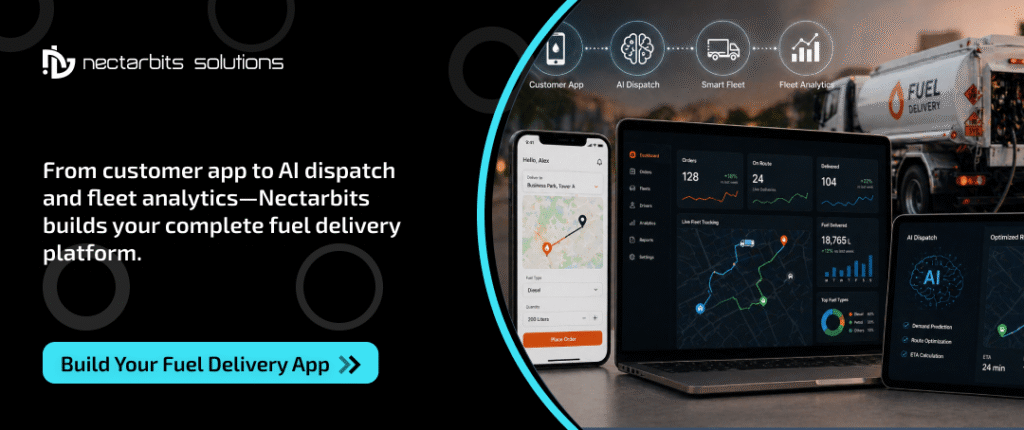
Want to Build a Fuel Delivery Platform? Here’s What Nectarbits Builds
At Nectarbits, we are a custom fuel delivery app development company based in Surrey, BC, Canada. We specialize in building on-demand fuel delivery platforms, from MVP-stage startups to full enterprise-grade systems, for clients across Canada, the USA, the UAE, South Africa, and globally.
We have built real fuel delivery platforms and understand both the software architecture and the market-specific regulatory requirements that determine whether a fuel delivery business succeeds or fails, whether that is TDG Act compliance in Canada, Ministry of Energy regulations in the UAE, or Petroleum Products Act licensing in South Africa.
If you are based in the UAE or South Africa, you are in one of the highest-growth fuel delivery markets in the world right now, with significantly less competition than in North America. We have worked with clients in both regions and understand the local compliance, payment, and language requirements needed to launch and scale.
Our fuel delivery development services:
- Custom iOS and Android customer and driver apps
- AI-powered route optimization and dispatch systems
- Real-time GPS tracking and live operations dashboards
- Fleet management and analytics portals (Booster Insights-equivalent)
- Compliance-ready architecture for Canada (TDG Act), USA (DOT/EPA), UAE (Ministry of Energy), South Africa (Petroleum Products Act), and other jurisdictions
- Arabic, French, and Afrikaans language support for regional markets
- Local payment gateway integrations (Stripe, PayFast SA, UAE payment rails, Interac CA)
- Telematics integrations (Geotab, Samsara, Verizon Connect)
- White-label solutions for fast launch
- Full custom SaaS platforms for long-term scale
Whether you want to replicate Booster’s enterprise fleet model, build a CAFU-style consumer and fleet hybrid for the UAE, or launch a diesel fleet platform for South Africa’s mining and logistics sector, we have the engineering depth and fuel industry experience to build it right.
Conclusion: What Booster Fuels Proves About Fuel Delivery App Development
Booster didn’t disrupt the fuel industry by offering cheaper fuel; it transformed it by eliminating the need for gas stations. By turning fuel delivery into a software-driven, on-demand logistics system, it fits seamlessly into how modern fleets operate.
The real value isn’t just in the fuel price, but in the massive operational savings, reducing hidden costs and improving efficiency across fleet operations. This proves that the model is not just about fuel delivery, but about building a scalable, efficiency-driven business powered by technology.
With AI routing, real-time tracking, and fleet analytics now more accessible than ever, this model can be replicated in emerging markets like Canada, the UAE, and South Africa. For businesses entering this space, the biggest opportunity lies in moving early and building the right tech foundation.
Frequently Asked Questions:
1. How Does the Booster Fuels Business Model Work?
Booster buys fuel wholesale directly from terminals, loads it into custom Smart Tanker trucks, and delivers it to fleet vehicles and corporate campuses using AI-optimized routes — charging clients a competitive per-gallon price plus a delivery fee. The business makes money on the fuel margin, delivery fees, specialty fuel upcharges, and renewable energy incentives.
2. What Fuel Types Does Booster Deliver?
Booster delivers regular gasoline, premium gasoline, diesel, ultra-low sulfur diesel, renewable diesel, biodiesel blends, and DEF (Diesel Exhaust Fluid). Renewable diesel is sourced through their partnership with Renewable Energy Group (REG) — North America’s largest biofuel supplier.
3. Can I Build a Fuel Delivery App in Canada?
Yes. Canada’s federal Transportation of Dangerous Goods (TDG) Act provides the compliance baseline for fuel logistics, with provincial variations for environmental regulations. The software architecture of a Booster-style platform is fully replicable. Nectarbits is a Canadian fuel delivery app development company with specific experience in TDG-compliant platform architecture and Canadian market requirements.
4. How Much Does Fuel Delivery App Development Cost in 2026?
A mid-tier custom fuel delivery platform (customer app, driver app, fleet portal, basic route optimization, and admin dashboard) typically ranges from $84,000 to $180,000. A full enterprise-grade platform with advanced AI routing, analytics, and telematics integrations ranges from $180,000 to $350,000+.
5. Is the On-Demand Fuel Delivery Model Profitable?
Yes, when built around the right customer segment. The model is highly profitable at B2B fleet scale because high-density deliveries (50+ vehicles per stop) maximize tanker utilization. Consumer-facing models (fueling individual parked cars across residential areas) are much harder to make economically because delivery density is low. Start with commercial fleets, not individual consumers.