
The global mobile fuel delivery market is valued at approximately $5.8 billion in 2026 and is projected to reach $10.1 billion by 2035, growing at a CAGR of 7.1%. Yet for every Booster Fuels or EzFill that breaks through, dozens of fuel delivery startups disappear within their first two years, not because their app was broken, but because their marketing was.
Marketing a fuel delivery app is fundamentally different from marketing any other on-demand service. You are selling a hazardous product delivery to safety-conscious consumers, navigating strict regulatory environments, competing in hyper-local geographies, and serving two completely different customer types, individual drivers and commercial fleet operators, each of whom needs a different message, a different channel, and a different funnel.
This guide covers the complete fuel delivery app marketing strategy for 2026: how to acquire your first 100 users, how to win fleet contracts that generate recurring revenue, which channels deliver the best ROI, and how to retain customers long-term. Whether you are planning an on-demand fuel delivery app development project or already have a live product, this is the playbook.
Quick answer: The most effective fuel delivery app marketing strategy combines B2B fleet outreach (LinkedIn, direct sales, partnerships) for immediate recurring revenue, with B2C digital marketing (Google Ads, local SEO, referral programs) to build consumer density. Launch B2B first, then scale B2C.
What Is a Fuel Delivery App – and Why Marketing It Is Uniquely Hard
A fuel delivery app is a mobile platform that connects users who need fuel with licensed service providers that deliver it directly to their vehicles, fleet yards, or job sites. Think of it as the on-demand economy applied to refueling: users place an order, and a certified tanker arrives at the location. The vehicle is fueled without the driver ever visiting a gas station.
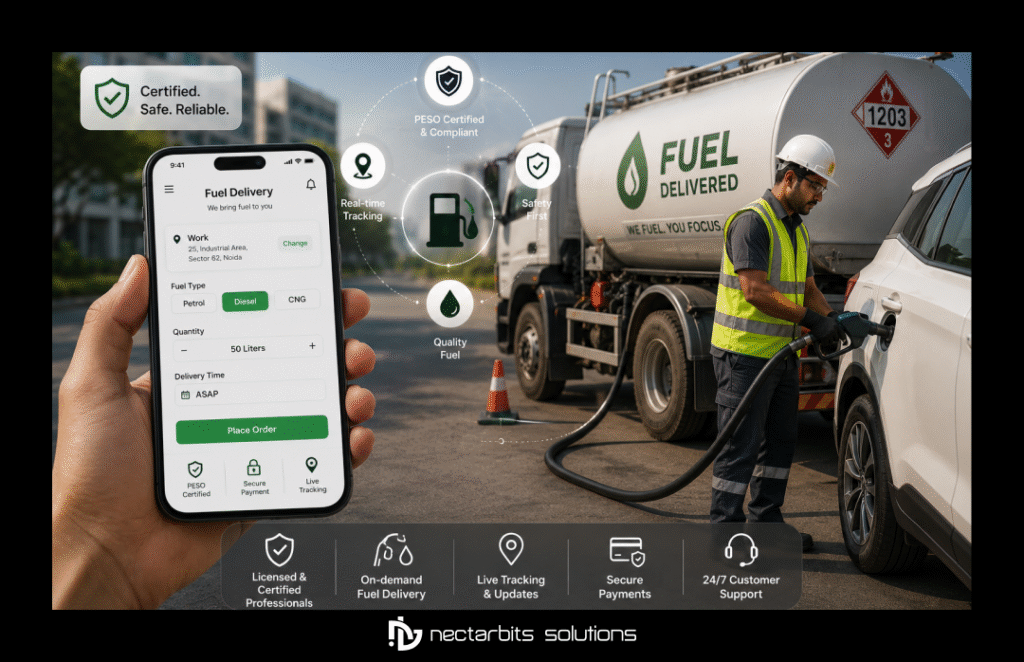
The model serves two distinct segments. B2C (Business-to-Consumer) means individual car owners ordering a tank-top at home, at work, or at a parking lot. B2B (Business-to-Business) means fleet operators, construction companies, logistics firms, ride-share fleets, and corporate campuses ordering bulk fuel deliveries on a scheduled or on-demand basis.
Here is why fuel delivery app marketing is harder than marketing a food delivery or ride-share app:
Safety perception barrier. Fuel is flammable and regulated. Before a new customer books their first delivery, they need to trust that your service is professional, certified, and safe. That trust takes more marketing investment to build than convincing someone to try a new pizza app.
Hyper-local geographic constraints. Unlike a food delivery app solution that can market city-wide on day one, a fuel delivery service only works where you have delivery density, enough orders in a small enough area to make each route economically viable. Marketing in areas you cannot yet serve profitably is money burned.
Regulatory complexity as a trust signal. PESO certification in India stopped MyPetrolPump for an entire year. DOT and HAZMAT compliance in North America shapes how you can even advertise fuel delivery in certain jurisdictions. Your marketing must proactively communicate compliance to convert safety-conscious customers.
Long B2B sales cycles. Winning a fleet contract from a logistics company or construction firm takes weeks of relationship-building. It is not a one-click conversion. Your B2B marketing funnel needs to nurture leads over time, not just drive impulse downloads.
Understanding these constraints is the first step. The second step is knowing exactly who you are marketing to.
The Two Audiences You Must Market to Differently: B2C Drivers vs B2B Fleet Operators
The biggest marketing mistake fuel delivery startups make is treating all potential customers as the same audience. They are not. Your B2C and B2B funnels need separate messaging, separate channels, and separate KPIs.
B2C: The Individual Driver
The typical B2C customer is an urban or suburban professional, aged 25–45, who values time over the marginal cost difference between pump pricing and delivery pricing. Their trigger is convenience: a busy week, an empty tank, a forgotten fill-up before a long drive. They find your app through Google (“gas delivery near me”), social media ads, or a referral from a friend.
Their decision journey is short: they see the ad, check the reviews, download the app, and either book immediately or within a week. Retention depends on how seamless the first experience was and whether your push notification strategy brings them back before they forget you exist.
Key B2C marketing levers: Google Ads on high-intent local keywords, Meta retargeting, referral programs, App Store Optimization, and push notifications timed to low-tank moments (typically Sunday evenings and Monday mornings). If you are planning to expand beyond your first market, understanding how to scale a fuel delivery business before you increase ad spend will save you significant budget.
B2B: The Fleet Manager or Operations Director
The typical B2B prospect manages a fleet of 20 to 500 vehicles and is currently dealing with: drivers wasting 40 minutes per day driving to fuel stations, fuel card fraud, inconsistent fuel logs, and idle time at pumps. They are not looking for convenience; they are looking for a cost reduction and an operational efficiency gain.
They discover you through LinkedIn, direct outreach from your sales team, an industry conference, or a referral from another fleet operator. Their decision journey is 4 to 12 weeks and involves a demo, a pilot program, a procurement review, and sometimes a legal contract.
Key B2B marketing levers: LinkedIn advertising targeting Fleet Managers and Director of Operations titles, direct email outreach with ROI calculators, partnership with fleet management software platforms like Fleetio, Samsara, and Verizon Connect, and case studies showing measurable time and cost savings.
Should You Launch B2B or B2C First?
The data is clear: launch B2B first. Fleet contracts provide predictable, high-volume, recurring orders that make your delivery routes economically viable from day one. Once you have delivery density from fleet clients, adding B2C consumers on top of existing routes costs almost nothing incrementally. Booster Fuels validated this model — they launched by winning corporate campus contracts with Cisco, Oracle, and early-stage tech companies before ever opening to the general public.
B2C-first is the harder path: you need high marketing spend to drive enough individual orders per zone to cover your delivery costs, and you will likely burn cash in low-density areas before you figure out which neighborhoods actually convert. If you are at the stage of deciding which path to take, our fuel delivery app development solution is built to support both go-to-market models from a single platform.
SEO & ASO Strategy: How to Get Found Before Your Competitors
A dedicated SEO and App Store Optimization strategy is the biggest gap in this entire niche. Not a single competitor blog covers how to rank a fuel delivery app in Google Search and the App Store. Here is the full playbook.
Keyword Clusters to Own
Start with three keyword tiers:
Informational keywords attract founders and operators researching the space: “fuel delivery app marketing strategy,” “how to market a fuel delivery app,” “on-demand fuel delivery app development,” “Booster Fuels marketing strategy.”
Local intent keywords capture ready-to-buy consumers: “gas delivery near me,” “fuel delivery [city name],” “propane delivery near me,” “diesel delivery app Canada,” “emergency fuel delivery [city].” These are high-converting and have almost no competition at the city level.
Commercial keywords convert prospects evaluating a build or partner decision: “fuel delivery app development company Canada,” “on-demand fuel delivery app development,” “white label fuel delivery app.”
For a new market launch, prioritize local intent keywords first. They have lower difficulty, higher purchase intent, and they are the exact terms your first 100 B2C customers will type.
Local SEO: The Channel Everyone Ignores
Every fuel delivery app is, by definition, a local business. Yet most companies market nationally and ignore the local SEO signals that Google uses to rank location-based searches.
Set up and fully optimize a Google Business Profile for every city you operate in. Use the “fuel delivery service” primary category. Post weekly updates with delivery area coverage maps, fuel pricing, and safety certifications. Collect Google reviews proactively after every delivery, your target is 50+ reviews per market within the first three months.
Build location pages on your website structured as: yourapp.com/fuel-delivery-[city]. Each page should include the coverage area map, local fuel pricing, and regulatory compliance details specific to that city or province. This last point matters more than most founders realize; the compliance requirements in Dubai differ significantly from those in Johannesburg, and getting that detail right on your local pages builds the trust that converts. Our breakdown of fuel delivery regulations across key markets is a useful reference when building these pages for international markets.
Target voice search queries explicitly. “Hey Google, find fuel delivery near me” is a growing search behavior, especially among fleet dispatchers who are hands-free on a job site. Structure your local pages with clear, direct answers to “what is your delivery radius” and “how fast can you deliver fuel.”
App Store Optimization (ASO)
According to Apple, 65% of App Store downloads happen directly after a search. If your app is not optimized for search within the App Store and Google Play, you are invisible to more than half of your potential users.
App title: Include your primary keyword naturally. “FuelNow, On Demand Gas Delivery” ranks for “gas delivery” and “on demand fuel” in the App Store keyword index.
Subtitle (iOS) / Short Description (Android): Use your second most important keyword cluster here. “Fuel delivered to your car, fleet or job site” covers multiple intent segments in 60 characters.
Keyword field (iOS): This is invisible to users but critical for rankings. Use: “gas delivery, diesel delivery, fleet fuel, propane delivery, mobile fueling, fuel on demand, emergency fuel.” Do not repeat words already in your title.
Screenshots: Your first screenshot should show the core value proposition — “Fuel delivered in 45 minutes”, with a map showing coverage. Conversion rates from app page view to install improve by 25–35% with a strong first screenshot. For a real-world benchmark of what a high-converting fuel app listing looks like in practice.
Our breakdown of what it takes to build an on-demand fuel delivery app like CAFU walks through the product decisions that directly affect store performance.
Reviews strategy: After each successful delivery, send an in-app prompt asking for a rating. A 4.5+ star rating with 100+ reviews is the threshold where your conversion rate stabilizes. Reviews also function as an ASO ranking signal; apps with more recent reviews rank higher.
Best Marketing Channels Ranked by ROI – With Real CAC Benchmarks
Not all acquisition channels work equally for fuel delivery. Here is a data-backed ranking based on what has worked across on-demand delivery platforms and what the fuel delivery category specifically demands.
Channel Performance Table
| Channel | B2C CAC Range | B2B CAC Range | Best For |
| Google Search Ads | $15–$50 | $80–$200 | High-intent “near me” queries |
| Referral Program | $8–$20 | $30–$80 | Expanding in a proven market |
| Direct B2B Outreach | N/A | $25–$150 | Fleet contract acquisition |
| Meta (Facebook/Instagram) | $25–$80 | $150–$400 | B2C brand awareness + retargeting |
| LinkedIn Ads | $80–$200 | $100–$300 | Fleet managers, logistics directors |
| App Store Organic (ASO) | $0–$5 | N/A | Long-term low-cost installs |
| Local SEO / Google Business | $0–$10 | N/A | City-level organic visibility |
| Industry Partnerships | $5–$30 | $10–$50 | Fleet platforms, insurance, parking |
CAC estimates based on on-demand delivery industry benchmarks and fuel sector data. Your actual numbers will vary by market density and campaign optimization.
Google Search Ads: Your Highest-Intent Channel
Google Search Ads targeting local fuel delivery keywords consistently produce the best B2C results because the user is actively searching for exactly what you offer. Someone typing “gas delivery near me” on their phone at 8 pm is one tap from converting.
Bid on exact match and phrase match for: “[city] fuel delivery,” “on demand gas delivery,” “fuel delivered to my car,” and emergency variants like “ran out of gas [city].” Keep your geographic targeting tight, within your actual delivery radius. Wasted spend on areas you cannot serve is the fastest way to blow a budget.
Target ROAS for fuel delivery apps on Google Search: 3:1 to 5:1. If you are not hitting 3:1 after 90 days of optimization, your performance marketing and landing page strategy needs to change, not your budget.
Referral Programs: The Highest LTV Channel
On-demand apps consistently report that referred users have 3 to 5 times higher lifetime value than paid-acquisition users. They convert faster, churn slower, and refer others at a higher rate. A simple “give $5, get $5” referral program for B2C, or “refer a fleet and earn a free month of service” for B2B, is the single highest-ROI growth lever available to a fuel delivery startup after initial traction.
EzFill used referral loops aggressively in their early Florida expansion; the data from their NASDAQ filings shows rapid fleet account growth that is consistent with high referral activity among commercial clients.
LinkedIn Ads for B2B Fleet Acquisition
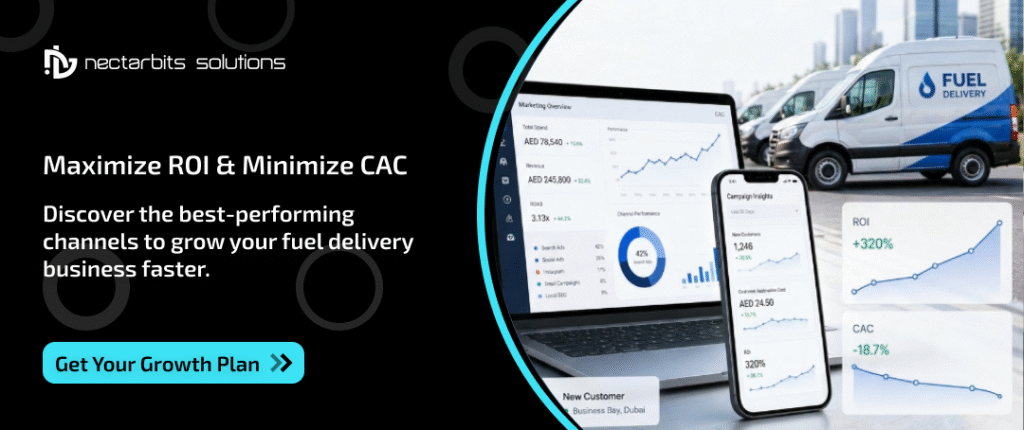
LinkedIn is the only platform where you can target by job title (Fleet Manager, Director of Operations, VP of Logistics), company size (50–500 employees), and industry (construction, transportation, logistics). This precision makes it the most cost-effective B2B channel despite higher CPCs.
Your LinkedIn ad creative should lead with a cost-saving angle, not a convenience angle. Fleet managers are not buying convenience; they are buying operational efficiency. The best-performing ad formats for B2B fuel delivery on LinkedIn are:
Carousel posts showing “Before vs After” daily fuel logistics (drivers losing 35 minutes at the pump vs. fueled at the yard overnight).
Document ads giving away a free “Fleet Fuel Cost Calculator” PDF. Fleet managers download this, you capture their email, and you have a warm lead.
Sponsored content sharing case studies: “How a 45-truck logistics company reduced fuel admin costs by 28% in 90 days.”
Target hashtags to include organically in company page posts: #FleetManagement, #FuelTech, #OnDemandFuel, #LogisticsTech, #FleetOperations.
Social Media Playbook: What to Post, Where, and How Often
Social media for a fuel delivery app is not about going viral. It is about being present where your target customers already are and building the trust signals they need before they commit to a first delivery.
Instagram and TikTok (B2C): Short video content works best. Film an actual delivery, the tanker arriving, the fuel hose connecting, the driver’s reaction. “Fueled your car while you were in a meeting” content performs exceptionally well because it makes the abstract concept tangible. Post 3–4 times per week. Behind-the-scenes content (safety certifications, driver training, tanker maintenance) builds the trust signals that overcome the safety perception barrier. TikTok founder-story content, “We built an app so you never have to stop at a gas station again”, earns organic reach that paid posts cannot replicate.
LinkedIn (B2B): Post twice per week minimum. Mix content types: original articles about fleet fuel management trends, ROI case studies from existing clients (anonymized if needed), industry news commentary, and direct-value posts like “5 signs your fleet fuel management is costing you more than it should.” Every post should end with a soft question that invites fleet managers to engage: “How does your company handle weekend fueling for field teams?”
Reddit (Community Play): Reddit requires a value-first approach. Never post promotional content. Instead, participate authentically in r/startups, r/Entrepreneur, r/fleetmanagement, and r/mobileapps. Share what you learned during custom fuel delivery app development, what surprised you about customer acquisition, what data you collected, and what you would do differently. When someone asks a question your product solves, answer the question fully; the link to your app, if it comes at all, should be a footnote, not the headline.
Twitter/X (Real-Time): Post real-time fuel price alerts for your city, delivery availability updates, and quick tips for fleet managers. The conversational nature of Twitter/X makes it ideal for building a personality around your brand and engaging directly with logistics and fleet management communities.
Real Startup Case Studies: What Booster, EzFill, Yoshi & MyPetrolPump Actually Did
These are not generic “lessons from successful companies” summaries. These are specific, replicable marketing moves extracted from each company’s actual growth story.
Booster Fuels: The B2B-First Playbook
Booster launched in 2015 by targeting corporate campuses, tech companies in Silicon Valley where thousands of employees park in the same lots every day. Instead of marketing to individual consumers, they marketed to HR and Facilities teams with a single value proposition: “We keep your employees’ tanks full so they spend more time at work and less time at the gas station.”
The marketing insight was brilliant: the buyer (the company) and the user (the employee) are different people. Booster sold the employer on a productivity benefit, then the employee became a daily user automatically. This B2B-first approach gave Booster a guaranteed high-density customer base in a small geographic area, the exact conditions needed to make fuel delivery economics work.
Today, Booster serves Amazon, UPS, FedEx, and Walmart across 28 US states, generating revenues approaching $92 million. The entire growth arc traces back to that initial B2B-first go-to-market decision. For your detailed analysis of the Booster business model.
See our: Booster Fuels business model breakdown
Replicable takeaway: Don’t market to individuals first. Find the organization that employs or concentrates your individual users, and sell to them as a group benefit or operational service.
Yoshi Mobility: Subscription Revenue + Investor Star Power
Yoshi raised $74.6 million from investors including General Motors Ventures, Bridgestone Americas, ExxonMobil, and high-profile individuals including NBA All-Star Kevin Durant and Joe Montana. The diversity of their investor base was itself a marketing asset — press coverage of “Kevin Durant backs a fuel delivery app” generated organic downloads that no paid campaign could have bought at the same cost.
Their $16/month subscription model was a marketing masterstroke for retention. Once a user is paying a monthly subscription fee, their psychological commitment to the service is dramatically higher than a pay-per-delivery user. They use the app more frequently to justify the cost; they refer friends more often (referral justifies the subscription to themselves), and they churn at a fraction of the rate.
In December 2024, Yoshi’s fuel division was acquired by EzFill Holdings, allowing Yoshi to pivot to mobile EV charging and automotive services, a segment also seeing rapid EV charging app development demand globally. The acquisition validated the model: EzFill paid for Yoshi’s assets, 26 trucks, commercial fleet accounts, and a footprint in California, Michigan, Tennessee, and Texas.
Read our: Yoshi Mobility business model breakdown
Replicable takeaway: A subscription model converts one-time users into recurring revenue and dramatically reduces churn. If your pricing model only offers pay-per-delivery, you are leaving LTV on the table.
EzFill: IPO + Acquisition as a Growth Strategy
EzFill went public on NASDAQ (ticker: EZFL), becoming one of the first on-demand fuel delivery apps to reach public markets. Their IPO was itself a massive marketing event — every press release, every earnings call, every analyst coverage became organic brand awareness that accelerated B2B sales. Fleet operators who saw EzFill on NASDAQ trusted the brand in a way that a private startup with the same product could not replicate.
EzFill’s acquisition of Yoshi’s fuel division in December 2024 added 26 trucks, 50+ commercial fleet accounts, and operations in four new states overnight. The marketing lesson: acquiring a competitor’s customer base and geographic footprint is sometimes faster and cheaper than organic customer acquisition.
Their “Orange Dawn” ad campaign targeted Florida consumers with high local TV and digital reach, establishing brand recognition before aggressive B2B sales outreach in the same markets. The sequence- build brand awareness first, then convert warm prospects to B2B accounts- is a playbook any funded startup can replicate.
Replicable takeaway: Use PR events (funding rounds, partnerships, regulatory approvals) as free marketing moments. Every announcement is a press release, a LinkedIn post, a reason to reach out to every warm prospect in your pipeline.
MyPetrolPump: The Regulatory Compliance Marketing Lesson
MyPetrolPump launched in Bengaluru, India, in 2017 and raised $1.6 million in funding. They then spent an entire year unable to operate because PESO (Petroleum and Explosives Safety Organization) issued orders preventing fuel suppliers from servicing the company. They survived by redesigning their tanker trucks to meet every safety requirement, and ultimately received full government support.
The marketing lesson is counterintuitive: your compliance story is a competitive advantage, not just a legal checkbox. MyPetrolPump came out of their regulatory battle with a narrative of “we worked with the government to make doorstep fuel delivery safe and legal.” That story built enormous consumer trust and effectively shut out less compliant competitors.
Replicable takeaway: Proactively communicate your safety certifications, regulatory approvals, and compliance measures in your marketing. It converts safety-conscious consumers and transportation and logistics operators who need documented proof of compliance before onboarding a vendor.
Filld: The Delivery Density Failure Lesson
Filld launched with strong VC backing and consumer-facing marketing in multiple US cities simultaneously. Their fatal marketing error was expanding their geographic footprint before achieving delivery density in any single market. With too few orders spread across too large an area, each delivery became uneconomical. The unit economics never worked, and the company eventually shut down.
Replicable takeaway: Never market in an area you cannot profitably serve. The correct sequence is: achieve density in one market → prove unit economics → expand to the next market. Premature geographic marketing is how fuel delivery startups die.
Read More: Filld App Case Study – How Fleet Fuel Delivery Works at the Platform Level
Retention & Repeat Orders: Turning One-Time Users into Subscribers
Acquiring a customer costs $15–$80. Retaining a customer costs almost nothing. Yet most fuel delivery app marketing budgets allocate 95% to acquisition and 5% to retention — exactly backwards for a business where repeat orders are the entire profit model.
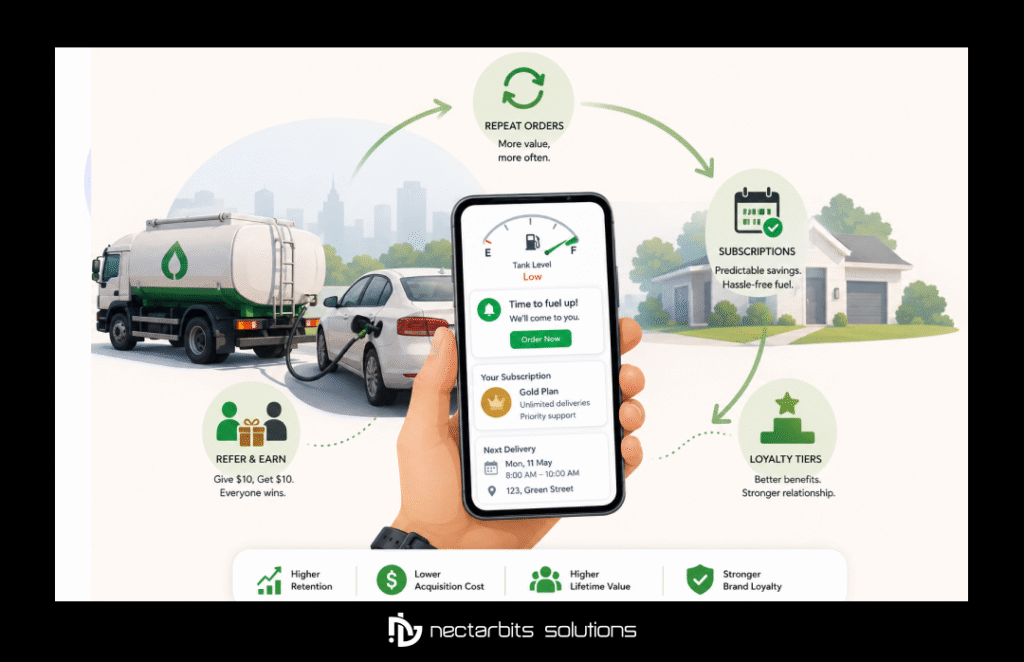
Subscription tiers are the most effective retention tool in the category. Yoshi proved it at $16/month for individual users. For B2B, monthly or annual fleet contracts with a slight volume discount over pay-per-delivery convert one-time pilots into locked-in revenue. If you want a faster path to launch while investing more budget into retention campaigns, a white-label on-demand delivery solution can get your platform live in weeks rather than months.
Push notification strategy: timed and contextual, is your second most powerful retention lever. The ideal push notification for a B2C fuel delivery user arrives on a Sunday evening or Monday morning, when tanks are typically lowest after weekend driving, and reads something like: “Good morning, your estimated tank level is low based on your last fill-up 12 days ago. Schedule a delivery for this morning?” That is not an ad. That is a useful service reminder. Open rates on contextual fuel notifications run 2 to 3 times higher than generic promotional pushes.
Referral programs designed specifically for your user type convert remarkably well. For B2C: “Give a friend $10 off their first delivery, get $10 credit when they book.” For B2B: “Refer a fleet operator, earn one free month of service.” Referred users on on-demand platforms show 3 to 5 times higher LTV because they come with a pre-existing trust signal from their referrer.
Loyalty tiers keep high-frequency B2C users engaged. A “Silver / Gold / Platinum” structure based on number of deliveries per quarter, with escalating benefits like priority delivery windows, locked-in pricing, or a dedicated customer success contact for Gold and Platinum, creates switching costs that make churn psychologically harder. Operators managing loyalty programs, pricing rules, and recurring service plans across multiple accounts find that automating these workflows significantly reduces the manual overhead as the customer base grows.
Measuring Marketing ROI: KPIs Every Fuel Delivery Founder Must Track
The single biggest gap in this entire niche is that nobody publishes actual benchmarks. Here are the metrics that matter, with realistic targets for a fuel delivery app in its first 12 months.
Core Marketing KPIs
| Metric | B2C Benchmark | B2B Benchmark | Why It Matters |
| Customer Acquisition Cost (CAC) | $15–$50 | $80–$300 | Primary efficiency metric |
| Customer Lifetime Value (LTV) | $150–$600 | $5,000–$50,000 | Determines max sustainable CAC |
| LTV: CAC Ratio | Minimum 3:1 | Minimum 5:1 | Below 3:1 = unprofitable growth |
| Month 1 Retention Rate | 40–55% | 70–85% | Core product-market fit signal |
| Referral Rate | 15–25% | 10–20% | Indicates NPS and word-of-mouth |
| Google Ads Conversion Rate | 3–6% | 1.5–3% | Typical for high-intent local search |
| App Install-to-First-Order Rate | 35–55% | N/A | Onboarding effectiveness |
| Delivery Density Threshold | 8+ orders/zip code/week | N/A | Minimum for unit economics |
The delivery density threshold is the metric almost no marketing guide mentions, but it is the most operationally important number. If you are running ads in a zip code where you are generating fewer than 8 orders per week, your delivery costs exceed your revenue per delivery. Pull back marketing in that zone and concentrate spend on your highest-density areas until you cross the threshold.
LTV: CAC ratio is your north star metric. Below 3:1 means you are spending more acquiring customers than they generate in value. Above 5:1 means you could actually afford to spend more on marketing and still be profitable, a signal to increase your budget, not cut it. Tracking these numbers becomes significantly easier when you have advanced reporting and analytics tools that surface them automatically rather than requiring manual reconciliation across spreadsheets.
7 Marketing Mistakes That Kill Fuel Delivery Apps
These are not hypothetical warnings. Each one maps to a real company failure or a documented pain point from Reddit’s r/startups and LinkedIn’s fleet management communities.
Mistake 1: Marketing before achieving delivery density. Filld’s collapse is the definitive case study. Running Google Ads across an entire city when you only have the capacity to serve two zip codes profitably means you are acquiring customers you cannot actually serve well — and one bad experience at scale destroys your review score faster than any good campaign can recover it.
Mistake 2: Treating B2B and B2C as the same audience. A single landing page, a single ad campaign, and a single message for both individual drivers and fleet managers will convert neither. Fleet managers are not impressed by “order in 3 taps.” They care about compliance documentation, fleet reporting dashboards, and volume pricing. Build separate funnels.
Mistake 3: Ignoring App Store Optimization. You can spend $50,000 on Google Ads and neglect the fact that 65% of app downloads come from in-store search. A poorly optimized app listing loses half your potential organic installs before they even land on your paid ad landing page. This is especially critical for mobile app development projects targeting consumer audiences.
Mistake 4: No push notification strategy. An on-demand fuel delivery app without a contextual push notification strategy has a 60–70% churn rate within the first 90 days. Users forget you exist. A well-timed, contextual reminder (“your tank is probably running low — schedule a delivery?”) reduces 90-day churn by 20–30 percentage points.
Mistake 5: Marketing before regulatory compliance. MyPetrolPump spent a year unable to operate because they launched marketing before their operational compliance was airtight. Every consumer you attract before you are legally operational becomes a disappointed customer and a negative review.
Mistake 6: Skipping the compliance and safety narrative. Safety-conscious consumers do not spontaneously trust a stranger delivering flammable liquid to their parked car. Your marketing must proactively answer: “Is this safe? Is this legal? Are your drivers certified?” Competitors who skip this trust-building step have higher acquisition costs and lower conversion rates.
Mistake 7: Measuring only downloads, not delivery density. Downloads are a vanity metric for fuel delivery. A user who downloads your app and never orders in your current delivery radius was always going to churn. Track orders per zone, delivery density per zip code, and repeat order rate; those are the metrics that actually predict whether your marketing is building a viable business.
How Nectarbits Can Help You Build the App Worth Marketing
Every strategy in this guide assumes one thing: you have a fuel delivery app that is reliable, compliant, and ready to scale. Without the right technical foundation, even the best marketing strategy cannot compensate for crashes at checkout, GPS tracking failures, or a clunky onboarding flow that loses users before their first order.
At Nectarbits, we have spent years building on-demand fuel delivery platforms for founders and enterprises across Canada, the United States, and internationally. We understand the three-sided ecosystem a fuel delivery app requires: a consumer app, a driver app, and an admin dashboard, and how each component needs to be engineered with delivery density, route optimization, and compliance in mind from day one.
Our fuel delivery development work directly informs the marketing strategy advice in this guide. When we build the driver dispatch system, we build it so push notification triggers and delivery density analytics work from launch. When we design the consumer onboarding flow, we design it so App Store conversion rates are maximized. Development and marketing strategy are not separate disciplines; the best fuel delivery app development companies think about both simultaneously.
If you are at the planning stage, our fuel delivery app development solution walks through exactly what a 2026-ready fuel platform needs, with Canadian compliance considerations built in. If you are looking for a faster path to market, our white-label option at on-demand-app lets you skip months of development and invest that budget directly into user acquisition.For international founders researching the development landscape, our guide to on-demand fuel delivery app development covers global market considerations alongside technical requirements.
Conclusion: The Marketing Strategy That Wins in 2026
The fuel delivery app market is growing, the competition is real, and the difference between apps that scale and apps that shut down comes down to marketing discipline.
The strategy that works in 2026 is this: launch B2B first to build delivery density and recurring revenue, use Google Search Ads and local SEO to capture high-intent B2C consumers in your proven zones, optimize your App Store listing to capture organic installs you are currently leaving on the table, and invest in retention, subscriptions, push notifications, referral programs, so every hard-won customer generates the LTV that makes your CAC sustainable.
Study what Booster did with corporate campuses. Study what EzFill did with strategic acquisitions and a public listing as a marketing event. Understand why Filld failed so you do not repeat its mistake of marketing beyond your operational capacity.
Most importantly, build the app first, the right way, with compliance, route optimization, and analytics built in, before you spend a dollar on marketing. The best fuel delivery app marketing strategy in the world cannot save a product that fails on delivery.
For founders ready to build and market a fuel delivery app in Canada and beyond, the Nectarbits team has built what you are looking for.
Frequently Asked Questions:
Q1: How much does it cost to market a fuel delivery app?
Marketing budgets for fuel delivery apps vary significantly by stage. Early-stage startups (pre-traction, single city) typically spend $3,000–$10,000 per month across Google Ads, social media, and local SEO to acquire their first 200–500 users. Growth-stage companies (multiple cities, proven unit economics) spend $20,000–$100,000+ per month across all channels. The more important figure is CAC, if your B2C CAC is under $50 and your LTV exceeds $150, your marketing spend is on the right track regardless of the absolute number.
Q2: Should a fuel delivery app launch B2B or B2C first?
Launch B2B first. Fleet contracts provide high-volume, recurring, predictable orders that make your delivery routes economically viable before you spend on consumer acquisition. Booster Fuels used this approach, securing corporate campus contracts before opening to individual consumers, and it became the foundation of their $92M+ revenue business. Once your B2B fleet density covers your operational costs, B2C consumer marketing becomes highly profitable because the marginal cost of adding a consumer delivery to an already-running route is minimal.
Q3: What is the customer acquisition cost for a fuel delivery app?
Based on on-demand delivery industry benchmarks, B2C customer acquisition cost for a fuel delivery app typically ranges from $15 to $50 via Google Search Ads and $25 to $80 via Meta advertising. B2B fleet customer acquisition is higher — $80 to $300 — but the LTV of a fleet contract ($5,000–$50,000+ annually) makes this dramatically more profitable than consumer acquisition. Referral programs consistently produce the lowest CAC, ranging from $8 to $20 for B2C.
Q4: What SEO keywords should a fuel delivery app target?
Start with local intent keywords where competition is lowest and purchase intent is highest: “fuel delivery [your city],” “gas delivery near me,” “diesel delivery app [province/state],” and “emergency fuel delivery [city].” Add informational keywords to build topical authority: “how does on-demand fuel delivery work,” “is fuel delivery safe,” and “fuel delivery for fleet.” Optimize your App Store listing for “gas delivery,” “fuel on demand,” “mobile fueling,” and “fleet fuel delivery” — 65% of app downloads come from in-store search, and these terms have almost no ASO competition in the fuel category.
Q5: How do fuel delivery apps retain customers long term?
The most effective fuel delivery app retention strategies are: (1) subscription pricing — monthly plans like Yoshi’s $16/month model dramatically reduce churn by creating psychological commitment and usage frequency; (2) contextual push notifications timed to likely low-tank moments (Sunday evenings, Monday mornings) rather than generic promotional blasts; (3) referral programs that give existing users a tangible incentive to share the app with their network; and (4) loyalty tiers that reward high-frequency users with priority delivery windows, locked-in pricing, or dedicated support. Retained customers have 3–5 times higher LTV than churned-and-reacquired customers — retention investment is always higher ROI than acquisition spend.