
In the competitive landscape of fuel delivery, operational efficiency isn’t just an advantage; it’s a necessity. As customer expectations soar and profit margins tighten, fuel delivery businesses are turning to sophisticated fleet management software and fuel solutions to gain a competitive edge.
The numbers speak for themselves: According to a 2024 industry report published on PR Newswire, companies that implement comprehensive fleet management systems see an average 25–30% reduction in operational costs and a 35% improvement in delivery efficiency within the first year.
But here’s the challenge: Not all fleet management software is created equal. The difference between a basic tracking solution and a comprehensive fleet management software platform can mean the difference between struggling to stay profitable and dominating your market.
For fuel delivery businesses, the stakes are even higher. You’re not just delivering packages; you’re transporting hazardous materials, managing strict compliance requirements, optimizing routes in real-time, and ensuring driver safety while maintaining profitability. This comprehensive guide breaks down the essential features your Fleet Management Software must have to thrive in 2025 and beyond. Whether you’re evaluating new solutions or upgrading your existing system, these insights will help you make informed decisions that drive real business results.
Why Fleet Management Software is Critical for Fuel Delivery Operations
The Unique Challenges of Fuel Delivery
Unlike standard delivery operations, fuel delivery presents distinctive challenges:
1. Hazardous Material Handling: Fuel is classified as hazardous cargo, requiring strict safety protocols and compliance tracking.
2. High-Value Cargo: A single fuel tanker can carry $20,000-$50,000 worth of product, making theft and spillage prevention critical.
3. Regulatory Compliance: Multiple federal, state, and provincial regulations govern fuel transportation, from DOT requirements to environmental standards.
4. Time-Sensitive Deliveries: Emergency fuel deliveries and scheduled refills demand precise timing and route optimization.
5. Vehicle Maintenance Complexity: Fuel tankers require specialized maintenance, and downtime directly impacts revenue.
6. Liquid Cargo Management: Unlike package delivery, fuel logistics involves compartmentalized loads, precise dispensing measurement, and contamination prevention.
The Business Impact of Modern Fleet Management
Research from the American Transportation Research Institute shows that fleet management technology delivers measurable benefits:
- Fuel cost reduction: 10-15% through route optimization and driver behavior monitoring
- Maintenance costs: 20% decrease through predictive maintenance
- Insurance premiums: Up to 25% reduction with telematics data
- Driver productivity: 30% increase through efficient dispatching
- Customer satisfaction: 40% improvement with accurate ETAs and on-time delivery (Source: ATRI Fleet Technology Research)
Core Features Every Fuel Delivery Fleet Management System Must Have
1. Real-Time GPS Tracking and Vehicle Location
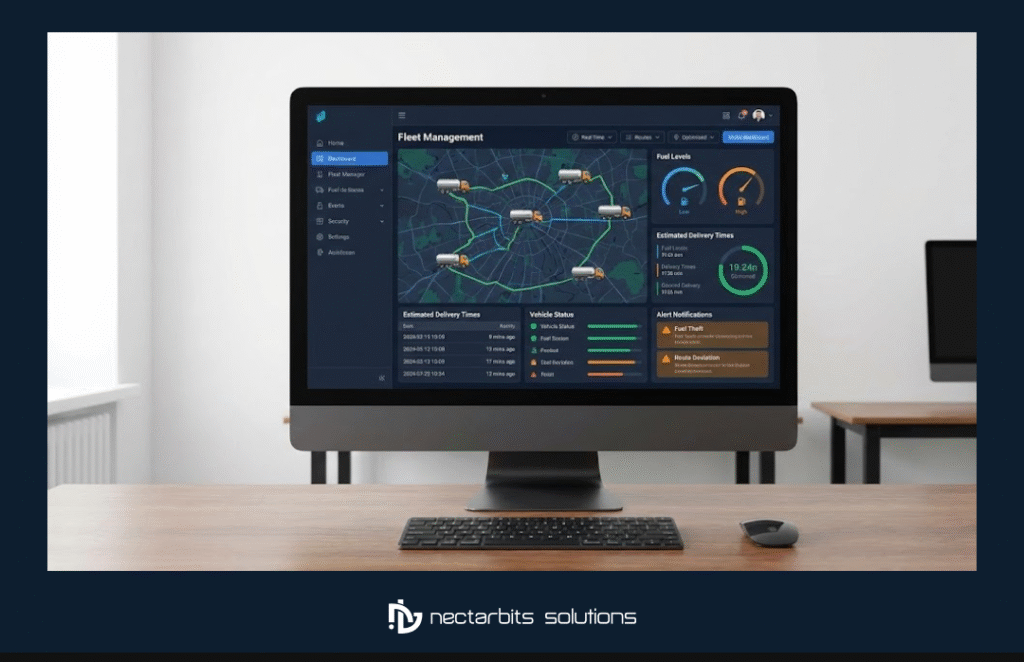
At the foundation of any effective delivery fleet tracking tool system is real-time GPS tracking.
Essential Capabilities:
- Live vehicle location: Know where every tanker is at any moment
- Historical route playback: Review past routes for optimization and dispute resolution
- Geofencing alerts: Receive notifications when vehicles enter or exit designated areas
- Multi-vehicle dashboard: Monitor entire fleet from a single interface
Business Impact: A 2023 analysis by Geotab highlights the impact of real-time GPS tracking on fleet operations, showing that businesses using telematics and live vehicle data achieve faster response times, improved route visibility, and greater control over vehicle usage. These capabilities help reduce unauthorized vehicle activity while enabling quicker decision-making during time-critical deliveries.(Source: Geotab – Fleet Telematics for Safety and Efficiency)
| Metric | Without GPS Tracking | With GPS Tracking | Improvement |
| Emergency Response Time | 45 minutes avg | 35 minutes avg | 22% faster |
| Unauthorized Use | 8.5 incidents/month | 2.1 incidents/month | 75% reduction |
| Route Efficiency | 72% optimal | 91% optimal | 26% improvement |
| Customer ETA Accuracy | 64% | 94% | 47% improvement |
2. Intelligent Route Optimization
Route optimization transforms fuel delivery operations from reactive to proactive.
Key Features:
- Dynamic route planning: Automatically calculate the most efficient routes based on multiple variables
- Multi-stop optimization: Sequence deliveries to minimize distance and time
- Real-time traffic integration: Adjust routes based on current traffic conditions
- Delivery time windows: Honor customer-specified delivery windows while optimizing efficiency
- Load balancing: Distribute deliveries evenly across available vehicles
Real-World Results: According to Route4Me’s 2024 fleet optimization report, businesses using advanced route optimization save an average of $5,547 per vehicle annually through reduced fuel consumption and increased delivery capacity.
3. Comprehensive Driver Management
Your drivers are your most valuable asset and your highest variable cost.
Essential Driver Management Features:
| Feature | Purpose | ROI Impact |
| Driver Behavior Monitoring | Track harsh braking, acceleration, and cornering | 15-20% fuel savings |
| Hours of Service (HOS) Tracking | Ensure compliance with driving time regulations | Avoid $1,000-$16,000 fines |
| Driver Scoring & Gamification | Motivate safe, efficient driving habits | 12% reduction in accidents |
| Digital Driver Communication | Send instructions and updates directly to drivers | 25% faster communication |
| Training & Certification Tracking | Monitor license renewals, hazmat certifications | 100% compliance |
| Driver Performance Analytics | Identify coaching opportunities | 18% productivity increase |
Safety Impact: The Federal Motor Carrier Safety Administration reports that fleets using driver behavior monitoring systems experience 30% fewer accidents and 35% reduction in insurance claims.
4. Fuel Management and Consumption Monitoring
For fuel delivery businesses, managing your own fleet’s fuel consumption while delivering fuel creates unique opportunities for optimization.
Critical Fuel Management Capabilities:
- Fuel consumption tracking: Monitor fuel usage per vehicle, route, and driver
- Fuel card integration: Automatically capture fuel purchase data
- Theft detection: Identify suspicious fuel level drops
- MPG analytics: Track fuel efficiency trends over time
- Idle time monitoring: Reduce wasteful idling
Cost Savings: Fleet management software with robust fuel monitoring capabilities helps businesses save $1,200-$3,500 per vehicle annually through reduced fuel theft, optimized consumption, and decreased idling, according to Verizon Connect’s 2024 fleet study.
4b. Automated Meter Register (LCR) Integration: The Game-Changer
The Difference Between Tracking and Dispensing
Here’s what separates general fleet software from specialized Fuel delivery app development solutions: General fleet software tracks where your truck goes. Specialized fuel delivery software tracks the flow of fuel through the hose.
The “Smart Hose” Connection:
Top-tier fuel management systems integrate directly with Electronic Liquid Control Registers (LCR-II, TCS 3000, Veeder-Root systems) via Bluetooth or IoT connectivity.
Key Benefits:
Auto-Invoicing: The moment the pump stops, the meter pushes the exact gallon amount to the mobile app. The driver cannot alter this number, ensuring 100% billing accuracy.
Theft Prevention: If the meter registers flow but no active job exists in the app, the system triggers an immediate “Theft Alert” to dispatch. This feature alone has helped fuel delivery companies recover an average of $8,500 annually per truck in prevented fuel theft.
Error Elimination: Manual data entry errors account for 2-4% of billing discrepancies in the fuel delivery industry. LCR integration removes 100% of these errors. For a business processing $2 million in annual fuel sales, this translates to $40,000-$80,000 in recovered revenue from eliminated billing mistakes.
Regulatory Compliance: Electronic meter data creates an immutable audit trail for regulatory agencies, insurance claims, and customer disputes. This documentation has proven invaluable during DOT audits and liability investigations.
Real-World Impact: A Chicago-based fuel distributor implemented LCR integration across their 15-truck fleet and reported eliminating $127,000 in annual discrepancies between metered fuel and invoiced amounts within the first year.
5. Predictive Maintenance and Vehicle Health Monitoring
Unexpected breakdowns don’t just cost money—they damage customer relationships and create safety risks.
Maintenance Management Features:
- Automated maintenance scheduling: Schedule service based on mileage, engine hours, or time intervals
- Vehicle diagnostics integration: Receive real-time alerts about engine codes and mechanical issues
- Maintenance history tracking: Maintain complete service records for each vehicle
- Parts inventory management: Track replacement parts and supply levels
- Vendor management: Coordinate with service providers and track costs
Financial Impact: Research by the American Trucking Associations shows that predictive maintenance reduces unplanned downtime by 45%, maintenance costs by 25%, and extends vehicle lifespan by 20-30%.
5b. PTO Monitoring & Fuel Tax Recovery: The Feature That Pays for Itself
Understanding Power Take-Off Operations
Fuel delivery trucks are fundamentally different from standard commercial vehicles: they burn fuel to pump fuel. This operation, known as Power Take-Off (PTO) usage, creates a significant—and often overlooked—opportunity for cost recovery.
The Tax Exemption Opportunity:
In many U.S. states and Canadian provinces, fuel burned during PTO operations (pumping, not driving) is exempt from road taxes because the vehicle isn’t actually using the road during this time. However, standard GPS trackers cannot distinguish between “stuck in traffic” (taxable idling) and “pumping fuel” (non-taxable PTO operation).
How Specialized Software Captures This Revenue:
Advanced fuel fleet management systems connect directly to the truck’s PTO sensor through the vehicle’s CAN bus system. The software automatically logs:
- PTO engagement and disengagement times
- Fuel consumed during active pumping operations
- Differentiation between traffic idling and operational idling
- Automated quarterly tax refund documentation
The Financial Impact:
A typical fuel delivery truck operates in PTO mode for 3-4 hours daily during deliveries. At an average PTO fuel consumption rate of 0.8 gallons per hour, this equals approximately 3.2 gallons per day, or 832 gallons annually per vehicle.
With road taxes averaging $0.24-$0.55 per gallon (varying by jurisdiction), accurate PTO tracking can generate $1,200-$1,800 in annual tax refunds per truck—often covering 60-100% of the fleet management software subscription cost.
Documentation for Compliance:
The software automatically generates IRS Form 4136 (Credit for Federal Tax Paid on Fuels) documentation and equivalent provincial forms for Canadian operators, complete with:
- GPS-verified location data proving off-road usage
- Time-stamped PTO engagement logs
- Fuel consumption calculations tied to specific delivery tickets
- Quarterly summary reports for tax filing
Case Example: A Pennsylvania-based fuel distributor operating 22 trucks implemented PTO monitoring and recovered $31,400 in previously unclaimed fuel tax refunds in their first year—turning their fleet management system from a cost center into a profit generator.
6. Regulatory Compliance and Safety Management
Fuel delivery involves complex regulatory requirements across multiple jurisdictions.
Compliance Features Table:
| Compliance Area | Required Features | Penalty Avoidance |
| DOT Regulations | Electronic logging, inspection reports | $1,000-$16,000/violation |
| HAZMAT Requirements | Certification tracking, route restrictions | $500-$25,000/violation |
| Environmental Regulations | Spill reporting, waste tracking | $10,000-$250,000/incident |
| Hours of Service (HOS) | Automated duty status, rest period alerts | $1,000-$11,000/violation |
| Vehicle Inspections (DVIR) | Digital pre/post-trip inspections | $1,000-$5,000/violation |
| Drug & Alcohol Testing | Testing schedule management | $2,500-$5,000/violation |
Compliance ROI: A single avoided violation can pay for months of fleet management software. Beyond avoiding fines, compliance features protect your business license and reputation.
7. Advanced Analytics and Reporting
Data-driven decisions separate industry leaders from struggling competitors.
Essential Reporting Capabilities:
- Executive dashboards: High-level KPIs for leadership decision-making
- Operational reports: Detailed metrics for fleet managers
- Custom report builder: Create reports specific to your business needs
- Automated report delivery: Schedule reports to stakeholders
- Benchmarking analytics: Compare performance against industry standards
Key performance indicators (KPIs) are essential for measuring the effectiveness of fleet management operations. Fuel delivery businesses should track metrics like cost per mile or kilometer to control operational expenses and on-time delivery percentage to ensure reliable service. Monitoring fuel efficiency (MPG or liters per 100 km) helps identify excessive consumption and driver behavior issues, while vehicle utilization rate indicates how efficiently fleet assets are deployed.
Additionally, KPIs like driver safety scores and maintenance cost per vehicle provide insight into risk reduction and long-term cost control. Route efficiency percentage shows optimization success, customer satisfaction scores reflect service quality, revenue per vehicle measures profitability, and compliance violation rate ensures regulatory adherence and mitigates potential risks. Tracking these indicators enables fleet managers to make data-driven decisions and improve overall operational performance.
8. Customer Portal and Communication Tools
Modern fuel delivery requires transparent customer communication through effective Professional Truck Booking App Development Services.
Customer-Facing Features:
- Real-time delivery tracking: Let customers track their fuel delivery
- Automated notifications: Send ETAs, delivery confirmations, and delays
- Digital proof of delivery: Capture signatures and photos electronically
- Customer portal: Allow customers to view history, schedule deliveries
- Feedback collection: Gather ratings and reviews automatically
Customer Experience Impact: According to a 2024 customer experience study, businesses offering real-time delivery tracking see 42% higher customer satisfaction and 28% increase in repeat business.
9. Inventory and Load Management
Effective inventory management ensures you have the right fuel at the right time.
Inventory Management Features:
- Real-time inventory tracking: Monitor fuel levels across all vehicles
- Load optimization: Maximize payload while staying within legal weight limits
- Fuel type management: Track different fuel grades and products
- Automated reordering: Trigger purchase orders when inventory runs low
- Tank level monitoring: Integrate with customer tank monitoring systems
Operational Efficiency: Proper load management increases deliveries per vehicle by 15-20% and reduces deadhead miles by 25%, according to industry benchmarks.
9b. Multi-Compartment “Liquid Tetris” Planning: Preventing Costly Contamination
The Compartmentalized Challenge
Unlike package delivery vans, fuel tankers are compartmentalized vessels. A typical 4,000-gallon truck may have four separate 1,000-gallon compartments, allowing for the simultaneous transport of Regular, Mid-Grade, Premium gasoline, and Diesel.
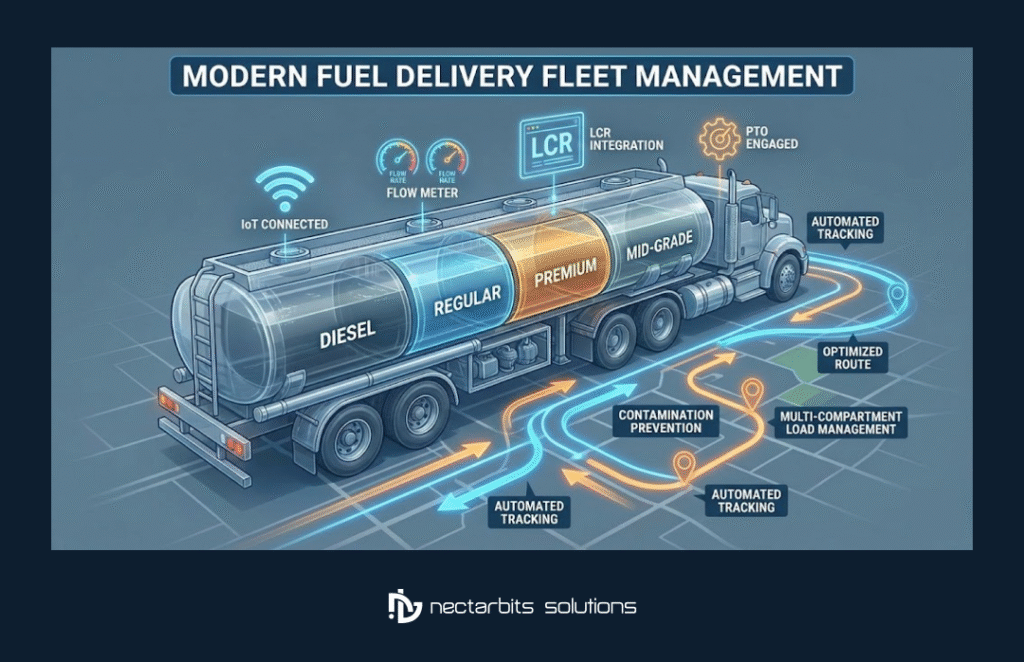
This creates a complex logistics puzzle that standard fleet software cannot solve.
The Cross-Contamination Risk:
Fuel grades cannot be mixed. Loading Diesel into a compartment that previously held gasoline—without proper flushing protocols—results in contaminated product worth thousands of dollars. Worse, delivering contaminated fuel to a customer’s tank can trigger:
- Damage claims ranging from $15,000-$50,000 for tank cleaning
- Equipment damage liability (contaminated fuel destroys engines)
- Regulatory violations and environmental fines
- Permanent loss of customer relationships
The Software Solution:
Advanced fuel fleet management systems maintain a “Prior Product History” for every compartment on every truck. The system tracks:
Compartment Memory: What product was last loaded in Compartment 1, 2, 3, etc.
Automatic Blocking: If a dispatcher attempts to assign a Diesel load to a compartment that last contained Regular gasoline, the system prevents the assignment and alerts the operator.
Flush Protocol Triggers: The software can require and log mandatory flush procedures before allowing cross-grade loading.
Split-Load Optimization:
Beyond contamination prevention, sophisticated algorithms solve the “liquid Tetris” problem of multi-grade deliveries:
Example Scenario: Your driver has six deliveries to make:
- Customer A needs 800 gal Regular, 200 gal Premium
- Customer B needs 600 gal Diesel
- Customer C needs 500 gal Regular
- Customer D needs 300 gal Premium, 400 gal Diesel
- Customer E needs 700 gal Regular
- Customer F needs 500 gal Premium
Basic software just lists these deliveries in order. Advanced software recognizes that if you complete deliveries in the wrong sequence, you’ll return to base with 800 gallons of Premium remaining but zero Regular—forcing an expensive partial-load return trip.
The Optimization Engine calculates:
- Ideal compartment allocation for loading
- Delivery sequence that empties all compartments proportionally
- Alternative routing if a customer’s tank is full (avoiding wasted trips)
- Real-time rebalancing if an emergency delivery disrupts the schedule
Financial Impact: Fuel companies using multi-compartment optimization report 12-15% reduction in partial-load returns and nearly eliminate contamination incidents, saving an average of $23,000 annually per truck in wasted fuel, truck rolls, and liability avoidance.
10. Mobile Driver App Integration
Your drivers need powerful tools that work in the field.
Mobile App Must-Haves:
| Feature | Driver Benefit | Business Benefit |
| Turn-by-turn navigation | Easier route following | Fewer missed deliveries |
| Digital proof of delivery | Paperless confirmation | Real-time delivery updates |
| Two-way messaging | Direct dispatcher communication | Faster problem resolution |
| Electronic DVIR | Quick vehicle inspections | Compliance documentation |
| Break/rest tracking | Easy HOS management | Automated compliance |
| Emergency assistance | Quick help access | Enhanced safety |
| Delivery instructions | Customer-specific notes | Better service quality |
11. Integration Capabilities
Your fleet management software fuel solution shouldn’t exist in isolation through Custom software development solutions.
Critical Integrations:
- Fuel delivery app development platforms: Seamlessly connect fleet management with customer-facing apps
- Accounting software: Sync financial data with QuickBooks, Xero, SAP
- CRM systems: Connect customer data with delivery operations
- Telematics devices: Integrate with existing GPS hardware
- Fuel card systems: Automatically import fuel purchase data
- Weather services: Adjust routes based on weather conditions
- Truck booking platforms: Connect with load booking systems
Integration ROI: Businesses using integrated fleet management ecosystems report 35% reduction in manual data entry and 40% improvement in data accuracy.
12. Dispatch and Scheduling Automation
Efficient dispatching maximizes fleet utilization and customer satisfaction.
Advanced Dispatch Features:
- Automated job assignment: Match drivers to deliveries based on location, qualifications, and availability
- Capacity planning: Forecast vehicle and driver needs
- Emergency dispatch: Quickly assign urgent deliveries
- Recurring delivery scheduling: Automate regular customer deliveries
- Load board integration: Access additional freight opportunities
Productivity Gains: Automated dispatching increases dispatcher productivity by 60% and allows one dispatcher to manage 3x more vehicles, according to fleet management research.
Evaluating Fleet Management Software: Key Selection Criteria
Total Cost of Ownership
Look beyond subscription fees to calculate true costs:
| Cost Component | Typical Range | Considerations |
| Software licensing | $30-$90/vehicle/month | Per-vehicle or flat fee? |
| Hardware (GPS devices) | $150-$400/device | One-time or bundled? |
| Installation | $50-$200/vehicle | DIY or professional? |
| Training | $500-$5,000 | Included or extra? |
| Integration fees | $2,000-$25,000 | API access costs? |
| Support fees | Included or 15-20% annually | Response time guarantees? |
| Customization | $5,000-$50,000+ | How flexible is the platform? |
User Experience and Adoption
Even the most feature-rich software fails if drivers and dispatchers won’t use it.
Evaluation Checklist:
- Intuitive interface: Can users navigate without extensive training?
- Mobile-friendly: Does it work seamlessly on smartphones and tablets?
- Minimal clicks: Can users complete tasks efficiently?
- Customizable dashboards: Can users personalize their view?
- Offline functionality: Does it work without an internet connection?
Vendor Stability and Support
Your fleet management software is mission-critical infrastructure.
Questions to Ask Vendors:
- How long have you been in business?
- How many active customers do you have in fuel delivery?
- What is your average customer retention rate?
- What support hours do you offer?
- What is your average support response time?
- Can you provide customer references in our industry?
- What is your product development roadmap?
- Where is your data hosted and backed up?
- What is your system uptime guarantee?
- Do you have experience with LCR integration and PTO monitoring?
Real-World Success Story: Comprehensive Fleet Management Transformation
Consider the case of a mid-sized fuel delivery company serving the Pacific Northwest with 18 trucks. Before implementing comprehensive fleet management software, they faced:
- 17% fuel waste from inefficient routing and excessive idling
- Average delivery delays of 35 minutes
- Three DOT violations in one year
- Vehicle utilization is only 62%
- Customer satisfaction score of 3.2/5
- Zero fuel tax recovery (unclaimed PTO refunds)
- Two contamination incidents cost $38,000 in liability claims
After implementing a robust delivery fleet tracking tools system with LCR integration, PTO monitoring, and multi-compartment management, their results after 12 months:
| Metric | Before | After | Improvement |
| Fuel Tax Rebates | $0 (Unclaimed) | $28,800/yr | New Revenue Stream |
| Fuel costs | $18,500/month | $14,200/month | 23% reduction |
| On-time deliveries | 68% | 96% | 41% improvement |
| DOT violations | 3/year | 0/year | 100% reduction |
| Vehicle utilization | 62% | 84% | 35% improvement |
| Customer satisfaction | 3.2/5 | 4.6/5 | 44% improvement |
| Deliveries per day | 47 | 68 | 45% increase |
| Contamination incidents | 2/year | 0/year | 100% elimination |
| Billing discrepancies | $67,000/yr | $4,200/yr | 94% reduction |
| Annual cost savings | – | $243,600 | ROI: 580% |
The company’s operations manager noted, “The LCR integration alone paid for the entire system. The PTO monitoring was pure profit; we didn’t even know it existed. And eliminating contamination incidents gave us peace of mind you can’t put a price on.
Future Trends in Fleet Management Technology
Artificial Intelligence and Machine Learning
AI is transforming fleet management through:
- Predictive analytics: Forecast maintenance needs before failures occur
- Intelligent routing: Learn from historical data to optimize future routes
- Demand forecasting: Predict customer needs and optimize inventory
- Driver coaching: Automated, personalized feedback based on behavior patterns
Electric Vehicle Fleet Management
As fuel delivery companies explore electric support vehicles, fleet management software must adapt:
- Battery charge monitoring and range prediction
- Charging station location and availability
- Optimal charging schedules based on electricity rates
- Total cost of ownership comparison tools
Autonomous and Semi-Autonomous Vehicles
While fully autonomous fuel tankers are years away, semi-autonomous features are emerging:
- Advanced driver assistance systems (ADAS) integration
- Platooning capabilities for highway driving
- Automated parking and maneuvering in depots
Blockchain for Compliance and Tracking
Blockchain technology offers:
- Immutable compliance records
- Transparent chain of custody for hazmat deliveries
- Smart contracts for automated billing and payments
- Enhanced security against data tampering
Read more: Case study on fleet management, service tracking, and compliance.
Conclusion: Choosing the Right Fleet Management Software
The right fleet management software fuel delivery solution is not a luxury—it’s a competitive necessity in 2025. As customer expectations rise, regulations tighten, and margins compress, fuel delivery businesses must leverage technology to stay profitable and competitive.
Key Takeaways:
Comprehensive features matter: Look beyond basic GPS tracking to intelligent routing, predictive maintenance, compliance management, LCR integration, PTO monitoring, and multi-compartment optimization.
Fuel-specific features deliver ROI: Generic fleet software tracks trucks; specialized fuel delivery software tracks dispensing, recovers tax refunds, and prevents contamination—features that directly impact your bottom line.
Integration is critical: Your fleet management software should connect seamlessly with meters, accounting systems, and customer-facing applications.
ROI is measurable: Expect 20-30% operational cost reductions, 35-45% efficiency improvements, and potentially 100%+ ROI when including tax recovery and error elimination.
User adoption drives success: The best software is worthless if your team won’t use it—prioritize intuitive interfaces and comprehensive training.
Customization may be necessary: Standard solutions work for many, but unique business models may require custom development to capture all available benefits.
Taking Action:
- Assess your current state: Document your biggest operational challenges and hidden costs
- Define must-have features: Use this guide to create your requirements list, emphasizing fuel-specific capabilities
- Evaluate 3-5 solutions: Request demos from top contenders and ask specifically about LCR, PTO, and compartment management
- Calculate total cost of ownership: Look beyond monthly fees to include tax recovery opportunities
- Plan your implementation: Prepare your team for change with phased rollout
- Measure and optimize: Track KPIs and continuously improve
The fuel delivery industry is evolving rapidly. Businesses that invest in robust, feature-rich fleet management technology today—specifically solutions built for liquid logistics, not just package delivery—will be the market leaders tomorrow.
Whether you choose an established platform with fuel-specific modules or invest in custom development to capture every optimization opportunity, the essential features outlined in this guide will ensure your solution delivers real, measurable business value that extends far beyond simple GPS tracking.
Related Reading
Fuel Delivery Management Software: Must-Have Features for Modern Fuel Delivery Businesses
👉 Top Fuel Delivery Apps: Your Ultimate Guide — Explore how leading fuel delivery companies use advanced fleet management, real-time tracking, automated dispatching, and customer-facing technology to streamline operations, improve compliance, and scale efficiently.
About NectarBits
NectarBits is a leading software development company specializing in logistics, fleet management, and on-demand delivery solutions for businesses across Canada and the USA. With deep expertise in building scalable, secure, and user-friendly platforms specifically for the fuel delivery industry, we help companies modernize their operations through innovative technology solutions.
From comprehensive fleet management systems with LCR integration and PTO monitoring to customer-facing mobile apps, our team delivers custom solutions that drive measurable business results. Our fuel delivery clients have achieved an ROI exceeding 400% in their first year through reduced costs, recovered tax refunds, and eliminated billing errors.
Contact us to discuss how we can transform your fuel delivery operations with technology built specifically for liquid logistics.
FAQS:-
1: What features should fleet management software have for a fuel delivery business?
Fuel delivery fleet software should include real-time GPS tracking, route optimization, fuel monitoring, LCR integration, PTO tracking, compliance management, and multi-compartment load control to prevent losses and errors
2: How does fleet management software help reduce fuel theft?
It detects abnormal fuel level drops, tracks dispensing through LCR integration, and sends real-time alerts when fuel is used without an active job, helping prevent theft and billing losses
3: Is generic fleet tracking software enough for fuel delivery companies?
No. Generic software tracks vehicles only, while fuel delivery needs dispensing tracking, PTO monitoring, contamination prevention, and automated invoicing features
4: What ROI can fuel delivery companies expect from fleet management software?
Most fuel delivery businesses see 20–30% cost savings and 35–45% efficiency gains within the first year, with higher ROI from tax recovery and error reduction