
In today’s fast-moving startup world, speed is the ultimate advantage. Many brilliant ideas never reach the market because they were delayed by overbuilding, feature overload, or slow development cycles. The result? Great products that arrive too late, or not at all.
This is why an MVP, or Minimum Viable Product, is crucial. An MVP isn’t just a stripped-down prototype; it’s a focused, testable product designed to validate assumptions, gather real user feedback, and learn quickly. Its goal is not perfection, but insight-driven progress, allowing startups to focus on what truly matters while avoiding wasted time and resources.
Startups often fail due to feature bloat, lack of early validation, and prolonged development timelines, making it harder to attract users or secure investors. According to CB Insights research, 42% of startups fail because there’s no market need for their product, a problem that proper MVP validation could have prevented. The faster you can test and refine your idea, the better your chances of success.
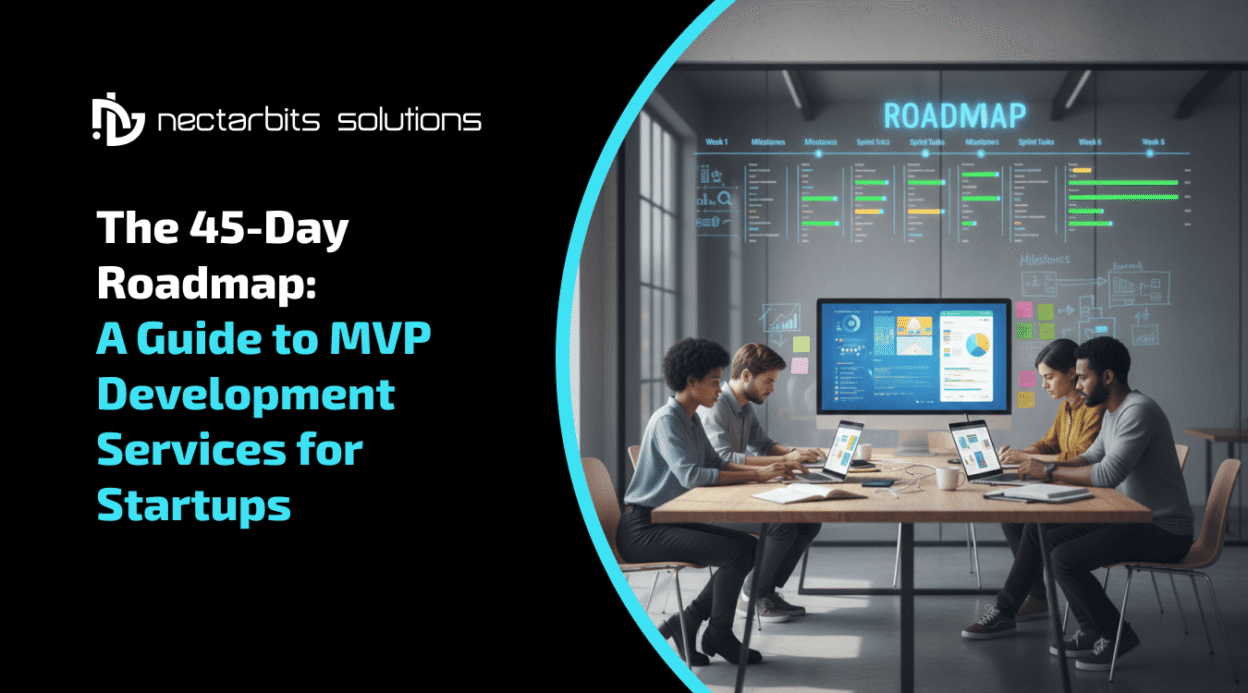
In this blog, we share a proven 45-day roadmap to take your concept from idea to launch efficiently. Using professional MVP development services for startups, you can validate ideas, reduce risks, and present a working product to investors, all in just six weeks.
Whether hiring a team or taking a hands-on approach, this guide will help you launch quickly, validate effectively, and set your startup on the path to success.
What is MVP & Why Startups Need It

A Minimum Viable Product (MVP) is more than just a bare-bones version of a product; it’s a strategic tool for testing assumptions, validating ideas, and learning from real users quickly. The core purpose of an MVP is to deliver only the essential features that solve the primary problem for your target audience, enabling startups to gather actionable insights without wasting time or resources on untested features.
In the modern startup ecosystem, where speed and validation are critical, building an MVP has become a standard practice. Startups that follow startup MVP development principles can test market demand, refine their product, and make data-driven decisions before committing to full-scale development.
Benefits of MVP Product Development:
- Faster Time-to-Market: By focusing only on core functionalities, startups can launch within weeks instead of months, capturing opportunities before competitors.
- Validated Learning: Real user feedback informs product decisions, reducing guesswork and ensuring the product aligns with actual needs.
- Investor Confidence: A working MVP provides tangible proof of concept, making it easier to attract funding compared to just a pitch deck.
- Cost-Effective Experimentation: MVPs minimize unnecessary development costs and allow for iterative improvements based on real-world usage.
It’s important to note that an MVP is not about perfection; it’s about learning. The goal is to validate hypotheses, identify early pain points, and refine the product in cycles, ensuring that every development step is backed by real insights rather than assumptions.
By adopting mvp product development strategies, startups can accelerate growth, reduce risk, and establish a foundation for scalable, user-driven products. Whether you’re building a SaaS platform, mobile app, or fintech solution, starting with an MVP ensures that your startup invests in what truly matters to users and maximizes the chances of long-term success.
How MVP Development Services Help Startups
For startups, speed and efficiency are crucial. That’s where professional MVP development services for startups come in. These services offer end-to-end solutions to transform an idea into a functional, market-ready product, while reducing risk and accelerating time-to-market.
Key Services Offered by MVP Development Teams:
- Discovery & Strategy: Understanding your target audience, market trends, and product vision. This phase helps define core features, validate assumptions, and create a roadmap for development. For strategic guidance, MVP consulting services can help align your vision with market realities.
- UX/UI Design: Crafting intuitive, user-friendly interfaces that ensure a seamless experience. Wireframes, clickable prototypes, and design systems are created to visualize the product before coding begins.
- Rapid Prototyping: Building interactive models that allow early testing with real users. This reduces guesswork, identifies potential issues, and ensures the product solves actual user problems.
- Full-Stack Development: Developing scalable, secure, and maintainable back-end and front-end systems. Technologies like React, Flutter, Node.js, and Firebase enable faster delivery without compromising quality.
- Testing & Launch Support: Ensuring functionality, performance, and security through manual and automated QA processes. MVP teams also set up analytics and prepare the product for a smooth launch.
- Post-Launch Iteration: Collecting user feedback, analyzing engagement, and implementing improvements to optimize product-market fit and prepare for scaling.
Benefits of Outsourcing vs. In-House Development:
- Expert Teams Accelerate Timelines: Experienced developers reduce development bottlenecks and guide startups through best practices.
- Agile Feedback Loops: Iterative development ensures rapid adjustments based on user insights.
- Scalable, Future-Ready Solutions: Services include architecture planning, API integrations, and cloud deployment for growth-ready MVPs.
Use Cases: MVP development services are ideal for SaaS platforms, mobile applications, fintech solutions, and web-based platforms. Startups can leverage these services as a turn-key MVP solution, accessing full-cycle expertise without building a large in-house team.
By leveraging MVP development services for startups, founders can focus on strategy and user acquisition while leaving technical execution to experts, ensuring faster validation, cost efficiency, and a higher chance of success in competitive markets.
Custom Code vs. Low-Code: Choosing the Right Approach
When building an MVP, choosing the right development approach is crucial. Startups must balance speed, cost, scalability, and long-term growth. The three main approaches, no-code/low-code, custom development, and hybrid solutions, each have distinct advantages depending on your goals.
1. No-Code / Low-Code Development
No-code and low-code platforms allow startups to build MVPs quickly and cost-effectively without extensive coding knowledge. Tools like Bubble, Adalo, or Glide are ideal for:
- Simple web apps, internal tools, or proof-of-concept products
- Rapid prototyping to test demand before investing heavily
- Non-technical founders who want to iterate without a dedicated engineering team
While these platforms accelerate development, they may limit customization, scalability, and control over your IP, making them less suitable for complex SaaS or fintech solutions.
2. Custom Development
Custom MVP development involves building the product from the ground up using programming languages and frameworks such as React, Node.js, Python, or Flutter. This approach is typically delivered by an experienced Custom Software Development Company that focuses on creating tailored, high-performance solutions aligned with a startup’s long-term vision.
- Scalable and secure architecture capable of supporting growth
- Full ownership of intellectual property
- Advanced features such as payment processing, AI integration, or complex workflows
Although custom development requires more time and investment upfront, it provides the flexibility to adapt and scale as your startup grows, making it a preferred choice for startup MVP development in competitive sectors.
3. Hybrid Approach
A hybrid approach combines the speed of no-code tools with the flexibility of custom development. By integrating APIs like Stripe, Twilio, Firebase, or Plaid, startups can:
- Accelerate MVP delivery without compromising on functionality
- Leverage third-party services for payments, notifications, and authentication
- Focus internal development on core value propositions while offloading common features
Choosing the right approach depends on your product complexity, budget, timeline, and growth plans. For most startups aiming for a competitive edge, MVP software development often blends speed with scalability, ensuring the product validates the idea while laying the foundation for long-term success.
Tech Stack for Speed: How Developers Launch Fast
When building a startup MVP, choosing the right tech stack is critical. The goal is to accelerate development, reduce costs, and ensure scalability while delivering a product that works seamlessly for users. Selecting the best tech stack for MVP depends on your product type, platform, and long-term goals.
1. Frontend Development
For web-based MVPs, frameworks like React.js and Vue.js are popular choices. They offer component-based architecture, reusable code, and fast rendering, which allows developers to deliver interactive interfaces quickly. These frameworks are ideal for startups aiming to launch visually appealing and responsive web applications.
2. Mobile Development
Cross-platform frameworks such as Flutter and React Native enable startups to build mobile apps for iOS and Android using a single codebase. This approach saves development time and cost while ensuring consistent performance across platforms. For comprehensive mobile app development services, Flutter is particularly strong in rapid UI prototyping, while React Native integrates easily with web services.
3. Backend as a Service (BaaS)
Using Firebase or Supabase for backend infrastructure accelerates MVP development by providing pre-built authentication, database management, and cloud hosting. These tools allow developers to focus on core functionalities rather than building servers from scratch, reducing development cycles by up to 50%.
4. Project & Collaboration Tools
Efficient collaboration is essential in fast-paced MVP development. Tools like Figma for design, Jira for agile project management, and Notion for documentation ensure teams stay aligned, track progress, and iterate quickly based on feedback.
By combining these technologies, startups can achieve rapid development without compromising quality, creating a robust, scalable product in record time. Choosing the best tech stack for MVP ensures your startup can validate its idea, onboard early users, and prepare for future growth efficiently.
To dive deeper into modern frameworks and tools, explore this detailed guide on the technology stack for web application development.
45-Day MVP Roadmap: Step-by-Step
Building a successful MVP isn’t about rushing development blindly; it’s about following a structured roadmap that balances speed, validation, and quality. With the right strategy, you can take your idea from concept to launch in just 45 days. This roadmap is designed for startups looking to leverage MVP development services for startups to validate their ideas, reduce risk, and attract early users and investors.
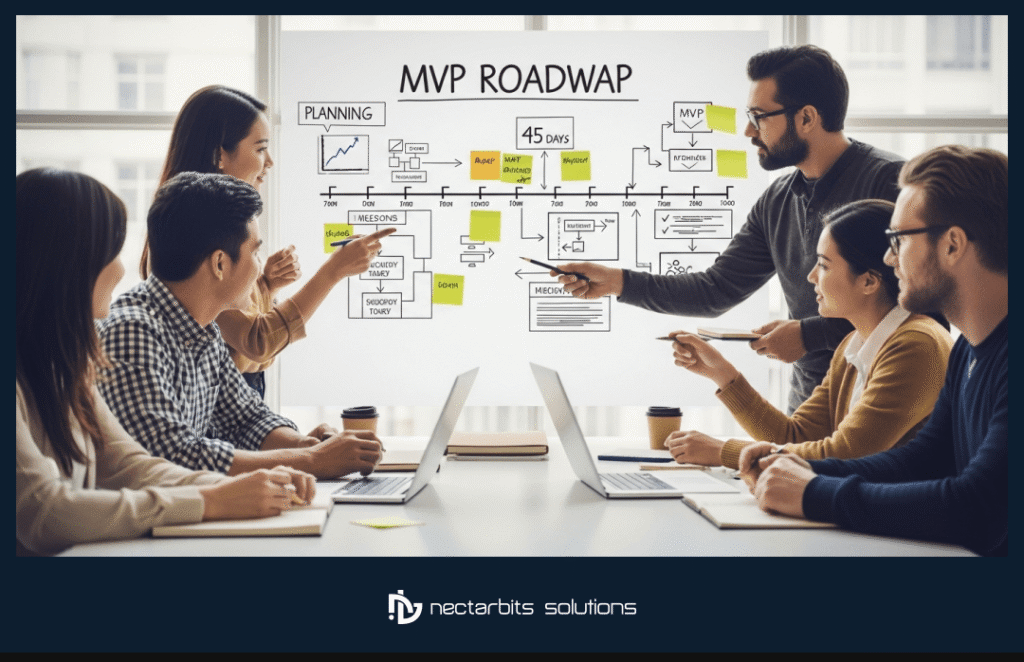
Here’s a week-by-week guide to help you navigate the process efficiently:
Week 1: Discovery & Validation
Goal: Understand your market, define your users, and validate the core idea.
Key Activities:
- Conduct market research to identify competitors, trends, and gaps.
- Segment target users and outline their pain points and preferences.
- Formulate testable hypotheses about the product’s value proposition.
- Collect initial feedback through surveys, landing pages, or interviews.
Deliverable: Product Requirements Document (PRD) detailing the product vision, core features, target users, and success criteria.
Best Practices:
- Keep your focus narrow—identify the one key problem your MVP will solve.
- Use quantitative and qualitative data to inform decisions.
Week 2: Strategy & Planning
Goal: Prioritize features and plan the product development.
Key Activities:
- Feature prioritization using frameworks like MoSCoW (Must-have, Should-have, Could-have, Won’t-have) or the Kano model.
- Define success metrics and Key Performance Indicators (KPIs) to measure product impact.
- Create user stories and journey maps to visualize how users interact with your MVP.
- Plan the technical architecture and select the best tech stack for MVP.
Deliverable: A clear development plan and feature roadmap aligned with business objectives.
Best Practices:
- Focus on features that directly validate your core hypothesis.
- Avoid overloading the MVP with “nice-to-have” features.
Week 3: UX/UI & Prototyping
Goal: Visualize the product and gather early user feedback.
Key Activities:
- Design wireframes and low-fidelity prototypes for each screen.
- Map user flows to ensure intuitive navigation.
- Conduct early usability testing with a small group of target users.
- Iterate design based on feedback and observed pain points.
Deliverable: Clickable Figma or InVision prototype ready for developers.
Best Practices:
- Focus on the “happy path”—the primary scenario that delivers value.
- Keep designs simple and avoid unnecessary visual elements.
For professional design support, explore UI/UX design services that ensure intuitive, user-centered interfaces.
Weeks 4–5: Core Development Sprint
Goal: Build the MVP’s functional core efficiently.
Key Activities:
- Set up development environment and backend infrastructure.
- Implement core features such as authentication, main workflows, and database connections.
- Conduct weekly agile sprints to track progress and adjust priorities.
- Integrate third-party APIs (Stripe, Twilio, Firebase) if needed for speed.
Deliverable: Functional MVP with core value proposition implemented.
Best Practices:
- Prioritize function over polish—features must work reliably, not be visually perfect.
- Maintain a continuous feedback loop between design and development teams.
If you need experienced developers, consider the option to hire full-stack developers who can handle both frontend and backend development efficiently.
Week 6: Internal QA & Testing
Goal: Ensure the MVP is functional, stable, and ready for beta release.
Key Activities:
- Perform manual and automated testing for bugs, usability, and performance.
- Validate integrations, data flows, and security protocols.
- Set up analytics tools (Google Analytics, Mixpanel, Hotjar) to track user behavior from day one.
- Document issues and prioritize fixes for immediate iteration.
Deliverable: QA-tested MVP ready for beta release.
Best Practices:
- Test across devices and browsers for consistent performance.
- Focus on critical bugs first; minor UI issues can be refined later.
Week 7: Beta Launch & Feedback
Goal: Release to early adopters and gather actionable insights.
Key Activities:
- Identify beta testers from your target audience.
- Release the MVP to a limited audience and monitor engagement.
- Collect qualitative feedback via interviews and quantitative data through analytics.
- Track pain points, usage patterns, and feature requests.
Deliverable: Beta feedback report highlighting key learnings and improvement areas.
Best Practices:
- Encourage honest feedback and observe actual behavior, not just opinions.
- Prioritize insights that validate or challenge your core hypotheses.
Week 8: Public Launch & Growth Planning
Goal: Launch the MVP publicly and plan for future iterations.
Key Activities:
- Execute official launch strategies on platforms like Product Hunt, social media, and email campaigns.
- Monitor KPIs such as active users, retention rate, conversion rate, and engagement metrics.
- Plan iteration cycles based on collected data to refine and scale the product.
- Outline the roadmap for post-MVP development toward full product-market fit.
Deliverable: Publicly launched MVP with initial metrics and iteration plan.
Best Practices:
- Treat the launch as a learning opportunity, not the final product.
- Use insights to prepare for funding rounds or scaling decisions.
By following this structured 45-day roadmap, startups can turn ideas into validated products quickly while minimizing risk. Leveraging professional MVP development services ensures expert guidance at each stage, from discovery to launch, helping founders make informed decisions, validate hypotheses, and attract early users.
Key Metrics to Track Your MVP Success
Launching an MVP is just the beginning; tracking the right metrics is what drives insights, iteration, and growth. For startups practicing agile MVP development, measuring performance ensures your product delivers value and validates your assumptions.
Core Metrics to Monitor:
- Activation Rate: The percentage of users who complete the first meaningful action, such as signing up or using a key feature. High activation indicates your MVP resonates immediately.
- Retention & Churn: Retention shows how many users return over time, while churn tracks those who drop off. These metrics highlight whether your MVP meets real user needs.
- Engagement: Tracks user interactions, frequency, and time spent on key features, helping identify which parts of the MVP provide the most value.
- Conversion Rate: Measures how many users complete desired actions, like subscribing or upgrading, indicating whether the product effectively delivers its value proposition.
- Feedback & Sentiment: Qualitative insights reveal pain points, satisfaction levels, and areas for improvement, guiding meaningful iteration.
The goal of MVP product development is learning over perfection. By focusing on these key metrics, startups can prioritize the features that truly matter, refine the product efficiently, and move closer to product-market fit.
Best Practices:
- Track the most critical metric per cycle to maintain focus.
- Combine quantitative insights with direct user feedback for a holistic understanding.
- Iterate rapidly based on data to maximize the value of your MVP.
Monitoring these metrics ensures your MVP is a powerful tool for validation, helping startups make smarter decisions, accelerate growth, and achieve success faster.
Common Mistakes Startups Make & How to Avoid Them
Even the best startup ideas can fail if execution is flawed. In startup MVP development, avoiding common mistakes early can save time, money, and market opportunities.
1. Overbuilding / Too Many Features
Many founders try to include every possible feature in the MVP. This leads to feature bloat, delayed launch, and wasted resources.
Tip: Focus on the core value proposition, the features that solve the main user problem. Everything else can be added after validating demand.
2. Ignoring Market Validation
Skipping validation can result in a product no one wants. Many startups spend months building before testing assumptions.
Tip: Conduct surveys, interviews, and early landing page tests to ensure your idea solves a real problem. Use insights to guide MVP development.
3. Waiting for Perfection
Some startups delay launch, chasing a flawless product. This wastes time and allows competitors to capture the market.
Tip: Launch an MVP that is good enough to test the hypothesis. Remember, the goal is learning, not perfection.
4. Not Engaging Early Users
Failing to involve early adopters means missing valuable feedback, reducing chances of product-market fit.
Tip: Release the MVP to a small group of users, gather feedback, and iterate quickly. Their insights will shape features and improve retention.
By avoiding these mistakes, startups can leverage MVP development services for startups to accelerate validation, reduce risks, and focus on building products that users actually want. Fast, data-driven iteration is the key to turning an MVP into a successful, scalable product.
MVP Development Cost & Team Structure
Understanding the cost of MVP development helps startups plan budgets, set realistic timelines, and choose the right development approach. Costs vary depending on complexity, technology, and geographic location of the development team. While a simple MVP can be built quickly, more advanced solutions, like AI-powered apps or fintech platforms, require larger teams and longer development cycles.
Typical MVP Cost Brackets
| MVP Type | Estimated Cost | Description |
| Simple Prototype | $5,000 – $10,000 | Basic web or mobile MVP, limited features, ideal for early validation. |
| Standard MVP | $15,000 – $30,000 | Full-featured MVP for web/mobile apps, scalable architecture, moderate complexity. |
| Complex MVP | $40,000+ | Advanced solutions (AI, fintech, SaaS platforms) with integrations, high scalability, and robust security. |
Typical Team Structure
A professional MVP development team usually includes:
- Project Manager: Oversees timelines, resources, and coordination.
- UX/UI Designers: Create intuitive user interfaces and prototypes.
- Developers: Frontend, backend, and mobile engineers implementing core functionality.
- Quality Assurance (QA): Ensures bug-free and stable MVP delivery.
- Product Owner: Aligns the MVP with business goals and ensures user needs are met.
Cost vs. Value
While low-cost solutions may seem attractive, they often come with technical debt, a lack of scalability, and a delayed time-to-market. Investing in professional MVP development services for startups ensures a well-architected product that can grow with your business, deliver faster validation, and reduce long-term costs.
For a comprehensive approach from concept to launch, consider full-cycle product development that covers strategy, design, development, and post-launch support.
Tip: Always balance budget, speed, and quality. An MVP is an investment in learning, validation, and future growth.
What Happens After Launch: Post-MVP Iteration & Growth
Launching an MVP is just the beginning. The real work begins post-launch, where startups refine their product based on real user feedback, validate assumptions, and prepare for scaling.
Post-Launch Iteration Cycles
After release, continuously collect user data and feedback to identify pain points, feature gaps, and opportunities for improvement. Agile iteration cycles allow teams to release updates quickly, improving functionality, UI, and overall user experience. Startups that iterate efficiently can achieve faster product-market fit while minimizing wasted effort.
From MVP to Product-Market Fit
An MVP proves that your solution addresses a real problem, but the next step is product-market fit (PMF), when a product meets the demands of the target audience consistently. Metrics like retention, engagement, and activation indicate whether users find lasting value. Focus on refining features that drive adoption and solving critical pain points, while deprioritizing low-impact ideas.
Growth, Acquisition, and Monetization Strategies
Once PMF is approaching, startups can implement growth strategies:
- User Acquisition: Leverage social media campaigns, referral programs, SEO, and partnerships.
- Monetization: Introduce pricing models, freemium upgrades, or subscription plans based on validated value.
- Funding: Use MVP traction, analytics, and user feedback to attract investors and secure funding for scaling.
By combining agile MVP development with structured post-launch strategies, startups can transform a validated MVP into a scalable product that meets market demand, grows sustainably, and maximizes ROI. Professional MVP development services for startups ensure that these post-launch processes are efficient, data-driven, and aligned with long-term business goals.
How to Choose the Right MVP Development Partner
Selecting the right partner for your MVP can make or break your startup journey. The goal is to hire MVP developers who not only build your product quickly but also guide you through validation, iteration, and scaling. Here’s how to make an informed choice:
Watch Out for Red Flags
Some agencies say “yes” to every feature request without prioritization. While it may seem accommodating, this approach often leads to feature bloat, delayed timelines, and wasted budgets. A reliable MVP partner should push back when necessary, helping you focus on what truly validates your product idea.
Ensure IP & Data Ownership
Your startup must own the code, data, and intellectual property. Clear contracts should specify ownership rights, licensing, and access to repositories. Protecting your IP ensures that your MVP remains a foundation for future growth without legal hurdles.
Effective Communication & Agile Workflows
Transparency is crucial. Choose a partner that follows agile methodologies, provides access to project management tools like Jira or Notion, and maintains regular updates. Time zone alignment is also important to enable real-time collaboration, reduce delays, and maintain accountability.
Check Their Portfolio
Look for agencies with proven experience in startup MVP development, not just corporate websites. Review case studies, prototypes, and live products to assess whether they understand rapid validation, user-centric design, and scalable architecture.
At NectarBits, we specialize in turn-key MVP solutions, combining expert teams, agile workflows, and scalable technology to bring startup ideas to life efficiently. Choosing the right development partner ensures your MVP is validated, robust, and ready for growth—saving time, reducing risk, and setting the stage for long-term success.
Key Takeaways:
- Prioritize partners who challenge your assumptions constructively.
- Ensure clear IP ownership and contract terms.
- Verify startup-focused portfolio experience.
- Favor agile communication and collaboration workflows.

Conclusion: Launch Fast, Learn Faster
Building an MVP is about speed, validation, and iterative learning. It’s not about perfection; it’s about testing your idea, collecting real user feedback, and making data-driven improvements. Startups that move quickly reduce risks, attract investors, and discover which features truly drive value.
With the right MVP development services for startups, your idea can become a validated, scalable product in as little as 45 days. Focusing on core functionality, user insights, and agile iteration ensures your MVP evolves based on real needs rather than assumptions.
At NectarBits, we help startups transform concepts into market-ready MVPs efficiently, combining expertise, strategy, and a turn-key approach. By prioritizing speed, learning, and continuous improvement, your MVP becomes a powerful tool to achieve product-market fit, growth, and long-term success.
The journey from idea to launch doesn’t have to be slow or risky; the right approach turns validation into opportunity.
Continue Your Journey
Launching an MVP is only the beginning. If you’re looking to balance speed, quality, and budget while moving toward product-market fit, understanding cost-efficient development strategies is essential.
Continue your journey by exploring proven, cost-effective MVP development approaches tailored for startups, especially those planning to build and scale efficiently in competitive markets.
FAQs:-
1. What is an MVP, and why do startups need it?
An MVP (Minimum Viable Product) is a version of your product with just enough features to validate ideas and gather user feedback. It helps startups save time, reduce costs, and test assumptions before full-scale development.
2. How long does it take to build an MVP for a startup?
With professional MVP development services for startups, a core MVP can be built in as little as 45 days, depending on complexity, tech stack, and features. Rapid prototyping ensures faster validation.
3. Should I choose custom code or low-code for my MVP?
It depends on your goals. Low-code/no-code is faster and cost-effective for simple MVPs, while custom code is scalable, secure, and ideal for SaaS, fintech, or complex platforms. A hybrid approach using APIs can accelerate development without sacrificing quality.
4. How much does MVP development cost?
Costs vary by complexity:
– Simple prototype: $5k–$10k
– Standard MVP: $15k–$30k
– Complex MVP (AI/Fintech): $40k+
Investing in professional development reduces technical debt and ensures a scalable product.