
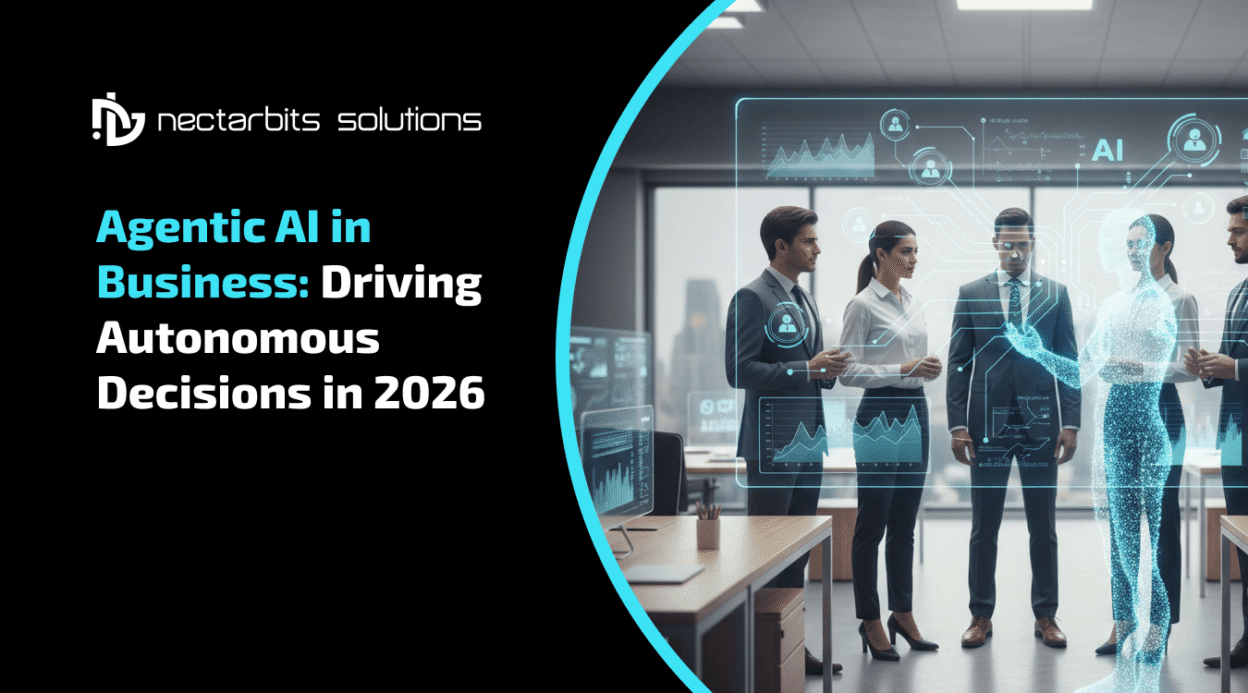
Businesses have spent years automating tasks, but 2026 marks a major shift: AI is no longer just assisting work, it’s running it. Agentic AI drives this evolution in business, a new generation of intelligent systems designed to operate with real autonomy.
Agentic AI refers to autonomous AI systems that can plan, make decisions, and act independently with minimal human input. Unlike traditional automation, which relies on fixed rules, agentic AI adapts dynamically as conditions change. And unlike generative AI and intelligent automation solutions, which create content in response to prompts, agentic AI focuses on execution. It doesn’t just recommend actions; it carries them out.
This capability is transforming how organizations operate. As workflows grow more complex and real-time decision-making becomes critical, businesses are moving beyond manual oversight toward autonomous systems that manage processes end to end. Industry forecasts suggest that by 2026, many enterprise applications will embed AI agents as core components, signaling a shift from experimentation to mainstream adoption.
The benefits are already clear. Companies using AI agent applications in business report faster decisions, reduced operational overhead, improved productivity, and greater scalability. From operations and customer service to finance and strategy, agentic AI is becoming a foundation for business autonomy.
This guide explores what agentic AI means for modern enterprises and how it’s shaping the future of work.
What Makes AI “Agentic”?
Not all AI systems are truly agentic. What differentiates agentic AI in business is its ability to operate with intent, autonomy, and accountability, not just intelligence. Agentic AI systems don’t wait for constant prompts or follow rigid scripts; they actively work toward defined business goals.
Core Characteristics of Agentic AI
Agentic systems are built around a few key capabilities that enable autonomy:
- Goal-driven behavior
Agentic AI is given outcomes, not instructions. Instead of executing a single task, it works toward objectives such as improving operational efficiency, reducing costs, or resolving customer issues end-to-end. - Planning and reasoning
These systems can break complex goals into smaller steps, sequence actions logically, and revise plans when data or conditions change. - Autonomous execution
Once a plan is created, agentic AI executes it independently, triggering workflows, interacting with enterprise systems, monitoring results, and correcting errors without human intervention.
How Agentic AI Differs from Traditional AI
- Automation scripts follow fixed rules and fail when workflows change.
- AI assistants and chatbots respond to prompts and provide recommendations, but usually stop short of taking action.
- Agentic AI systems combine reasoning, decision-making, and execution, closing the loop between insight and action.
Why This Evolution Matters for Businesses
For large enterprises, productivity challenges don’t come from a lack of tools; they come from fragmented systems and slow coordination. Agentic AI addresses this by acting as an intelligent layer that connects data, applications, and workflows.
As a result, agentic AI use cases in businesses are expanding rapidly, including:
- End-to-end customer service automation
- Financial operations and compliance monitoring
- IT incident resolution and system optimization
- Supply chain and workflow orchestration
By moving from task-level automation to outcome-driven autonomy, agentic AI enables businesses to scale faster, operate smarter, and reduce operational complexity, marking a foundational shift in how work gets done. Organizations investing in AI software development for process automation are already seeing measurable gains in efficiency and decision-making speed.
Agentic AI vs. Generative AI vs. RPA — What’s the Difference?
One of the most common questions business leaders ask in 2026 is how agentic AI relates to tools they already know — chatbots, generative AI like ChatGPT, and robotic process automation (RPA). Here is the clearest comparison:
| Traditional Automation / RPA | Generative AI | Agentic AI | |
|---|---|---|---|
| How it works | Follows fixed, pre-scripted rules | Generates content from a prompt | Plans and executes multi-step goals autonomously |
| Human input needed | Every workflow must be scripted in advance | A new prompt is needed for every task | Initial goal only — the agent handles the rest |
| Decision-making | None — rule-based only | Single-turn recommendation | Continuous, adaptive decision loop |
| Handles exceptions? | No — breaks on unexpected inputs | Sometimes, but takes no action | Yes — replans and adapts when conditions change |
| Memory | None | Single session only | Short-term and long-term memory across sessions |
| Best for | High-volume, repetitive, predictable tasks | Content creation, Q&A, summarisation | Complex, multi-step, cross-system business workflows |
Bottom line: RPA automates tasks. Generative AI responds to prompts. Agentic AI pursues outcomes.
This is why businesses that have already deployed RPA and generative AI are now investing in agentic AI as the third layer — the execution layer that connects intelligence to action.
How Agentic AI Works: The 4-Step Operational Loop
Understanding how an AI agent actually works helps businesses design better deployments and set realistic expectations. Every production-grade agentic AI system runs on four interconnected steps:
Step 1: Perceive. The agent ingests data from its environment, CRM records, emails, databases, APIs, and system alerts, and builds a real-time picture of the current state.
Step 2: Reason and Plan Using a large language model (LLM) as its intelligence core, the agent interprets the goal, breaks it into sub-tasks, determines which tools are needed at each step, and sequences the actions logically.
Step 3: Execute. The agent acts on its plan, triggering API calls, updating records, sending messages, routing tasks, or making decisions autonomously, without waiting for a human to approve each step.
Step: 4 Evaluate and Adapt. The agent monitors results against its goal. If something fails or conditions change, it replans rather than stopping. If it hits a decision outside its authority, it escalates to a human.
This loop runs continuously, which is what makes agentic AI fundamentally different from any automation tool that came before it.
For businesses building on this architecture, custom AI development services ensure the agent is connected to the right data sources and tools from day one.
The Growing Business Momentum Behind Agentic AI
In today’s fast-moving digital era, businesses aren’t just looking to automate — they’re looking to transform. That’s why agentic AI in business has moved from buzzword to strategic imperative.
What’s Driving Adoption?
1. Digital Transformation Goals
Most mid-to-large businesses now have API-connected cloud platforms, structured data pipelines, and established integration layers. Agentic AI needs all three. In 2022, most businesses lacked this foundation. In 2026, most have it — which is why deployment is accelerating now.
2. The Talent Gap Is Widening
McKinsey’s research shows organisations face growing pressure to scale output without scaling headcount proportionally. A single well-deployed agent can handle what previously required a team of coordinators — without overtime, sick days, or training cycles.
3. Generative AI Created the Appetite — Agentic AI Delivers the Action
After two years of generative AI adoption, executives understand what AI can produce. They now want it to act, not just respond. Agentic AI is the natural next step — the difference between a knowledgeable assistant and one who also does the work.
4. Enterprise Forecasts and Expectations
By the end of 2026, Gartner projects 40% of enterprise applications will embed AI agents by default, up from less than 5% in 2025. Salesforce, Microsoft, ServiceNow, and SAP have restructured their platforms around agentic capabilities. The 2026 Protiviti AI Pulse Survey finds nearly 70% of organisations will integrate autonomous or semi-autonomous AI agents this year.
5. Balancing Trust and Innovation
While the benefits are compelling, enterprise adoption requires realistic expectations. Organizations need robust data governance, transparency in decision logic, and a phased implementation strategy to build trust. Notably, Gartner forecasts that 40% of agentic AI initiatives will be abandoned by end of 2027 — not because the technology failed, but because organisations underestimated governance requirements. The businesses that win will be those that treat governance as a first-class priority from day one.
Top AI Agent Applications in Business Today
The era of agentic AI in business is here, transforming how companies operate across every department. AI agents are no longer passive tools; they are autonomous decision-makers that execute tasks, optimize processes, and drive outcomes. By embedding intelligence directly into workflows through full-stack mobile and web app development, businesses are improving efficiency, reducing errors, and unlocking scalability previously unattainable. Let’s explore the top applications and real-world examples of AI agents in action.
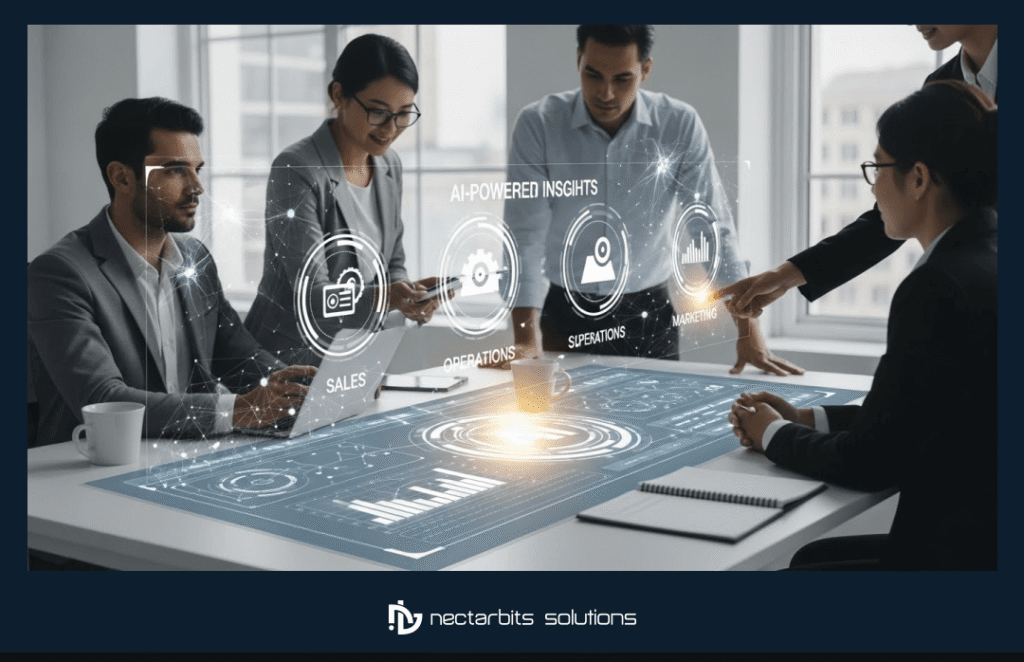
1 Sales & Marketing Automation
Sales and marketing teams often juggle high volumes of leads and complex campaigns. AI agents are revolutionizing this by automating repetitive processes while personalizing customer engagement.
Key applications:
- Lead scoring and qualification: Agents analyze historical interactions and behavioral patterns to prioritize the most promising prospects.
- Personalized campaigns: Automatically crafting targeted emails, recommendations, and sequences for individual customers.
- Meeting scheduling and follow-ups: Coordinating timely interactions without manual intervention.
Example: Enterprises using AI agents for sales pipelines report higher conversion rates and improved ROI. Sales teams can focus on strategic engagement instead of repetitive administrative tasks.
2 Customer Support & Virtual Assistants
Customer expectations demand instant, personalized service. AI agents are meeting this need by handling complex support workflows autonomously, improving both speed and satisfaction.
Applications include:
- Ticket triaging and escalation: AI agents automatically classify issues and route them to the appropriate team.
- Personalized responses: Leveraging customer history and context for tailored communication.
- 24/7 virtual assistance: Managing routine queries while human agents handle complex challenges.
Example: A global SaaS provider implemented AI agents in their support system, reducing response times by 60% and boosting customer satisfaction metrics. Advanced customer experience platform solutions integrated with AI agents are transforming how businesses deliver personalized, real-time support.
3 Finance & Risk Management
Financial operations are data-heavy and highly sensitive. AI agents powered by AI solutions for business operations are enabling real-time monitoring, predictive analysis, and autonomous decision-making, helping organizations mitigate risk while improving efficiency.
Applications include:
- Fraud detection: Spotting anomalies and unusual activity instantly.
- Compliance monitoring: Ensuring regulatory standards are met automatically.
- Forecasting and anomaly detection: Anticipating trends and identifying deviations in real time.
Example: Banks and financial institutions report faster audits, fewer errors, and better risk management after integrating AI agents into their operations.
4 Operations & Workflow Orchestration
Enterprises often struggle with multi-department workflows that slow productivity. AI agents streamline operations by orchestrating complex processes and removing bottlenecks. Companies leveraging on-demand app development for automated workflows can integrate AI agents seamlessly into existing systems for maximum impact.
Applications include:
- Automated approvals and routing: Ensuring tasks flow seamlessly across teams.
- Real-time decision-making: Monitoring operational data and triggering actions autonomously.
- Productivity optimization: Identifying and resolving process inefficiencies dynamically.
Example: An e-commerce company implemented AI agents across HR and finance workflows, cutting approval times by 50% and improving cross-department coordination.
5 Supply Chain, Inventory & Manufacturing
Agentic AI is reshaping supply chains and manufacturing by anticipating needs, coordinating resources, and minimizing downtime.
Applications include:
- Predictive restocking and routing: Forecasting demand and managing replenishment efficiently, with AI-powered delivery and logistics solutions optimizing routes and inventory in real time
- Machine maintenance: Monitoring equipment to prevent failures before they occur.
- Multi-agent optimization: Coordinating inventory, production, and logistics across multiple facilities.
Example: Manufacturing firms using AI agents report up to 30% improvements in operational efficiency, reduced costs, and more predictable supply chain performance.
From sales and marketing to supply chain management, AI agents are no longer supplementary; they are core drivers of enterprise efficiency and decision-making. By adopting agentic AI in business, companies can operate smarter, scale faster, and free human talent to focus on strategic priorities, making it a critical investment for enterprises in 2026 and beyond.
Explore More: Discover how Nectarbits’ deep learning and AI development services power autonomous business systems and intelligent workflows.
6. IT Operations & Incident Management
IT teams managing large volumes of support tickets and system alerts are among the biggest beneficiaries of agentic AI in 2026.
Key applications:
- Monitoring system health 24/7 and detecting anomalies automatically.
- Triaging and classifying incidents, resolving known L1 issues without human involvement.
- Coordinating cross-team responses for complex incidents with full context pre-loaded.
- Generate post-incident reports and documentation automatically.
Named tools in production: ServiceNow AI agents, Microsoft Copilot for IT, Moveworks
Result: Organisations with agentic IT operations report 40%+ of routine IT requests handled fully automatically — freeing engineers from helpdesk triage to focus on infrastructure improvements and strategic projects.
7. Human Resources & Talent Operations
HR teams managing large workforces benefit enormously from agentic automation — from recruitment through onboarding and ongoing employee experience.
Key applications:
- Screening and ranking candidates automatically based on role criteria.
- Scheduling interviews across calendar systems without manual back-and-forth.
- Answering candidate and employee FAQs 24/7 without HR staff involvement.
- Automating new hire onboarding — document generation, account provisioning, training assignment.
- Monitoring employee engagement signals and surfacing retention risks before they become resignations.
Named tools in production: Workday AI agents, Eightfold AI, Paradox (conversational HR agent)
Result: HR teams using agents for recruitment screening report processing 10x the candidate volume with the same headcount while applying more consistent shortlisting criteria than manual reviewers.
Best Agentic AI Platforms for Business in 2026
The platform you choose determines how quickly you can deploy, how deeply you can integrate with your existing systems, and how much governance control you maintain. These are the five platforms most widely adopted in enterprise settings in 2026:
Salesforce Agentforce
Best for businesses already running Salesforce. Agentforce embeds agentic capabilities directly into the Salesforce ecosystem — across sales, service, and marketing workflows — without requiring separate infrastructure. Fastest path to agentic deployment for companies already on the Salesforce platform.
Microsoft Copilot Studio
Best for Microsoft 365 environments. Copilot Studio lets business teams build, deploy, and manage custom AI agents across Microsoft Teams, SharePoint, and Dynamics 365. It offers a low-code interface for business users and a full development environment for technical builds — strong for IT helpdesk, HR, and internal operations workflows.
CrewAI
Best for technical teams building multi-agent systems. CrewAI is an open-source framework that assigns specialised roles to individual agents — researcher, analyst, executor, reviewer — and coordinates them toward a shared goal. It integrates with most major LLMs and has become a standard for custom enterprise agentic builds.
UiPath Maestro
Best for businesses with existing RPA infrastructure. Maestro sits on top of UiPath’s established automation platform and upgrades existing RPA bots with reasoning and adaptive planning — without rebuilding from scratch. Strong governance features make it popular in regulated industries.
IBM Watsonx Orchestrate
Best for large enterprises with complex governance requirements. Watsonx Orchestrate enables business users to build agents through natural language while giving IT full visibility and control. Purpose-built for regulated industries including banking, insurance, and healthcare.
For businesses that need a custom-built agentic system integrated with their specific software environment, AI software development services provide the architecture, integration, and ongoing support that off-the-shelf platforms cannot always deliver.
Industry Examples & Case Studies
The adoption of agentic AI in business is no longer experimental; enterprises across industries are unlocking real, measurable benefits. By automating complex workflows, enhancing decision-making, and improving efficiency, AI agents are reshaping how work gets done. Let’s explore how different sectors are leveraging agentic AI to drive tangible results.
1 Financial Services
The financial sector, with its high-volume data and stringent compliance requirements, is an ideal environment for agentic AI.
- Workflow automation: Banks are using AI agents to manage tasks like research, data compilation, compliance monitoring, and reporting.
- Real-world example: Citigroup piloted AI agents to autonomously gather and summarize market data. Analysts were freed to focus on insights and strategy rather than manual data processing.
- Business impact: Faster reporting cycles, reduced errors, and improved operational efficiency.
Financial services highlight how agentic AI in business can streamline repetitive but critical processes while maintaining accuracy and regulatory compliance.
2. Supply Chain — Siemens and PepsiCo Digital Twin Agents
Siemens and PepsiCo unveiled a Digital Twin Composer system that deploys AI agents to simulate and stress-test supply chain changes with physics-level accuracy before any physical modification is made. Agents run thousands of scenario simulations overnight that would previously have required weeks of manual modelling.
Business impact: Procurement and operations teams make data-validated decisions significantly faster, with full simulation evidence rather than intuition.
Sector takeaway: In supply chain, the highest-value agentic deployment is not execution automation — it is decision support at a speed and scale humans cannot match.
3. Retail & E-commerce
In retail and e-commerce, speed, personalization, and operational efficiency are essential. AI agents are transforming how businesses interact with customers and manage operations.
- Dynamic pricing: Agents analyze demand, inventory, and market trends to adjust prices in real time.
- Personalized customer experiences: AI agents automate recommendations, email campaigns, and promotional strategies for individual shoppers.
- Order and inventory management: AI agents coordinate stock replenishment, routing, and fulfillment to reduce errors and delays.
Example: Leading online retailers employing AI agents report higher conversion rates, faster order processing, and improved customer satisfaction. AI agents help brands act quickly on insights, creating more seamless, responsive shopping experiences.
4. Healthcare & Diagnostics
Healthcare systems are increasingly leveraging agentic AI to enhance patient care and operational efficiency.
- Triage and scheduling: AI agents prioritize patients, manage appointments, and coordinate staff efficiently.
- Monitoring and alerts: Continuous data analysis allows early detection of potential health issues and reduces human error.
- Impact example: Hospitals using AI agents for workflow management have reported faster triage times, optimized bed utilization, and smoother care coordination.
Healthcare demonstrates how agentic AI use cases in businesses can directly improve outcomes, streamline processes, and deliver a higher standard of service.
Across finance, retail, and healthcare, agentic AI in business is delivering measurable improvements. From accelerating analytics and compliance in financial services to optimizing operations in retail and enhancing patient care in healthcare, AI agents are proving to be a strategic asset. Businesses adopting these technologies are not only improving efficiency, but they are also preparing for a future where intelligent autonomy is central to competitive advantage.
Benefits of Adopting Agentic AI in Business
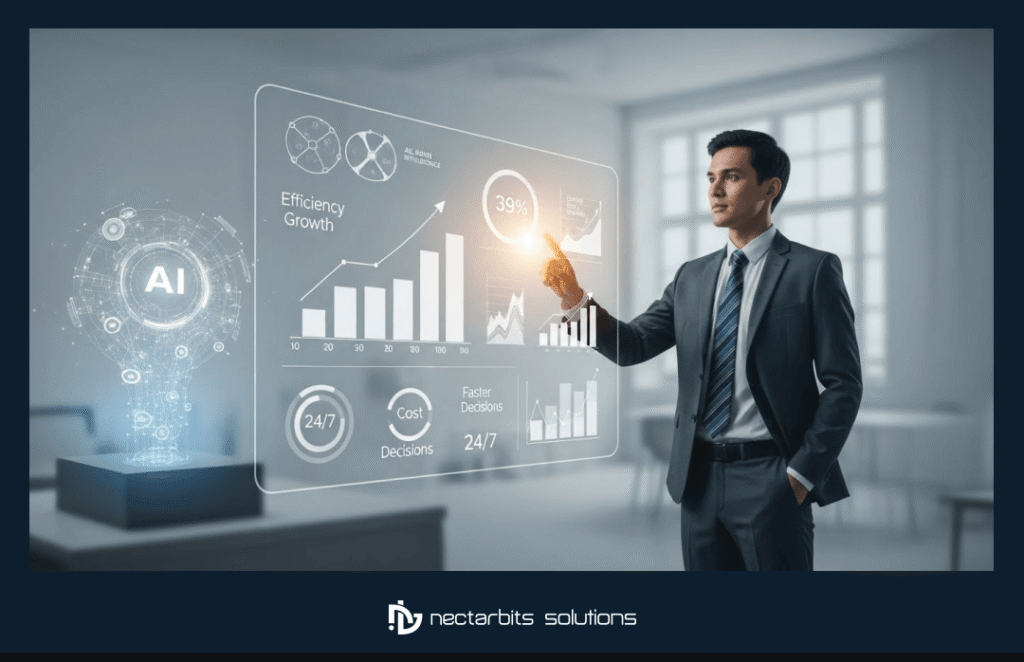
The rise of agentic AI in business is more than a technological trend; it’s a strategic enabler for organizations seeking measurable improvements in productivity, efficiency, and decision-making. By embedding autonomous intelligence into workflows, businesses are achieving results that were previously impossible with traditional tools.
1. Increased Productivity and Output
AI agents handle repetitive, time-consuming tasks with precision and speed. By automating lead management, ticket triaging, financial reporting, and workflow orchestration, employees are freed to focus on high-value, strategic work. Enterprises implementing agentic AI have reported productivity gains of up to 30–40%, as teams can achieve more without additional headcount.
2. Lower Operational Costs
Automation at the agentic level reduces reliance on manual labor for complex processes, cutting operational costs across departments. In finance, retail, and customer service, AI agents can process thousands of transactions, analyze data, and manage workflows autonomously, delivering significant savings in both time and resources.
3. Faster Decision Cycles
Agentic AI systems continuously monitor data, evaluate options, and take action in real time. This accelerates decision-making across the organization, from supply chain adjustments and financial planning to personalized marketing campaigns. Businesses using AI agents have observed 50–70% faster response times in critical processes, enabling more agile, data-driven operations.
4. 24/7 Automation Without Human Fatigue
Unlike traditional teams, AI agents work continuously, around the clock, without breaks or fatigue. Customer support, monitoring, and operational workflows can run 24/7, ensuring consistent service delivery, faster issue resolution, and uninterrupted operations.
Industry Insight
According to recent industry research, enterprises that integrate agentic AI into core business processes experience higher operational efficiency, faster time‑to‑market, and improved customer satisfaction, including measurable productivity, cost savings, and better outcomes when using enterprise AI agents, improving productivity and decision‑making across departments.
Adopting agentic AI in business enables organizations to scale smarter, work faster, and make decisions with confidence. By increasing productivity, lowering costs, accelerating workflows, and operating continuously, AI agents are transforming business performance and establishing a foundation for truly autonomous enterprises in 2026 and beyond.
Multi-Agent Orchestration: The Next Evolution
The first wave of agentic AI was single agents handling isolated tasks. The second wave — well underway in 2026 — is multi-agent orchestration: coordinated teams of specialised agents working in parallel toward shared business goals.
Gartner reported a 1,445% surge in enterprise enquiries about multi-agent systems between Q1 2024 and Q2 2025, signalling that this has moved from a research topic to an active business decision.
How Multi-Agent Systems Work
In a multi-agent architecture, individual agents specialise in distinct functions, analysis, validation, execution, monitoring, and communication, and coordinate through an orchestration layer. Each agent does one thing well. The orchestrator assigns tasks, manages dependencies, and aggregates results.
Real example — a multi-agent procurement workflow:
- Agent 1 (Market Intelligence): monitors supplier pricing and availability continuously
- Agent 2 (Demand Forecasting): pulls internal consumption data and predicts reorder needs
- Agent 3 (Approval Routing): checks purchase requests against budget rules, routes for human sign-off
- Agent 4 (Supplier Communication): drafts and sends purchase orders, logs confirmations
- Orchestrator: coordinates all four agents, ensures each step completes before the next begins, and escalates exceptions to a human buyer
Result: An end-to-end procurement process that previously required four people working across two days completes in under an hour, with human oversight only at the approval step.
Why This Matters for Business Leaders
Multi-agent systems are not just more efficient than single agents — they are qualitatively different in capability. Complex, cross-departmental workflows that were previously impossible to automate become tractable. Businesses building multi-agent infrastructure in 2026 will have a structural operational advantage that compounds over time.
Building multi-agent systems requires careful architecture — the orchestration logic, inter-agent communication protocols, and failure-handling are non-trivial engineering challenges. Custom software development services with AI specialisation are the right partner for this kind of build.
Challenges & Risks to Consider
While agentic AI in business offers significant benefits, its adoption comes with real-world challenges that organizations must address to succeed. Recognizing these risks upfront ensures smoother implementation and long-term success. According to recent surveys, nearly 60% of AI leaders cite integrating with legacy systems and addressing risk and compliance concerns as their primary challenges in adopting agentic AI, followed closely by lack of technical expertise.
- Trust and Transparency: Autonomous AI agents make decisions with minimal human oversight. Without clarity on how decisions are made, stakeholders may hesitate to rely on AI. Organizations should prioritize explainable AI and transparent reporting to build confidence.
- Data Quality: AI agents depend on accurate, complete, and well-structured data. Poor data quality can lead to flawed decisions, operational errors, and reduced ROI. Strong data governance and validation protocols are essential.
- Compliance, Bias, and Regulatory Constraints: AI systems must comply with industry regulations, avoid algorithmic bias, and remain auditable. Regular monitoring and adherence to standards reduce ethical and legal risks.
- Human Adoption and Workflow Impacts: Employees may resist changes or struggle to trust AI-driven workflows. Effective training, change management, and phased implementation help integrate AI smoothly into daily operations.
Key Challenges and Mitigation Strategies
| Challenge | Potential Impact | Mitigation Strategy |
|---|---|---|
| Trust & Transparency | Low confidence in autonomous decisions | Use explainable AI; require agents to produce decision rationales in plain language |
| Data Quality | Errors and flawed decision-making | Implement strong data governance and validation checkpoints before deploying |
| Compliance & Bias | Regulatory violations, ethical issues | Conduct bias audits; maintain compliance checks; review regularly |
| Human Adoption & Workflow | Resistance, workflow disruption | Training, change management, phased rollout |
| Digital Identity & Security | Machine identities now outnumber human employees 82-to-1, creating an unmanaged attack surface (Centric Consulting, 2026) | Apply privileged access management to agent identities with the same rigour as human accounts |
| Hallucination & Confident Errors | Agents can take incorrect actions based on LLM errors in the planning phase | Implement validation layers and output verification before agents execute irreversible actions |
| Legacy System Integration | Agents cannot access data locked in old systems | Map integration points early; use API layers and connectors before deployment begins |
By proactively addressing trust, data integrity, compliance, and human adoption, businesses can unlock the full potential of agentic AI in business while minimizing operational, ethical, and reputational risks.
Responsible AI: Governance & Human-in-the-Loop Design
As agentic AI moves from experimentation into production, the governance frameworks surrounding deployments become as important as the technology itself. This is especially relevant for Canadian businesses, where PIPEDA (Personal Information Protection and Electronic Documents Act) governs how personal data is collected, used, and disclosed by AI systems.
Human-in-the-Loop (HITL) Design
Not all decisions should be fully delegated to an agent. A well-designed agentic system classifies every decision type by impact and reversibility:
- Low-impact, reversible actions (sending a status update, routing a ticket, generating a report) → fully automated
- High-impact, irreversible actions (releasing a payment, terminating a contract, sending a legal notice) → require human confirmation before execution
HITL design is not a workaround for untrustworthy AI — it is the correct architecture for trustworthy AI at enterprise scale.
Key Governance Principles
Transparency and explainability: Every agent action should be logged with a rationale a non-technical business user can understand. “Agent routed ticket to billing because it detected a payment dispute keyword and the account was in arrears” is acceptable transparency. A black-box action with no audit trail is not.
Bias auditing: Agents making decisions affecting people — hiring, credit, healthcare prioritisation — must be audited regularly for discriminatory patterns. In many jurisdictions this is a legal compliance requirement, not optional ethics.
Data minimisation: Agents should access only the data they genuinely need for their assigned task. Broad data access creates unnecessary privacy risk and regulatory exposure.
Agent identity management: Each AI agent is a non-human identity with system access. Apply the principle of least privilege — agents should have the minimum permissions required for their task, reviewed and updated regularly.
Clear escalation paths: Every agent needs a defined boundary — what it can do autonomously, what it must pause and escalate, and what it must never do. These boundaries should be codified at the system level and reviewed as the agent’s role expands.
Businesses working with AI consulting services should ensure their governance framework is designed before deployment begins. Retrofitting governance onto a live production agent is significantly harder than building it in from day one.
How to Get Started with Agentic AI
Adopting AI agent applications in business can seem complex, but a structured approach helps organisations achieve meaningful results while minimising risks. McKinsey’s analysis of 50+ agentic AI builds found that organisations that scale successfully share one trait: they redesign workflows, not just automate existing ones.
Step 1: Identify Key Workflows to Automate
Begin by mapping high-impact processes that can benefit from autonomous AI. Look for repetitive, data-intensive tasks in areas like customer service, finance, marketing, or supply chain. Prioritise processes with measurable outcomes, time saved, error rate, and throughput to ensure early wins and stakeholder buy-in.
Good starting points: support ticket triage, invoice processing, lead qualification, HR onboarding document generation, and scheduled reporting.
Step 2: Map the Workflow Before You Build Anything
Before configuring a single agent or writing a line of code, document the current workflow in detail:
- What inputs arrive, from which systems, in what format?
- What decisions are made at each step, and by whom today?
- What are the most common exceptions, and how are they currently handled?
- What does “done” look like, and how is success measured?
Agents fail at production scale when this mapping is skipped. The agent encounters an exception the developer did not anticipate, takes an incorrect action, and loses team trust — often permanently.
Step 3: Establish Quality Data Foundations
Agentic AI relies on accurate and comprehensive data. Organisations should invest in data cleaning, integration, and validation, ensuring that AI agents have reliable inputs to make informed decisions. Without solid data foundations, even the most advanced AI systems will underperform.
Step 4: Pilot with Supervision
Start with small-scale pilots before granting full autonomy. Run the agent in “shadow mode”, it completes its workflow, but a human reviews and approves each action before it executes. This validates the agent’s judgment, identifies edge cases, and builds team confidence simultaneously.
Step 5: Measure Impact Using KPIs
Track clear key performance indicators such as time saved, revenue uplift, operational efficiency, and error reduction. Set baseline metrics before the pilot starts, and define target metrics for 3, 6, and 12 months. Regular measurement not only quantifies ROI, it provides the insight to improve your agent strategy over time.
Step 6: Scale with Governance and Transparency Controls
Once the pilot demonstrates success, scale AI agents across departments with clear governance, transparency, and compliance checks. Resist the temptation to make the first agent do more; instead, deploy a second agent on a different workflow. Build the organisational muscle for rapid agent deployment, then introduce orchestration to enable agents to collaborate across departments.
For businesses seeking expert guidance, Nectarbits AI consulting services help organisations implement autonomous workflows, measure impact, and scale efficiently from pilot to production.
By following these steps, workflow identification, data preparation, pilot testing, KPI tracking, and governance, business leaders can successfully implement AI agent applications in their business, unlocking productivity, efficiency, and a strategic advantage.
Agentic AI for Canadian Businesses
Canada is entering the agentic AI era with genuine structural advantages — and one important compliance consideration every business processing personal data needs to plan for.
Canada’s AI Advantage
Canada is one of the world’s leading AI research nations, home to the Vector Institute (Toronto), Mila (Montréal), and the Alberta Machine Intelligence Institute (AMII) — the three national AI institutes funded through the Pan-Canadian Artificial Intelligence Strategy. This gives Canadian businesses unusual proximity to cutting-edge AI research and a stronger local talent pool than most comparable economies.
PIPEDA Compliance for Agentic AI
The most important compliance consideration for Canadian businesses deploying agentic AI is PIPEDA. Any agent that processes personal information, customer records, employee data, or health information must comply with PIPEDA requirements:
- Purpose limitation: data collected for one purpose cannot be used by an agent for a different purpose
- Accountability: a named person within the organisation must be accountable for how the agent uses personal data
- Data residency: if your agent processes data through US-hosted cloud services, cross-border data transfer obligations apply
Working with a Canadian AI development partner familiar with PIPEDA ensures your agent architecture is compliant by design — not retrofitted after a regulatory review forces the issue.
Canadian SMBs Have a Speed Advantage
Contrary to the assumption that agentic AI is only for large enterprises, Canadian small and mid-sized businesses have a genuine structural advantage: speed of decision-making. A 50-person business can pilot an agent in weeks. A 50,000-person enterprise has procurement committees, CISO sign-offs, and legacy system rollouts that create multi-quarter delays.
Canadian businesses in sectors such as fuel delivery, cleaning services, and e-commerce are already seeing meaningful efficiency gains from agentic deployments for scheduling optimisation, customer communication automation, and demand forecasting, without enterprise-scale budgets.
Future Trends & What to Expect in 2026
The future of agentic AI in business promises a dramatic shift in how enterprises operate. By 2026, AI agents will move beyond isolated tasks, becoming fully integrated decision-making partners across organizations, driving efficiency, productivity, and innovation.
Multi-Agent Ecosystems and Collaboration Bots
Next-generation AI will operate in collaborative ecosystems, where multiple agents coordinate with one another to solve complex problems. Imagine AI agents across finance, marketing, supply chain, and HR working together seamlessly, sharing insights, predicting outcomes, and making autonomous decisions. These collaboration bots will enable faster workflows, minimize bottlenecks, and allow human teams to focus on strategy and creativity rather than operational tasks.
AI Agents Embedded Across Enterprise Applications
By 2026, enterprise software, from ERP and CRM systems to project management and analytics tools, will routinely embed AI agents. Gartner predicts that over 70% of new enterprise applications will include autonomous AI agents by 2026, automating repetitive processes, optimizing workflows, and providing real-time insights. This integration ensures AI is not just a tool but a core operational layer, driving smarter business decisions.
Wider Adoption and Industry Convergence
AI agents will no longer be confined to specific departments; they will converge across industries, accelerating innovation in finance, healthcare, retail, manufacturing, and logistics. Organizations that adopt agentic AI early will gain a competitive advantage through faster decision cycles, improved customer experiences, and operational resilience.
The trajectory of agentic AI in business points toward a future where autonomous agents are central to enterprise strategy. Companies that invest in multi-agent ecosystems, integrate AI across platforms, and anticipate cross-industry adoption will be best positioned to thrive in 2026 and beyond.
Conclusion
Agentic AI in business represents a transformative shift in how organizations operate, moving from simple automation to autonomous decision-making. Across sales, marketing, finance, operations, healthcare, and supply chains, AI agents are proving their value by boosting productivity, reducing errors, and enabling smarter, faster decisions.
For companies looking to stay competitive in 2026 and beyond, adopting agentic AI is not just an option; it’s a strategic imperative. By starting with high-impact workflows, ensuring strong data foundations, piloting with supervision, and scaling with governance, businesses can unlock measurable ROI while minimizing risks.
The future promises even greater opportunities, from multi-agent ecosystems to AI embedded across enterprise applications, creating smarter, interconnected organizations capable of operating with unprecedented efficiency and agility.
Businesses that act now, exploring AI agent applications in business, investing wisely, and embracing change, will be best positioned to thrive in a landscape driven by autonomous intelligence.
Takeaway: Embrace agentic AI thoughtfully, measure impact diligently, and scale strategically, because the enterprises of 2026 will be those that harness autonomous intelligence to drive growth and innovation.
Continue Your Learning
Want to see agentic AI in action? Discover how AI is transforming field service operations, boosting efficiency, and enabling intelligent automation across real-world business workflows.
Read More: AI in Field Service Management for Smarter Operations
FAQs:
1. What is agentic AI, and how is it different from regular AI?
Agentic AI refers to autonomous systems that can plan, decide, and execute tasks independently with minimal human intervention. Unlike traditional AI or chatbots that respond to a single prompt and stop, agentic AI keeps working — taking actions across connected systems, adapting to changing conditions, and managing multi-step workflows until a defined business goal is reached.
2. Which business areas can benefit most from AI agents?
AI agents provide strong ROI across industries such as finance, retail, healthcare, logistics, HR, IT operations, and legal services. Common use cases include fraud detection, customer support automation, recruitment screening, demand forecasting, dynamic pricing, workflow orchestration, and contract analysis. Businesses with repetitive, high-volume, multi-step operations benefit the most from agentic AI deployment.
3. How do companies start implementing agentic AI safely?
Start small with high-impact workflows, ensure clean, reliable data, and pilot AI agents under supervision. Track performance using KPIs like time saved, revenue uplift, and error reduction. Once the pilot succeeds, scale with proper governance, transparency, and employee training to maximize adoption and minimize risks.
4. What are the main challenges of adopting agentic AI in business?
Key challenges include:
– Trust and transparency: Employees and stakeholders may hesitate without clear AI decision logic.
– Data quality: Inaccurate or incomplete data can lead to poor outcomes.
– Compliance and bias: AI must adhere to regulatory standards and avoid ethical issues.
– Human adoption: Resistance can occur if workflows are disrupted.
Addressing these early ensures successful integration and high ROI.
5. What does the future of agentic AI in business look like?
By 2026, agentic AI will evolve into multi-agent ecosystems, collaborating across departments and even industries. Gartner predicts that over 70% of enterprise applications will embed AI agents, enabling real-time insights, autonomous workflows, and predictive decision-making. Early adopters in finance, retail, healthcare, and logistics will gain competitive advantages through faster operations, better customer experiences, and smarter resource management.