


The debate between native and hybrid mobile apps has been a hot topic in the tech world for years. Native apps, built with platform-specific languages like Swift for iOS, are known for high performance, smooth user experience, and full access to device features. Hybrid apps, in contrast, use a single codebase for multiple platforms, allowing faster development and lower upfront costs, often at the expense of speed, UX, and device integration.
In Canada, this decision matters more than ever. With industries such as fintech, healthcare, e-commerce, and education rapidly embracing digital solutions, businesses need apps that are secure, reliable, and capable of handling complex functionality. For companies targeting the iOS ecosystem, Swift mobile app development Canada remains the clear leader, powering apps that are fast, scalable, and future-ready.
This guide examines the debate over native vs. hybrid app development in Canada, comparing performance, user experience, cost, and long-term viability. By the end, you’ll understand why iOS app development in Canada continues to favor Swift, and how choosing the right approach can impact your app’s success.
Understanding Native and Hybrid Mobile Apps
Choosing the right mobile app development approach begins with understanding the differences between native and hybrid apps, their strengths, and their limitations. This knowledge is essential for businesses in Canada aiming to deliver high-performing, user-friendly apps.
What Is Native App Development?
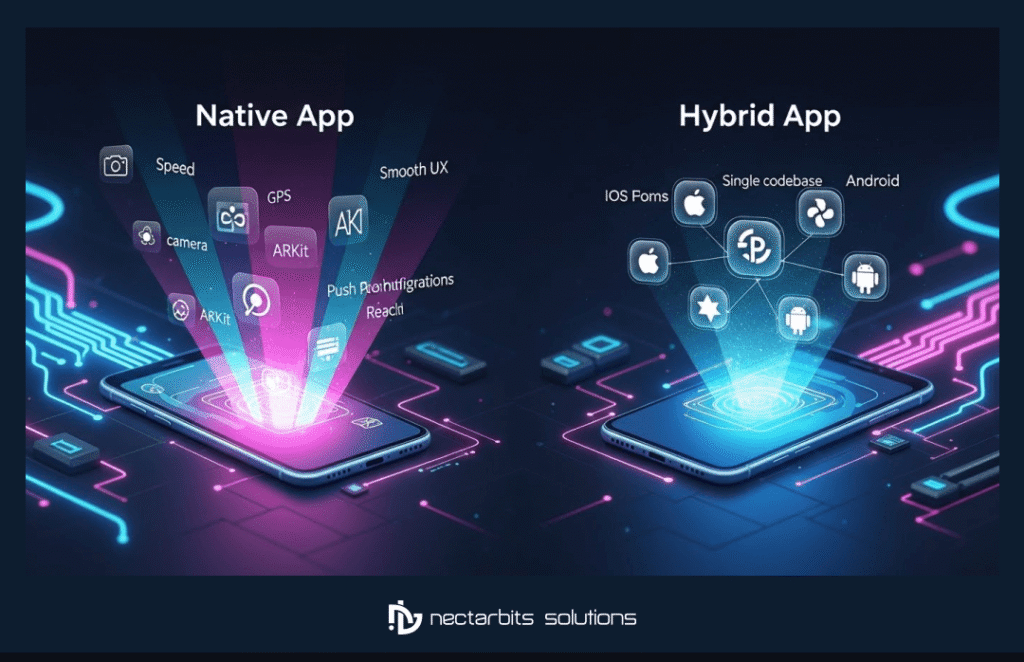
Native apps are built specifically for a single platform using platform-specific programming languages and tools. For iOS, developers use Swift, while Android apps are typically built with Kotlin. Native apps are installed directly on the device and interact seamlessly with the operating system, providing the best possible performance and user experience.
Key Advantages of Native Apps:
- High performance: Compiled directly to machine code, resulting in faster execution and smooth animations.
- Seamless OS integration: Full access to device features such as cameras, GPS, sensors, and push notifications.
- Superior UX: Optimized for platform-specific design standards, giving users a polished, intuitive interface.
For businesses in Canada, Custom iOS App Development is particularly crucial for creating apps that require reliability, scalability, and deep integration with Apple’s ecosystem. Industries like fintech, healthcare, and e-commerce rely on native apps to handle complex transactions and sensitive data securely.
What Is Hybrid App Development?
Hybrid apps combine web technologies such as HTML, CSS, and JavaScript with a native container that allows the app to run on multiple platforms. Instead of writing separate code for iOS and Android, hybrid development frameworks like React Native, Flutter, and Ionic enable developers to use a single codebase across platforms.
Key Advantages of Hybrid Apps:
- Faster time-to-market: One codebase reduces development time and simplifies updates.
- Lower initial cost: Shared code means fewer resources are required for development.
- Cross-platform compatibility: Apps run on both iOS and Android, making them ideal for smaller projects or MVPs.
However, hybrid apps often face performance and UX limitations compared to native apps, especially in complex, resource-intensive applications. This is why the debate between native vs hybrid app development in Canada continues, as businesses must balance speed, cost, and quality when choosing an approach.
Swift Mobile App Development Canada: Why Native Wins
For businesses in Canada looking to build high-quality iOS applications, Swift mobile app development in Canada remains the gold standard. Swift, Apple’s modern programming language, has transformed native app development by offering high performance, safety, and seamless integration with Apple’s ecosystem. Let’s explore why native apps built with Swift continue to outperform hybrid alternatives.
Swift’s Role in iOS Development
Swift is a modern, safe, and high-performance programming language designed specifically for iOS, macOS, watchOS, and tvOS. Unlike hybrid solutions, Swift apps are compiled directly into machine code, which results in faster execution, smoother animations, and reduced crashes.
Swift also provides developers with access to the latest Apple frameworks, including:
- SwiftUI – a declarative UI framework for building intuitive interfaces efficiently
- ARKit – for immersive augmented reality experiences
- Combine – for handling asynchronous events and data streams
This combination of performance, safety, and framework support makes Swift the preferred choice for businesses seeking to deliver enterprise-grade iOS apps in Canada.
Full Access to Apple Ecosystem Features
Native apps developed with Swift enjoy deep integration with iOS APIs. This allows developers to leverage:
- SiriKit – for voice-controlled app interactions
- Core ML – for machine learning-powered functionalities
- Camera and ARKit – for advanced imaging and AR features
Such integration ensures that apps can fully utilize device capabilities, resulting in smoother interactions, enhanced performance, and features that hybrid apps often struggle to replicate.
Superior User Experience & Performance
Performance is a critical factor in user satisfaction. Swift-built native apps offer:
- Faster load times and minimal lag
- Smooth, responsive animations
- Reduced crashes and bugs
These advantages translate to higher user engagement, better app store ratings, and long-term retention. For Canadian companies in sectors like fintech, healthcare, and retail, this can make a significant difference in business outcomes.
By choosing Swift mobile app development Canada, businesses ensure that their apps are future-proof, reliable, and aligned with user expectations, something hybrid solutions often cannot match.
Hybrid Apps: Flexibility and Faster Deployment
While native apps excel in performance and user experience, hybrid app development has gained popularity due to its flexibility and cost-effectiveness. Hybrid apps are ideal for businesses that want to reach both iOS and Android users quickly, especially when resources or timelines are limited.
Single Codebase Across Platforms
Hybrid apps are developed using web technologies like HTML, CSS, and JavaScript, wrapped in a native container. This allows developers to write code once and deploy it across multiple platforms, including iOS and Android.
Benefits:
- Faster development cycles compared to building separate native apps
- Quicker rollout of updates and bug fixes
- Simplifies cross-platform feature implementation
This makes hybrid apps an attractive option for startups and small businesses testing their mobile product ideas.
Lower Initial Costs & Easier Maintenance
Developing a single codebase reduces the initial investment required to launch an app on multiple platforms. Additionally, maintenance is simplified, as updates and patches only need to be applied once rather than separately for iOS and Android.
Advantages:
- Reduced development budget
- Faster iteration for MVPs or market testing
- Efficient team collaboration with fewer specialized developers
Modern Hybrid Frameworks Narrowing the Gap
Recent advancements in hybrid frameworks like React Native and Flutter have significantly improved performance, UX, and native feature access. For example:
- React Native App Development allows native-like UI rendering and access to device APIs through plugins
- Flutter app development for cross-platform solutions offers high-performance rendering with its custom engine and consistent UI across platforms
Despite these improvements, hybrid apps still lag behind native solutions in terms of raw performance, hardware integration, and complex animations, especially for resource-intensive applications.
This balance between speed, cost, and performance highlights why businesses must carefully evaluate native vs hybrid app development in Canada before choosing the right approach.
To dive deeper into this comparison, Learn the key differences between React Native and native apps to choose the best approach for performance, UX, and scalability.
Read More: React Native vs Native Mobile App Development Comparison
Side-by-Side Comparison: Native vs Hybrid
Understanding how native and hybrid apps differ across key factors is essential for Canadian businesses making decisions in iOS app development in Canada. The table below highlights the main differences:
| Factor | Native (Swift) | Hybrid |
| Performance | Compiled directly to machine code, delivering fast execution, smooth animations, and minimal crashes. | Runs through a web or bridge layer, which can cause slower performance, especially for resource-intensive apps. |
| User Experience (UX) | Optimized for the platform, providing intuitive, seamless interfaces. | Offers a consistent design across platforms, but may feel less native and slightly less responsive. |
| Development Cost | Higher upfront cost due to separate iOS and Android development. | Lower initial cost since one codebase works for multiple platforms. |
| Time-to-Market | Longer development cycles as each platform requires separate coding. | Faster deployment because of a shared codebase and simplified updates. |
| Access to Device Features | Full access to all device hardware and iOS APIs, including camera, sensors, ARKit, and Core ML. | Limited access; relies on plugins or third-party libraries, which may lag behind platform updates. |
| Maintenance | Requires platform-specific updates and ongoing support. | Unified updates across platforms, making maintenance simpler but sometimes less optimized. |
Key Takeaways:
- Native apps excel in performance, UX, and device feature access, making them ideal for enterprise-grade or complex iOS applications.
- Hybrid apps are best for faster deployment, lower initial cost, and simpler maintenance, making them suitable for MVPs, prototypes, or small-scale apps.
- For Canadian businesses targeting iOS users, native development with Swift ensures long-term reliability, high user satisfaction, and future-proof scalability.
Why Swift Still Rules Canadian Tech
Even as hybrid frameworks gain popularity, native iOS development with Swift remains the preferred choice for Canadian businesses. From enterprise solutions to consumer apps, Swift delivers performance, security, and reliability that hybrid alternatives often cannot match.
1. Growing Adoption of iOS in Canada
Canada boasts one of the highest iPhone penetration rates globally, with millions of Canadians using iOS devices daily. According to Statista’s 2025 report, Apple holds a significant market share in Canada’s smartphone market, reinforcing the importance of iOS-focused development. This widespread adoption has created a market that expects apps to be fast, secure, and highly intuitive.
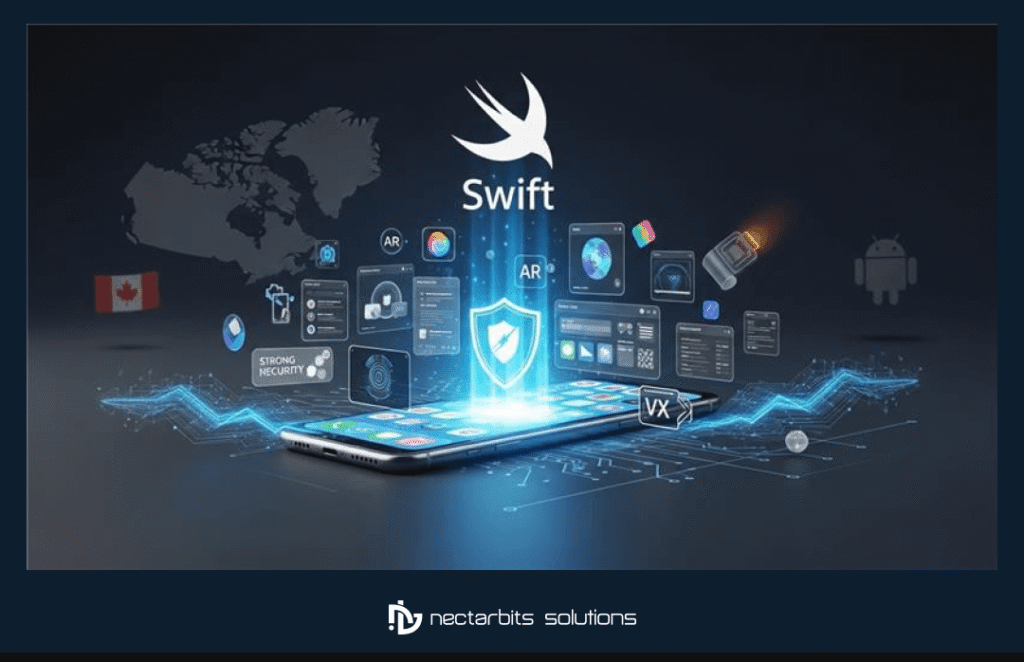
Businesses that invest in Swift mobile app development in Canada can meet these expectations by delivering:
- High performance: Smooth, responsive apps with minimal crashes or lag
- Strong security: Protection of sensitive data, critical for fintech, healthcare, and enterprise apps
- Superior user experience: Intuitive interfaces and seamless interactions that keep users engaged
As a result, Canadian enterprises increasingly favor native apps over hybrid solutions, ensuring quality and reliability for both users and businesses.
2. Scenarios Where Native Apps Are Essential
Certain applications demand the full power of native development:
- Performance-intensive apps: Real-time analytics, AR/VR applications, and high-traffic fintech platforms require direct machine code execution and high responsiveness.
- Security-sensitive apps: Apps handling financial transactions, health records, or personal data rely on Swift’s native security frameworks and iOS encryption.
- Hardware-reliant apps: Applications utilizing cameras, sensors, ARKit, or Core ML need deep integration with device capabilities that hybrid apps cannot fully provide, including specialized IoT mobile app development services.
For businesses pursuing long-term, enterprise-ready iOS apps, native development is the safest and most future-proof choice.
3. When Hybrid Makes Sense
While native apps are ideal for high-performance requirements, hybrid apps still have their place:
- Startups testing MVPs: Quickly launch and validate ideas across iOS and Android
- Budget-conscious projects: Lower upfront development costs with a single codebase
- Rapid market testing: Quickly gather user feedback before committing to a full native build
This highlights the ongoing debate in native vs hybrid app development in Canada—but for performance, security, and long-term scalability, Swift continues to lead the way.
Real‑World Use Cases
Understanding theoretical differences is one thing; seeing how these approaches are applied in real projects helps clarify when native or hybrid makes sense. Companies like Nectarbits build both native and hybrid apps, depending on client goals and technical requirements, making them a good reference for real‑world decision-making.
Successful Native Apps
Native iOS apps are ideal when performance, security, and deep device integration matter most. Many enterprise and consumer solutions fall into this category:
Enterprise & Industry Apps
Large‑scale solutions, like financial, healthcare, logistics, or utility apps, often choose native because they require precise performance, smooth animations, and strong security. For example:
- Custom iOS solutions that align with company branding, scalable architecture, and intuitive UX (as offered by Nectarbits’ iOS team). These apps are built with native toolsets like Swift and deliver excellent performance on iPhone and iPad.
Performance‑Critical Applications
- Real‑time data apps (e.g., analytics dashboards or live reporting tools) benefit from native execution that minimizes lag and load time.
- High‑security apps such as fintech or health platforms leverage native frameworks to tap into iOS encryption, secure storage, and OS‑level protections. Native apps can adopt the latest Apple security practices at launch rather than waiting for third‑party plugin support.
Immersive Experiences
- AR/VR and advanced camera integration apps rely on frameworks like ARKit, which are available only through native development and provide a seamless, highly interactive user experience on compatible devices.
Overall, Swift mobile app development in Canada delivers the responsiveness, polish, and deep device access required for sophisticated applications.
Successful Hybrid Apps
Hybrid apps provide a fast, cross‑platform path to deployment and are especially effective when speed and cost control are key priorities.
Content‑Focused & Internal Tools
Many businesses build hybrid apps for use cases where heavy native optimization is not mission‑critical:
- Content delivery apps that push updates, articles, or videos to users without deep hardware needs.
- Internal business tools such as employee dashboards, management utilities, or simple productivity apps, where users interact with web content wrapped in an app UI.
Frameworks like React Native hybrid mobile app solutions allow developers (including teams at companies like Nectarbits) to build these apps quickly and maintain one codebase for both iOS and Android.
MVPs and Early Market Tests
Startups often begin with hybrid apps to validate product ideas and test market demand before investing in fully native solutions. Because hybrid apps share code across platforms, they reduce initial development time and cost, enabling startups to iterate rapidly.
For example, many early versions of apps built by hybrid frameworks focus on core functionality and simple user pathways, helping founders gather feedback before committing to more sophisticated native enhancements.
Key Insight
Both native and hybrid approaches have their place in real‑world projects:
- Native (Swift) apps excel when performance, security, and UX are top priorities, particularly for enterprise and high‑impact consumer apps.
- Hybrid apps shine when speed, cross‑platform reach, and reduced cost matter most, such as MVPs, internal systems, or simple content platforms.
This reflects the ongoing conversation in native vs hybrid app development in Canada; each approach brings value, and the right choice depends on the project’s goals, audience, and long‑term vision.
How to Choose Between Native and Hybrid
Choosing between native iOS app development in Canada and hybrid solutions is a critical decision for businesses looking to build successful mobile apps. The choice depends on factors like budget, timeline, user experience, and performance needs, as well as long-term scalability and target audience preferences.
Native apps, particularly those built with Swift, excel in performance, security, and deep device integration, making them ideal for complex, performance-critical, or enterprise-grade apps. Hybrid apps, on the other hand, are best for simpler apps, MVPs, or projects with tight budgets, offering faster development across platforms but sometimes compromising on performance or advanced functionality.
A quick comparison can help clarify which approach fits your project:
| Factor | Native (Swift) | Hybrid |
| Performance & UX | Optimized for iOS devices, smooth animations, fast execution, and full hardware integration | Adequate for general use, consistent across platforms, but may lag for resource-intensive apps |
| Development & Maintenance | Higher upfront cost and longer timeline; requires platform-specific updates | Lower cost and faster time-to-market; single codebase simplifies maintenance |
| Best Use Cases | Enterprise apps, fintech, healthcare, AR/VR, and apps requiring security and high performance | MVPs, content apps, internal tools, and apps needing rapid deployment |
| Long-Term Scalability | High, future-proof, fully aligned with the Apple ecosystem | Moderate; may require native rewrite for advanced features later |
By evaluating your project against these criteria, businesses can make a well-informed choice. Canadian companies that invest in Swift mobile app development in Canada ensure their apps are not only reliable and secure but also future-ready with the performance and UX that users expect. For comprehensive support across all development needs, consider partnering with experts offering Mobile App Development Services.
Future Trends in Mobile App Development
As we move into 2026, mobile app development continues to evolve rapidly. Businesses in Canada must stay ahead of trends to ensure apps are high-performing, scalable, and future-proof. For iOS, this means leveraging the full potential of Swift mobile app development in Canada.
1 Modern Swift Features Driving Innovation
Apple’s Swift ecosystem is constantly expanding with features that make native app development more efficient and powerful:
- SwiftUI – A declarative UI framework that allows developers to build responsive, visually appealing interfaces with less code, reducing development time while maintaining native performance.
- Combine – Apple’s framework for handling asynchronous events, enabling real-time data updates and smoother app interactions.
- Async/Await – Simplifies asynchronous programming, making apps faster, more reliable, and easier to maintain.
Adopting these tools ensures apps are optimized for iOS devices, delivering the speed, stability, and user experience that Canadian users expect.
2 Cross-Platform Frameworks Are Improving
Frameworks like Flutter and React Native have made significant strides in recent years, offering near-native performance for simpler apps. Startups and small businesses increasingly rely on these frameworks to launch MVPs quickly across multiple platforms.
However, for performance-intensive applications, native iOS apps built with Swift still outperform hybrid solutions in:
- App load times
- Smooth animations
- Hardware integration (AR, sensors, Core ML)
- Security and compliance
In other words, while hybrid frameworks are catching up, native development remains superior for high-performance and enterprise-grade apps.
3 Staying Future-Proof in 2026
For Canadian businesses planning long-term mobile strategies, investing in Swift mobile app development in Canada is essential:
- Ensures compatibility with the latest iOS features and devices
- Provides a stable and scalable foundation for future updates
- Delivers better user experience, security, and retention, which are critical in competitive markets like fintech, healthcare, and e-commerce
With Swift and modern iOS frameworks, companies can confidently build apps that remain relevant, secure, and high-performing well into the future. Businesses can also leverage White Label Web Development services to scale their offerings while maintaining quality standards.
Conclusion
In the rapidly evolving world of mobile app development, Swift mobile app development in Canada continues to set the standard for high-performance, secure, and scalable iOS applications. Native apps built with Swift deliver superior user experience, seamless integration with device features, and robust security, making them the preferred choice for long-term, enterprise-ready projects.
Hybrid apps, while improving in performance and versatility, remain best suited for MVPs, content-focused apps, or projects with limited scope and budget. They provide a faster, cost-effective way to enter the market, but they often cannot match the performance, UX, or advanced capabilities of native apps.
For Canadian businesses aiming to build apps that are future-proof, high-performing, and fully aligned with iOS ecosystem standards, investing in native Swift development is the smartest path forward. By carefully evaluating project goals, performance needs, and long-term scalability, companies can choose the right approach and ensure their apps stand out in a competitive market.
Continue Your Journey
Ready to explore cross-platform alternatives? Discover the most popular cross-platform frameworks and when to use them for fast, cost-effective app development. This comprehensive guide will help you understand which framework best fits your project needs and budget constraints.
FAQs:
1: What is the difference between native and hybrid mobile app development?
Native apps are built specifically for a single platform, like iOS apps using Swift, offering superior performance, smooth UX, and full access to device features. Hybrid apps use a single codebase for multiple platforms with frameworks like React Native or Flutter, allowing faster development and lower initial costs, but often with limited hardware integration and slightly lower performance.
2: Why is Swift mobile app development preferred in Canada?
Canada has high iPhone adoption and user expectations for secure, reliable, and high-performing apps. Swift mobile app development in Canada enables developers to build native iOS apps that are fast, secure, future-proof, and fully compatible with Apple’s ecosystem, making it ideal for enterprise-grade applications and industries like fintech, healthcare, and e-commerce.
3: When should a business choose hybrid app development instead of native?
Hybrid apps are best suited for startups, MVPs, or projects with limited budgets. They allow companies to quickly launch apps across both iOS and Android using a single codebase, ideal for content-focused apps, internal tools, or testing ideas before investing in full native development.
4: Will hybrid apps outperform native apps in the future?
While hybrid frameworks like Flutter and React Native are improving, native apps built with Swift still outperform hybrid apps in performance-critical areas like AR/VR, real-time analytics, security, and complex hardware integration. For long-term, high-performance, and enterprise-ready applications, native development remains the most reliable choice in 2026.