
Quick Summary
Fuel delivery companies are increasingly adopting the fuel delivery subscription model to secure predictable revenue, reduce the impact of fuel-price volatility, and improve customer retention. By offering monthly plans, tiered fleet packages, or prepaid fuel credits, businesses can streamline operations and forecast demand more accurately. This blog breaks down how the subscription model works and how fuel delivery providers can implement it profitably
Fuel delivery businesses often struggle with unstable cash flow due to fluctuating fuel prices, seasonal demand changes, and unpredictable ordering patterns. Many companies now adopt digital solutions, such as a fuel delivery app development approach, to stabilize operations and improve automation. To reduce this volatility, many providers are shifting to the fuel delivery subscription model, where customers pay a fixed monthly fee for scheduled deliveries, service priority, and value-added features. This approach helps businesses secure predictable monthly recurring revenue (MRR), retain customers longer, and plan operations more efficiently.
In this blog, we explore how subscription-based fuel delivery works, its real-world advantages, the most effective pricing structures, and the technology required to launch and scale a profitable subscription program.
Subscription Economy & Fuel Delivery Market Growth
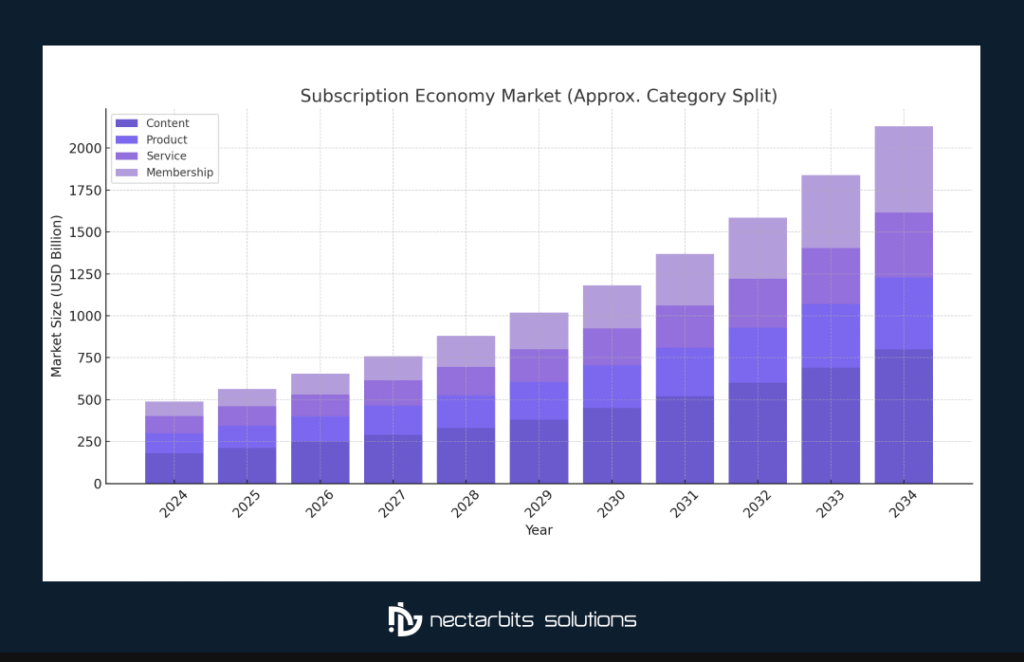
Fuel Delivery & Subscription Economy Growth
Here are some important industry-level data points and trends that make the case for why the subscription model is gaining traction in fuel delivery:
- The global subscription economy continues its rapid ascent: the subscription-economy market was valued at approximately USD 487 billion in 2024, and is projected to grow to over USD 2,100 billion by 2034, at a CAGR of ~15.9 %.
- In more detailed forecasts, the subscription economy is expected to grow at a 13.3% CAGR from 2025 to 2033, expanding from ~$492 billion in 2024 to over $1,500 billion by 2033.
- According to Cashfree, companies using subscription-based models often report 3–5× higher customer lifetime value (CLV) compared to one-off transactional business models.
- Monetisation via recurring billing also supports retention: many on-demand businesses (not just fuel) with subscription options see 30–50% better customer retention, according to industry reporting.
- On the cost side, fuel (transport) prices have seen significant volatility. For example, in the EU, diesel prices peaked with a +45.2% annual rate of change in June 2022, while petrol rose +35.7% in the same period. (source :- market.us)
- Such extreme fluctuations create strong incentives for fuel businesses to adopt predictable, recurring-revenue models to hedge against margin risk.
Implication for Fuel Delivery:
These macro trends show that subscription models are not just a niche: recurring revenue is growing faster than traditional transactional business models, and subscription customers tend to stay longer and spend more over time. Given the high volatility in fuel prices, fuel delivery companies can leverage this trend to stabilise cash flow, reduce customer churn, and provide more predictable operations.
Understanding Fuel Delivery Subscription Models
Q: What Is a Fuel Delivery Subscription Model?
A fuel delivery subscription model is a recurring service plan where customers pay a fixed monthly fee for guaranteed fuel deliveries, scheduled refills, and priority support. Unlike one-time fuel orders, subscriptions convert fueling into a predictable, managed service—similar to how SaaS or mobility subscriptions work.
For fuel delivery companies, this model creates reliable Monthly Recurring Revenue (MRR). For customers, it offers stable pricing, zero downtime, and automated fueling. These plans can support both individual vehicles and large commercial fleets, making them suitable for logistics, construction, transportation, and residential users.
Common formats include:
- Monthly vehicle/fleet plans
- Tiered subscription packages
- Usage-based subscriptions with minimum commitments
- Prepaid fuel credits
- Custom enterprise contracts with SLAs
Q: How It Works in a Fuel Delivery Ecosystem
Fuel delivery subscriptions operate within a digitally connected ecosystem, integrating payment automation, delivery scheduling, usage tracking, and fleet dispatching. Many businesses adopt a Custom fuel delivery platform to manage these workflows seamlessly.
Here’s how it typically functions:
- Plan Selection – Customers choose a plan based on consumption, vehicle count, or desired service level.
- Recurring Billing – Monthly payments are processed automatically through integrated billing systems.
- Scheduled Deliveries – Deliveries are set on fixed intervals (daily, weekly, or monthly) or triggered through sensors/requests.
- Usage Monitoring – Telematics, IoT meters, or app-based logs track real-time fuel usage and consumption patterns.
- Automated Dispatch – Route optimization software assigns deliveries to minimize distance, delays, and operational cost.
- Customer Dashboard – Subscribers access digital invoices, delivery history, usage analytics, and plan controls.
- Plan Adjustments – If limits are reached, the system issues overage charges or suggests an upgrade to the next tier.
This ecosystem reduces manual intervention and ensures both efficiency and transparency for customers.
Q: Why is it becoming Essential Today
Fuel delivery subscription models are becoming a core business strategy due to major market and operational pressures:
1. Fuel Price Volatility
Global fuel price fluctuations make per-order revenue unpredictable. Subscriptions provide stable, predictable income, helping businesses manage margins more effectively.
2. Higher Customer Retention
Subscription businesses consistently report 30–50% better retention compared to transactional models. Customers value consistent costs and guaranteed service availability—especially fleets operating on tight schedules.
3. Operational Predictability
Scheduled fueling leads to:
- Better inventory forecasting
- Reduced emergency deliveries
- Higher fleet utilization
- Improved route efficiency
- Lower operational waste
4. Demand for Digital Convenience
Customers expect automation—monthly billing, real-time tracking, reminders, and seamless service. Subscriptions align perfectly with digital-first customer behaviour.
5. Financial Stability & Growth
The model boosts business health by improving:
- Monthly Recurring Revenue (MRR)
- Cash flow stability
- Customer Lifetime Value (CLV)
- Business valuation
As fuel delivery becomes more tech-enabled, subscription models are emerging as a competitive differentiator and a long-term revenue stabilizer
Key Market Challenges Fuel Delivery Companies Must Overcome
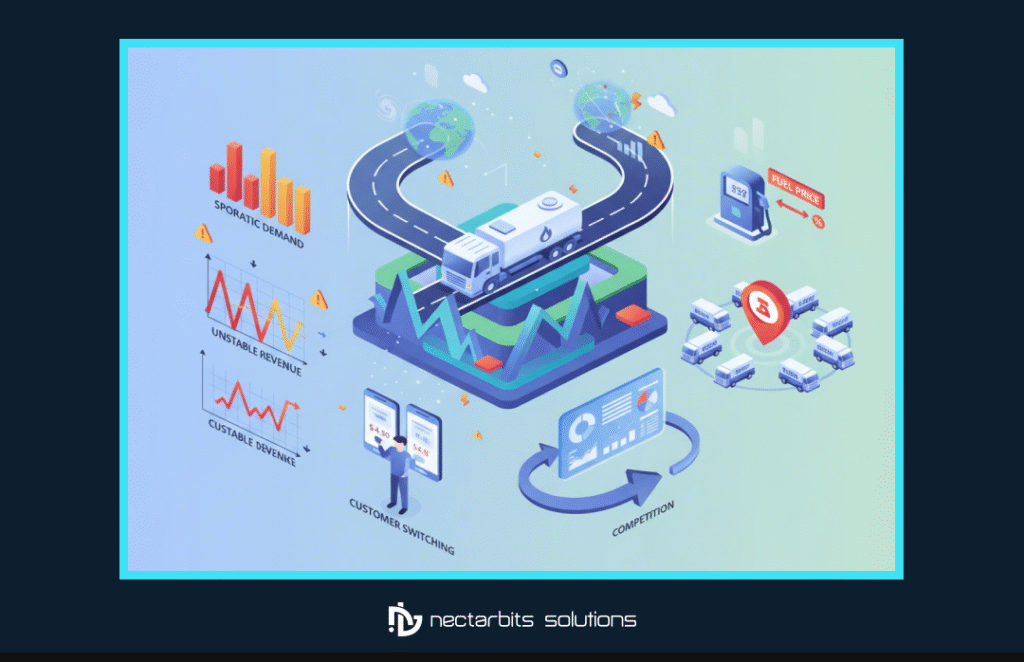
Fuel delivery companies operate in an environment where demand, pricing, and operational costs can shift rapidly. This volatility affects everything—from day-to-day planning to long-term financial stability. Below are the key challenges that make it difficult for fuel delivery providers to maintain consistent growth and profitability.
- Unpredictable Customer Demand
Customer demand in the fuel delivery sector is rarely stable. Fleet operations may fluctuate week to week depending on logistics cycles, construction activity, or seasonal changes. Some days bring a surge in fueling requests, while others experience long periods of inactivity. This inconsistency makes it harder for companies to allocate resources effectively, optimize routes, or manage inventory. Idle trucks, underutilized staff, and wasted miles are common outcomes of such unpredictable demand patterns.
- Revenue Fluctuations
Because most fuel delivery businesses still rely on a transactional, per-order model, revenue becomes directly tied to daily market behavior. Even slight drops in order volume can severely impact monthly cash flow, making it difficult to forecast income or plan reinvestments. This type of revenue instability also increases financial risk, especially for smaller operators who depend on steady working capital to keep delivery operations running smoothly.
- Fuel Cost Instability
Fuel prices are among the most volatile commodity prices globally, influenced by:
- Crude oil market changes
- Geopolitical tensions
- Supply chain disruptions
- Seasonal refinery maintenance
- Currency exchange variations
When wholesale fuel prices rise suddenly, profit margins shrink instantly. Many providers struggle to adjust retail pricing quickly enough, resulting in financial losses. This instability is one of the biggest reasons companies explore recurring revenue models to protect margins.
- Competition from Global & Local Providers
The fuel delivery market is rapidly expanding, which brings competition from both large-scale, tech-enabled companies and aggressive local distributors. Startups are leveraging mobile apps, automation, and subscription-based pricing models, while traditional suppliers are lowering prices to retain local customers. This crowded landscape puts pressure on fuel delivery businesses to differentiate themselves—not just with pricing, but with service quality, reliability, and digital convenience.
- Customer Churn Due to Price Sensitivity
Fuel buyers are extremely price-sensitive, especially fleet operators managing tight budgets.
If a competitor offers a lower per-liter cost or delivery discounts, customers may switch quickly.
Key churn drivers include:
- Sudden price hikes
- No loyalty incentives
- Inconsistent delivery experience
- Lack of predictable monthly costs
A subscription model reduces churn by offering stable pricing, guaranteed service levels, and value-added benefits that encourage long-term commitment.
Why Subscription Models Are Redefining the Future of Fuel Delivery
Subscription-based models are rapidly becoming the strategic backbone of modern fuel delivery businesses. As the market becomes more competitive and volatile, companies are shifting from one-time fueling requests to predictable, contract-driven subscriptions that offer stability, efficiency, and stronger customer relationships. This shift is driving a fuel delivery subscription market disruption that is reshaping how providers engage with customers.
- Stable & Predictable Monthly Revenue (MRR)
Fuel delivery companies have always struggled with seasonal demand drops, fluctuating order volumes, and unpredictable cash flow. Subscription plans solve this by locking in recurring revenue.
According to the Subscription Economy Index, companies using subscription billing achieve 4–8× faster revenue stability and significantly smoother MRR forecasting, enabling better financial planning and operational decision-making. For fuel providers, this shift reduces dependence on daily order spikes and improves profit margins even during low-demand periods.
- Stronger Customer Loyalty & Reduced Churn
Fuel delivery is a highly price-sensitive market, making customer retention difficult. Subscription packages—whether for fleets or households—build long-term engagement.
Businesses offering fixed or tiered fueling subscriptions experience 25–40% lower churn, mainly because customers get consistent service, predictable costs, and exclusive perks. When users subscribe, they are far less likely to switch providers due to temporary price fluctuations from competitors.
- Ability to Offer Value-Added Services
With a subscription foundation, fuel companies can bundle premium features that create stronger differentiation. These may include:
- Scheduled fueling windows
- Priority bookings
- Emergency top-up credits
- Discounted rates during off-peak hours
- Integrated vehicle diagnostics or fleet reporting
Such value-added offerings not only increase the perceived value of the plan but also generate new revenue streams. Many fleet operators now expect digital add-ons as part of their fueling contract, making subscriptions the ideal vehicle to deliver them.
- Higher Customer Lifetime Value (CLV)
The biggest advantage of subscriptions is increased lifetime revenue per customer.
Industry reports show businesses moving from transactional billing to subscription models see 3–5× higher CLV, thanks to longer retention cycles and consistent monthly engagement. For fuel providers, this means turning one-time buyers into loyal, high-value accounts who stay for years, not months.
- Better Resource, Fleet & Inventory Planning
Fuel delivery operations are logistics-heavy—requiring accurate forecasting of driver availability, tanker routes, fuel procurement, and overall inventory cycles. Subscription-based demand patterns make this far easier:
- Providers know approximate delivery windows
- Fleet teams can plan routes in advance
- Procurement managers can negotiate bulk fuel contracts
- Inventory remains balanced with fewer shortages or excess stock
As a result, operating costs drop, route efficiency improves, and wastage is minimized. Many companies report 15–25% operational improvement once subscriber demand data is integrated into dispatch and fleet operations.
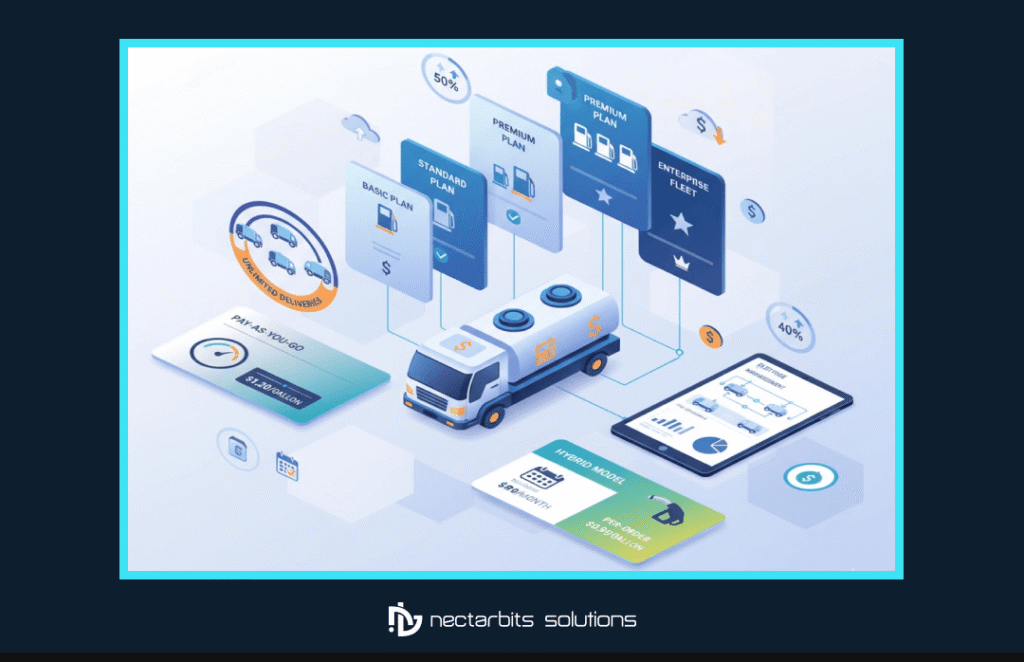
Types of Subscription Models for Fuel Delivery
Fuel delivery companies are increasingly shifting to subscription-based pricing as a way to secure predictable revenue, improve customer loyalty, and streamline operational planning. Several models have emerged across the industry, each designed to match different usage patterns—from individual drivers to large enterprise fleets.
- Tiered Subscription Plans (Basic, Standard, Premium)
Tiered plans are the foundation of most subscription-based fuel businesses because they align well with different consumption levels.
- Basic:- plans target occasional users who want affordable scheduled deliveries.
- Standard:- plans often include lower delivery fees, flexible scheduling, and app-based tracking.
- Premium:- subscribers receive priority fueling, faster dispatching, emergency top-ups, and discounted per-liter pricing.
This three-tier structure helps companies segment users, increase average revenue per customer (ARPU), and deliver predictable monthly recurring revenue (MRR).
- Pay-As-You-Go with Membership Add-On
In markets where users prefer flexibility, pay-as-you-go combined with a small monthly membership is becoming a popular option. Customers still pay for each delivery individually, but the monthly membership provides advantages such as reduced delivery charges, access to better fuel prices, and priority service. This model works well for price-conscious customers, and it allows companies to maintain recurring income even when delivery frequency fluctuates.
- Unlimited Delivery Subscription Plans
Some advanced fuel delivery startups in North America and the Middle East now offer unlimited fuel delivery requests for a fixed monthly fee (fuel charged separately).
This approach is ideal for:
- Daily commuters
- Gig workers
- Small business fleets
- High-mileage vehicle owners
While profitable with strong logistics and route optimization, companies must closely track dispatch efficiency to prevent operational overhead.
- Fleet Subscription Plans for Enterprises
Fleet subscriptions are becoming a cornerstone offering for companies serving logistics, construction, rental vehicle operators, and school transportation fleets. These plans often include scheduled fueling, consolidated monthly billing, discounted volume pricing, and service-level guarantees. Long-term contracts—ranging from quarterly to annual—provide reliable revenue for providers while giving fleet operators predictable operational costs and detailed consumption analytics.
- Hybrid Subscription + Per-Order Pricing
Hybrid models combine the stability of subscription income with the flexibility of pay-per-use. Subscribers pay a low monthly fee that unlocks benefits such as discounted deliveries and exclusive fuel rates, while still paying per order.
This approach is ideal for regions with inconsistent fuel demand or seasonal variations, ensuring revenue stability without forcing customers into rigid usage commitments.
- Seasonal or Annual Fueling Contracts
Industries with predictable cyclical fuel demand, such as agriculture, construction, tourism, and transportation, prefer seasonal or annual plans. These contracts allow companies to plan fueling schedules months in advance, negotiate better wholesale rates, and manage inventory more efficiently. Businesses benefit through stable pricing and guaranteed fueling support during their peak operational periods.
What Should Be Included in a Fuel Delivery Subscription Package?
A successful fuel delivery subscription package must offer clear, tangible value that encourages customers to stay subscribed month after month. While the exact inclusions vary based on customer type—individual users vs. businesses—the most effective packages combine cost savings, convenience, and digital insights. Companies evaluating a fuel delivery subscription platform development cost can better understand which features are essential to include.
- Discounted Per-Litre Rates
Price advantage is one of the biggest motivators for subscribers. Offering discounted per-litre rates gives customers predictable monthly expenses and encourages long-term commitment. For fuel delivery companies, this creates recurring revenue and helps forecast demand more accurately. Even a 2–5% discount can significantly increase customer retention.
- Free or Priority Delivery
Most subscription packages offer either free delivery or prioritised service windows. This ensures subscribers always get faster access to fuel refills, even during peak hours or high-demand periods. Priority delivery also reduces churn because customers can depend on timely service without waiting in queues or paying surge fees.
- Scheduled Deliveries
One of the biggest advantages of a fuel delivery subscription model is the ability to automate recurring deliveries. Scheduled top-ups—weekly, bi-weekly, or monthly—help customers avoid running out of fuel while allowing companies to plan fleet routes efficiently. For businesses, this means zero downtime, smoother operations, and fewer emergency refuel requests.
- Fuel Usage Analytics
Modern fuel delivery apps now provide real-time consumption insights such as daily usage trends, mileage efficiency, monthly expenditure, and service history. Subscribers appreciate this transparency, and businesses benefit from better monitoring and budgeting. For B2B fleets, analytics play a major role in preventing fuel theft, identifying inefficient vehicles, and managing driver behaviour.
- Emergency Service Credits
Emergency credits are a strong value addition—subscribers get a limited number of urgent refuel requests per month at no extra charge. This benefit is particularly attractive for commercial fleets, gig drivers, and customers operating during odd hours. It not only improves trust but also reduces the risk of service interruptions due to unexpected fuel shortages.
- Maintenance Alerts & Fleet Reports (For B2B)
For enterprise clients, subscription packages often include digital fleet reports, preventive maintenance alerts, and performance insights. These features help companies keep vehicles road-ready and reduce breakdown risks. Automated alerts for oil changes, fuel filter issues, or excessive idling create long-term value and strengthen the provider–customer relationship.
Financial Benefits: How Subscription Models Create Predictable Cash Flow
For fuel delivery companies operating in markets where prices fluctuate daily and demand can shift overnight, subscription models offer something the traditional per-order approach cannot—financial stability. By converting unpredictable fueling behavior into consistent monthly commitments, businesses gain reliable income, stronger cash flow, and clearer growth visibility. Here’s how subscription models directly strengthen financial performance.
- Monthly Recurring Revenue (MRR) Framework
The biggest financial advantage of subscriptions is the creation of Monthly Recurring Revenue (MRR). Instead of relying solely on one-off orders, companies receive a guaranteed monthly income from every subscriber. MRR provides a stable revenue foundation, allowing businesses to plan fuel procurement, pay operational expenses on time, and invest confidently in fleet upgrades, technology, and staffing. For many fuel delivery startups and mid-sized providers, a steady MRR base is what enables long-term scalability.
- Lower Acquisition Cost per Customer
Subscriber customers tend to stay longer, spend more, and require fewer marketing incentives compared to one-time buyers. This significantly reduces the Customer Acquisition Cost (CAC). When a customer subscribes for 6–12 months, the revenue generated far outweighs the initial acquisition investment. Over time, businesses depend less on continuous promotions and seasonal marketing pushes because recurring subscribers consistently drive revenue without extra advertising costs.
- Increased Revenue Stability During Market Volatility
Fuel delivery businesses are heavily affected by price fluctuations, weather disruptions, economic slowdowns, and seasonal demand dips. Subscriptions soften these financial shocks. Even when fuel prices rise or daily orders drop, subscribers continue paying their monthly fee, protecting the business from sudden cash flow gaps. This stability becomes crucial during uncertain periods such as supply shortages, transportation strikes, or sudden market shifts.
- Cross-Sell and Upsell Opportunities
Subscription users are already engaged and trust the service, which makes them far more likely to purchase additional offerings. Fuel delivery companies can introduce add-ons such as emergency top-up credits, maintenance plans, engine oil changes, fleet diagnostics, or premium delivery windows. These cross-sell and upsell opportunities increase Average Revenue Per User (ARPU) and boost overall customer lifetime value—without increasing marketing spend.
- Forecasting and Budgeting Advantages
Predictable monthly revenue makes financial planning far more accurate. Companies gain visibility into how much income is coming in every month, allowing them to:
- Plan fuel procurement more effectively
- Budget for operational expenses
- Allocate fleet resources strategically
- Negotiate better wholesale fuel contracts
- Reduce wastage and improve route efficiency
Stronger forecasting helps businesses avoid overstocking fuel, under-utilizing delivery vehicles, or overspending during low-demand periods. Subscription revenue essentially turns the fuel delivery business into a more predictable, data-driven operation.
Read More: Explore How Fuel Delivery Subscriptions Maximize Revenue & Efficiency
Technology Needed to Power Subscription-Based Fuel Delivery
A subscription-based fuel delivery business can only scale efficiently when backed by a strong technology ecosystem. From automated billing to predictive routing, every component must work seamlessly to deliver a frictionless, reliable, and cost-efficient experience. Here’s a breakdown of the key technologies that make subscription fuel delivery models successful.
- Mobile App for Customers
The customer-facing mobile app is the core touchpoint of the subscription model. It must enable users to manage plans, schedule deliveries, track fuel trucks in real time, update payment details, and receive renewal reminders. A smooth, intuitive interface increases customer retention—one of the most important metrics for subscription businesses.
- Billing & Subscription Management System
Your billing module should handle everything from monthly renewals and auto-charge cycles to proration, refunds, invoice generation, and usage-based billing. Advanced subscription management platforms also support coupon codes, loyalty points, and membership tiers, helping you build predictable recurring revenue (MRR).
- Route Optimization & Scheduling
Since subscription users often opt for scheduled or recurring deliveries, your backend must include an intelligent routing engine that groups orders, reduces dead mileage, and improves fuel consumption. Smart scheduling ensures your trucks follow the shortest, most efficient path—cutting operational costs by up to 20–30% and improving service-level reliability.
- Fleet Management Dashboard
A centralized fleet dashboard gives dispatchers real-time visibility into driver locations, delivery status, fuel levels, maintenance schedules, and safety alerts. For subscription-based fleets, this ensures consistent delivery performance—even during peak demand—while minimizing delays, idle time, and operational leaks.
- Inventory & Tank Monitoring System
Accurate inventory tracking is essential to avoid stock-outs, especially when handling prepaid or scheduled subscription orders. Real-time fuel level sensors, tank telemetry, and automated inventory forecasting help businesses ensure they always have enough fuel available to serve recurring customers without interruption.
- Automated Alerts, Notifications & Reminders
Automation reduces the burden on support teams while enhancing the customer experience. Push notifications and SMS reminders can alert users about delivery windows, plan expiry, low balance, upcoming renewals, or offers for upgrading their subscription. For fleet clients, alerts can include critical updates like consumption spikes or unusual vehicle usage.
- Payment Gateway Integration (Recurring Billing)
Seamless integration with secure payment gateways is crucial for handling auto-renewals, recurring payments, e-mandates, and subscription upgrades or downgrades. Support for credit cards, debit cards, UPI, digital wallets, ACH transfers, and corporate invoicing ensures smooth cash flow and reduces payment failures.
Pricing Strategy for Subscription Models
A successful subscription-based fuel delivery model depends on smart pricing that balances predictable income for the company with clear, long-term value for the customer. Since fuel margins fluctuate daily, subscription pricing must be engineered to reduce volatility, support stable cash flow, and offer meaningful benefits that make customers stay subscribed month after month. Companies evaluating MVP development costs in Canada can better plan their initial app-based subscription offerings.
- How to Determine Pricing Levels
Pricing in a fuel delivery subscription framework starts by calculating your true cost per delivery—fuel procurement, logistics, manpower, vehicle maintenance, and technology overhead. Once the baseline cost is defined, companies add margin protection and apply subscription incentives such as reduced delivery fees, locked-in per-litre rates, or scheduled refill discounts.
The final price must reflect both economic feasibility and competitive positioning, ensuring the subscription feels cheaper and more reliable than ad-hoc fuel orders.
- Understanding Customer Segmentation
Fuel consumption patterns vary widely, so pricing must adapt to different customer groups:
- Residential customers value convenience and predictable monthly billing.
- Commercial vehicles and SMEs want guaranteed deliveries and lower downtime.
- Large fleets prioritize usage analytics, bulk pricing, and advanced reporting.
Segment-based pricing ensures each plan speaks directly to usage levels, delivery frequency, and business needs—while preventing underpricing or over-discounting.
- Margin Optimization
Subscription models only work if margins remain protected. Fuel companies achieve this by:
- Aligning subscription tiers with average consumption, preventing unnecessary deliveries.
- Batching and optimizing routes, lowering cost per delivery.
- Locking customers into longer billing cycles so revenue becomes predictable.
- Using technology to automate operations, reduce manpower costs.
These techniques ensure that discounts offered through subscriptions do not harm profitability but instead support long-term financial stability.
- Dynamic Fuel Pricing vs Fixed Subscription
One of the most important decisions is choosing between dynamic or fixed pricing:
- Dynamic pricing passes real-time fuel market fluctuations to customers—this keeps your margins safe but offers less predictability.
- Fixed pricing locks per-litre costs for a billing cycle—customers love the stability, but the business must manage risk if fuel prices rise unexpectedly.
Most companies today use a hybrid structure: fixed monthly delivery fees combined with dynamic fuel pricing, or fixed fuel pricing only for premium subscribers.
- Incentives & Loyalty Bundles
To increase subscription adoption and retention, fuel delivery companies bundle extra value around their plans. Examples include:
- Free priority deliveries
- Roll-over credits for unused litres
- Analytics dashboards for fuel budgeting
- Loyalty points are redeemable for refills
- Partner discounts (auto-care, tire service, vehicle wash)
These add-ons turn a simple fuel subscription into a value-rich ecosystem, increasing customer lifetime value and reducing churn.
Operational Considerations for Successful Subscription Adoption
Launching a fuel delivery subscription model requires more than creating attractive pricing plans—it demands operational readiness that ensures every delivery is punctual, cost-efficient, and compliant with safety regulations. To sustain predictable revenue and customer satisfaction, companies must refine their logistics, planning, and monitoring systems to handle recurring demand with minimal risk or waste.
- Capacity Planning
Subscription fuel delivery runs on predictable cycles, and this predictability only works if your operational capacity matches the demand. Businesses must plan based on:
- Expected daily/weekly/monthly delivery volumes
- Vehicle availability and utilization rates
- Driver workforce scheduling
- Storage and refill logistics
Accurate capacity planning prevents missed deliveries, delays, and cost overruns—ensuring subscribers consistently receive the value they pay for.
- Delivery Frequency Management
Since subscriptions often promise scheduled or unlimited deliveries, managing frequency becomes crucial. Companies must set clear rules around how often a subscriber can request refills while maintaining operational efficiency. This involves:
- Intelligent scheduling to reduce route duplication
- Clustering deliveries geographically
- Prioritizing peak-hour slots for high-tier customers
Optimized delivery frequency improves fleet productivity and keeps fulfillment costs under control.
- Preventing Underutilization
Underutilization occurs when vehicles make trips with partial loads or excess route gaps. Subscription models can worsen the problem if delivery schedules aren’t optimized. To prevent this, companies should use:
- Automated route optimization
- Load balancing algorithms
- Predictive analytics for refill needs
- Smart batching for nearby customers
Maximizing utilization lowers the cost per delivery and keeps margins healthy, even when offering discounted subscription benefits.
- Fuel Storage & Forecasting
With subscription customers depending on guaranteed availability, fuel storage management becomes a strategic advantage. Businesses must track:
- Daily tank levels
- Consumption patterns
- High-demand periods
- Procurement lead times
Forecasting tools help avoid stockouts, stabilize purchase pricing, and reduce emergency procurement—ultimately maintaining smooth subscription fulfillment.
- Ensuring Delivery Compliance & Safety
Fuel delivery—especially recurring home, commercial, or fleet deliveries—must comply with safety regulations at every stage. Successful subscription adoption requires:
- Driver training and certifications
- Real-time vehicle and fuel monitoring
- Compliance with hazardous material transport laws
- Proper maintenance of delivery trucks and storage tanks
- Digital incident reporting systems
Safety compliance not only protects the business legally but also strengthens trust among long-term subscribers.
Read More: Operational Strategies to Scale Your Fuel Delivery Subscription Business
How Subscription Models Improve Customer Experience
Subscription-based fuel delivery transforms the customer journey from a reactive, uncertain process into a seamless and predictable service experience. Instead of worrying about fluctuating prices, last-minute refill requests, or inconsistent delivery times, customers enjoy a premium, automated, and fully transparent fueling system designed around their convenience. This shift not only enhances satisfaction but also builds long-term trust and loyalty.
- Peace of Mind with Scheduled Refills
A subscription eliminates the anxiety of running low on fuel. Customers—whether homeowners or fleet operators—can rely on automatic, scheduled refills based on real usage patterns. Deliveries happen on time, every time, without the need for repeated calls or follow-ups. The result: zero downtime, zero stress, and uninterrupted mobility or business operations.
- No Surprise Fuel Costs
With subscriptions, unpredictable fuel bills become a thing of the past. Customers get consistent, transparent pricing with fixed delivery fees or protected per-litre rates for the billing cycle. This financial predictability is a major relief during periods of volatile fuel prices, helping customers budget confidently month after month.
- App-Based Tracking & Transparency
Modern fuel delivery platforms offer subscribers complete visibility through mobile apps—real-time delivery tracking, tank level monitoring, refill history, pricing breakdowns, and consumption insights. This transparency builds confidence and empowers customers to make informed decisions about their fuel usage.
- Priority Customer Support
Subscribers often receive faster service queues, priority dispatch, and dedicated support channels. For businesses managing multiple vehicles, this can include SLA-backed assistance or account managers who oversee operations. Faster resolution and guaranteed service windows significantly elevate the customer experience.
- Seamless Digital Payments
Recurring billing and automated payments simplify the entire experience. Customers enjoy frictionless transactions, instant invoices, secure digital receipts, and one-click renewals. No delays, no manual tracking, no administrative burden—just smooth, effortless payments that align perfectly with subscription convenience.
Steps to Launch a Subscription Model for Your Fuel Delivery Business
Building a profitable subscription model requires careful planning, the right technology foundation, and a structured rollout strategy. Here’s a practical, real-world roadmap fuel delivery companies can follow to successfully introduce subscription plans that generate predictable revenue and maximize customer retention.
Step 1: Market Research & Customer Segmentation
Start by analyzing your target market’s fuel consumption patterns, delivery frequency, pain points, and willingness to pay for predictable services. Residential customers may want convenience and fixed monthly billing, while fleets prioritize guaranteed availability and analytics. Clear segmentation ensures your subscription plans align with the unique needs of each customer group and prevent offering discounts to the wrong segments.
Step 2: Plan Tier Creation
Next, design subscription tiers that deliver increasing value without hurting margins. Common structures include Basic, Standard, and Premium plans with features such as scheduled deliveries, priority service, fixed per-litre pricing, or emergency call-out credits. Each tier should have a clear “value jump” that encourages upgrades while maintaining operational feasibility for your business.
Step 3: Build or Upgrade Your App & Software
A subscription model cannot function without the right digital infrastructure. You need:
- A customer app for subscription signup, tracking, and payments
- A billing engine for recurring charges
- A dispatch and route optimization system
- Fleet management dashboards
- Analytics for monitoring usage and predicting refill schedules
Technology plays a central role in reducing manual work and ensuring seamless subscription service delivery.
Step 4: Launch a Pilot Program
Before going all-in, test your subscription model with a small customer base or select geographic zone. A pilot helps you validate pricing, understand real delivery workload, identify operational gaps, and gather early feedback. This phase also shows which features customers value most—and which can be adjusted or removed.
Step 5: Optimize Based on Customer Usage
Once the pilot results come in, refine your subscription tiers, delivery schedules, pricing, and route planning. Analyze how often customers request refills, track peak demand hours, and review profitability across segments. This optimization ensures your subscription model becomes sustainable, efficient, and attractive to customers.
Step 6: Scale to New Regions
With a proven and optimized subscription structure, expand gradually to new areas. Focus on regions with strong demand, high fuel consumption, or underserved delivery markets. Scaling should include targeted marketing, partnerships, fleet expansion, and localized pricing to maintain profitability across diverse markets.
Conclusion:
Subscription models are shaping the future of fuel delivery by giving businesses predictable monthly revenue and customers a more dependable, convenient experience. With automated billing, scheduled refills, transparent pricing, and smart routing, companies can operate more efficiently while reducing the risks of fuel price volatility.
As competition increases and markets fluctuate, adopting a subscription model makes fuel delivery businesses more stable, scalable, and customer-focused. Those who implement it early will gain a lasting advantage and build a stronger, more resilient operation.
FAQs:
1. What are the benefits of a fuel delivery subscription model?
It ensures predictable monthly revenue, stabilizes cash flow, reduces dependence on fluctuating fuel prices, improves customer retention, and streamlines fleet and delivery operations.
2. How do subscriptions differ for fleets and individual customers?
Commercial fleets receive scheduled refueling, bulk discounts, usage analytics, and SLA-backed service. Individual customers enjoy fixed per-litre pricing, priority delivery, and automated scheduled refills for convenience.
3. What technology is needed for a subscription-based fuel service?
A mobile app for customer management, an automated billing system, route optimization software, a fleet dashboard, inventory monitoring, and real-time alerts help deliver seamless, recurring service efficiently.
4. Can subscriptions protect against fuel price volatility?
Yes. Fixed or hybrid subscription plans provide predictable revenue and stable customer costs, shielding the business from sudden fuel price spikes or demand fluctuations.